
Policy Analysis | Protect and Teach CIC | 23 October 2026
The University of Leeds Inclusive Fieldwork Hub has published Trans+ Inclusive Fieldwork Guidelines, developed as an output of the Pathways: Participatory Approaches to Trans-Inclusive Field Research project.
The guidelines expand upon earlier PRIDE Guidelines for LGBTQ+ Inclusive Fieldwork and focus specifically on the inclusion of what the authors term “trans+” identities. They are informed by focus groups and interviews conducted in 2026 with trans+ researchers and self-described allies at the University of Leeds and while attending the Nordic Geographers Meeting in Reykjavík. The project was undertaken by Professor Martin Zebracki, Dr Robin Hayward and Dr Tilen Kolar, with support from the Research England Enhancing Research Culture Fund.
The materials address a range of practical issues including risk assessments, toilets, accommodation, clothing, medication, airports, travel management companies and isolation from support networks. They are presented as research-informed recommendations intended to support safe, equitable and inclusive participation in fieldwork.
There is a fundamental difficulty. Research-informed recommendations produced by a university project team do not constitute institutional policy, still less a binding legal standard. The University’s statement accompanying the guidelines says that they do not replace its own policies and procedures for fieldwork, and directs colleagues to follow those policies alongside applicable legislation and statutory guidance. The practical question for institutions, supervisors and researchers is therefore not whether the document expresses a particular set of concerns, but whether its framing, definitions and recommended practices are compatible with the legal duties that govern risk assessment, single-sex spaces, safeguarding, academic freedom and the protected characteristic of sex.
1. Status of the Document
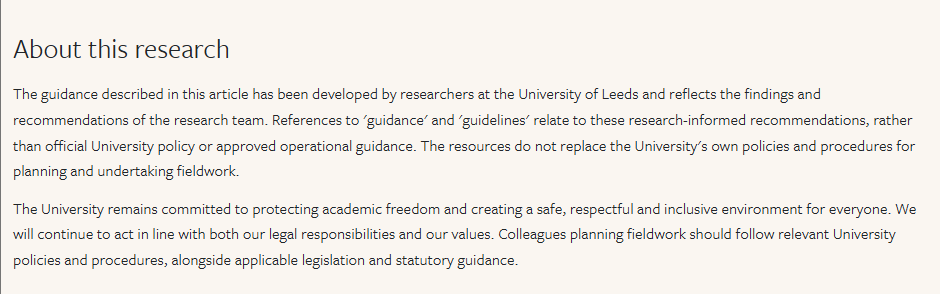
The University of Leeds is careful to distinguish the guidelines from official policy. The accompanying statement notes that references to “guidance” and “guidelines” relate to research-informed recommendations rather than approved operational guidance, and that the resources do not replace University policies or procedures for planning and undertaking fieldwork. Colleagues are directed to follow relevant University policies, applicable legislation and statutory guidance.
This distinction is important. A research output reflecting the views of a project team and participating researchers cannot, of itself, determine how risk is to be assessed, how single-sex facilities are to be managed, or how competing rights and interests are to be balanced. The legal effect of any institutional adoption of the recommendations would depend on the precise terms of any subsequent policy and on its consistency with primary legislation, including the Equality Act 2010, and relevant case law. This includes the Supreme Court’s judgment in For Women Scotland Ltd v The Scottish Ministers [2025] UKSC 16, which confirmed that the terms “sex”, “woman” and “man” in the Equality Act refer to biological sex.
What is established: The guidelines are published research recommendations, not binding University policy.
What is not established: Their publication does not demonstrate that the University has implemented the recommendations in particular accommodation or toilet facilities, or that any unlawful practice has occurred.
A research recommendation is not a statutory safeguard.
2. Definitional Scope: “Trans+”
The guidelines adopt the term “trans+” to refer to “all identities under the trans umbrella, which may include non-binary and gender nonconforming or gender-questioning identities, as well as binary transgender identities.” The definition is expansive. It may encompass individuals who have obtained legal recognition under the Gender Recognition Act 2004, those who have undergone medical transition, those who have transitioned socially only, and those who describe themselves as gender-questioning or nonconforming.
The breadth of the category has practical consequences. Recommendations concerning toilets, accommodation, clothing norms, risk assessments and visibility address a heterogeneous group whose needs and circumstances may differ substantially. The authors themselves acknowledge these differences and advocate a case-by-case approach. Nevertheless, the recommendations seek to establish common institutional responses across a broad range of identities and circumstances.
Yet the legal and safeguarding implications of access to single-sex sleeping, washing or toilet facilities cannot be determined by the research category alone. Relevant considerations include biological sex, the nature and legal status of the facilities, the applicable statutory provisions and the factual circumstances of the fieldwork setting. The presence or absence of a Gender Recognition Certificate may be relevant to an individual’s legal circumstances under the Gender Recognition Act 2004, but it does not alter their sex for the purposes of the Equality Act 2010.
The Equality Act 2010 protects the characteristic of gender reassignment. It also separately protects the characteristic of sex. Section 7 does not require an individual to undergo medical treatment or obtain a Gender Recognition Certificate to qualify for protection against gender reassignment discrimination. However, the guidelines’ broader research category of “trans+” is not itself a statutory protected characteristic, and inclusion within that category does not automatically establish that an individual meets the definition in section 7.
Following the Supreme Court’s decision in For Women Scotland Ltd v The Scottish Ministers [2025] UKSC 16, delivered on 16 April 2025, the meaning of “sex”, “woman” and “man” in the Equality Act is biological. This interpretation applies regardless of whether an individual possesses a Gender Recognition Certificate. The judgment did not remove the Act’s protections against discrimination on grounds of gender reassignment.
Importantly, the Supreme Court’s reasoning expressly considered the statutory exceptions concerning separate-sex and single-sex services and communal accommodation. At paragraphs 210–228, the Court examined how these provisions operate and why their coherent application requires a biological interpretation of sex. The Court recognised that such provisions can protect privacy, dignity and safety, including in circumstances involving shared changing facilities, sleeping accommodation and sanitary facilities.
Single-sex exceptions remain available. Under Schedule 3, Part 7, paragraphs 26–28, separate-sex and single-sex services can be lawful where the relevant statutory conditions are satisfied. Paragraph 27(6) expressly recognises circumstances in which a person of one sex might reasonably object to the presence of a person of the opposite sex when a service is used simultaneously. Paragraph 28 also provides for proportionate exceptions concerning gender reassignment discrimination in qualifying services.
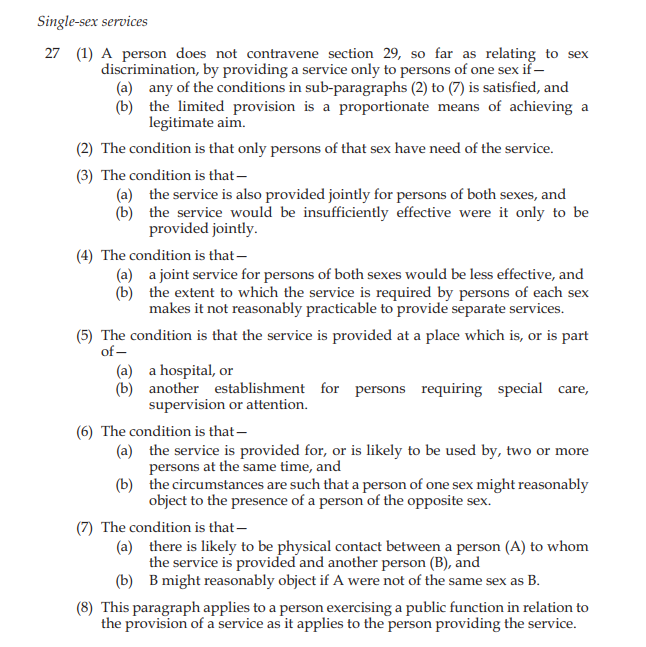
These provisions do not establish an unrestricted right to exclude individuals, nor do they automatically govern every workplace toilet or fieldwork facility. Their application depends on the nature of the service, the statutory conditions and, where required, whether the treatment is a proportionate means of achieving a legitimate aim.
The communal accommodation exception in Schedule 23, paragraph 3, may also be relevant to shared sleeping and associated washing arrangements. The provision expressly recognises that some residential accommodation should be used only by persons of the same sex for reasons of privacy. Its application depends on the nature of the accommodation and statutory conditions, including fairness between men and women, the practicality of alternative arrangements and proportionality in relation to gender reassignment discrimination.
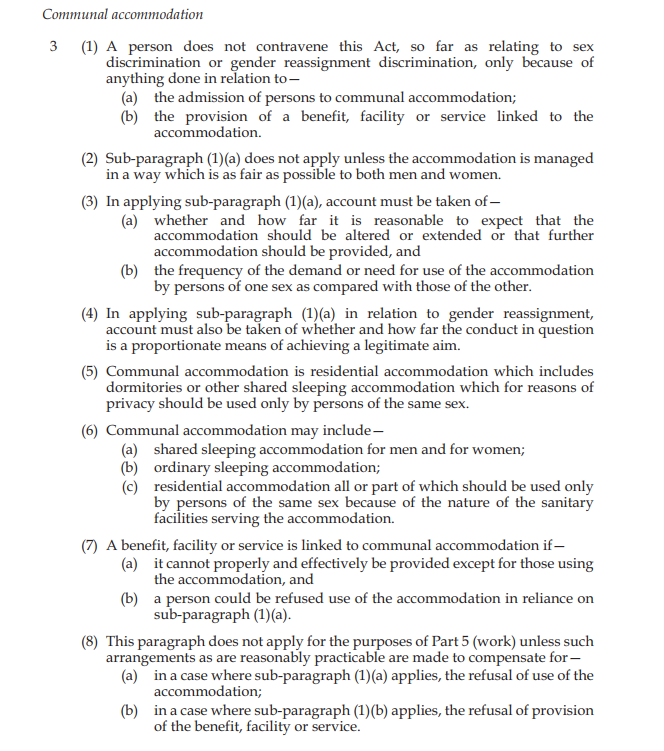
The Supreme Court addressed this provision specifically at paragraphs 222–225 of its judgment, explaining that interpreting sex by reference to acquired rather than biological sex would undermine the privacy considerations that the communal accommodation exception was intended to protect.
The Equality and Human Rights Commission’s statutory Code of Practice for Services, Public Functions and Associations (2026) reflects the Supreme Court’s interpretation and provides further guidance on the application of separate-sex and single-sex service exceptions. However, its provisions must be applied within their proper legal scope and do not replace the distinct rules governing employment, workplace facilities or communal accommodation.
Research recommendations that treat self-identification or an expansive “trans+” category as determinative of facility access therefore risk coming into tension with those legal boundaries. The appropriate response requires an assessment of the applicable law, the circumstances of the facility and the rights and interests of all affected individuals, rather than reliance on a research category alone.
Toilets: the recommendations in the original document
On page 5, the guidelines recommend that trans+ researchers be supported to use whichever toilets they prefer, without barriers or questioning about their gender. They state that the decision should rest with the researcher.
The same page acknowledges that the authors cannot provide clear advice on legal responsibilities and limitations because of developments in this area, and directs readers to obtain current guidance elsewhere.
Protect and Teach’s assessment: There is a tension between acknowledging that the legal position requires external clarification and recommending that individual preference determine access without qualification.
The appropriate legal framework may differ between workplace facilities, services, residential accommodation and other premises. A recommendation about personal preference cannot itself resolve those statutory requirements or the interests of other users.
In workplace settings, regulation 20 of the Workplace (Health, Safety and Welfare) Regulations 1992 requires suitable and sufficient sanitary conveniences, with separate rooms containing conveniences for men and women unless each convenience is in a separate room with a door capable of being secured from inside. Regulation 21 contains corresponding requirements concerning washing facilities.
These provisions are particularly relevant where fieldwork facilities fall within the scope of the workplace regulations. Their application cannot simply be assumed for every hotel, public toilet, residential facility or overseas fieldwork location.
The Supreme Court’s judgment in For Women Scotland Ltd v The Scottish Ministers [2025] UKSC 16 establishes the biological meaning of sex for the purposes of the Equality Act 2010. However, the judgment does not, by itself, determine the precise arrangements required for every toilet facility. The applicable legislation and circumstances must be identified.
Where toilets form part of services governed by section 29 of the Equality Act, Schedule 3, paragraphs 26–28, and the EHRC’s statutory Code of Practice for Services, Public Functions and Associations (2026) may be relevant. The Code recognises that lawful separate-sex and single-sex services can be provided, while also requiring consideration of proportionality and suitable alternative provision, particularly for essential facilities such as toilets.
The legal question is therefore not simply which facility an individual prefers, but what arrangements the institution is lawfully required or permitted to provide, taking account of the rights, privacy, dignity and safety of all affected users.
This does not establish that the University has unlawfully operated its facilities. It establishes that the recommendation would require legal assessment before being adopted as an operational rule.
Shared accommodation and competing rights
Page 6 recommends that shared accommodation should not automatically be divided by gender, that fieldworkers should be able to determine their own groupings where possible, and that sites allowing gender-neutral allocation should be prioritised.
Importantly, the authors also state that single-sex accommodation should remain available on request and acknowledge that individual accommodation, including private toilets and bathrooms, would ideally be provided to all fieldworkers where practicable.
However, the guidelines go further when addressing objections to sharing accommodation.
They recommend that where someone does not wish to share gendered accommodation with a trans+ researcher, the request should be resolved by providing alternative accommodation to the person raising the concern. They add that the trans+ researcher should not be removed where relocating the objecting person would be equally straightforward.
This is an explicit recommendation, although it is not a binding University rule.
Protect and Teach’s assessment: The recommendation risks establishing a presumption that the person objecting should relocate, without first distinguishing between the different reasons for the objection or examining the relevant sex-based privacy and accommodation provisions.
A request might arise from personal discomfort, religious or philosophical beliefs, a specific safeguarding concern, a previous traumatic experience or a legitimate expectation of single-sex privacy. These circumstances cannot necessarily be assessed identically.
The appropriate response depends on the circumstances, the facilities available and the applicable legal requirements. Schedule 23, paragraph 3, of the Equality Act 2010 is particularly relevant where its conditions concerning communal accommodation are engaged.
That provision recognises circumstances in which residential accommodation involving shared sleeping arrangements should be used only by people of the same sex for reasons of privacy. It establishes an exception concerning sex and gender reassignment discrimination in qualifying communal accommodation and associated facilities, subject to statutory conditions.
Those conditions include managing accommodation as fairly as possible between men and women, considering the practicability of alterations or additional accommodation, and assessing proportionality where gender reassignment discrimination is concerned. Additional requirements concerning reasonably practicable compensatory arrangements apply where the exception is relied upon in employment.
The Supreme Court considered this provision in For Women Scotland Ltd v The Scottish Ministers [2025] UKSC 16. Its interpretation of sex as biological is relevant to the operation of the communal accommodation exception and the privacy interests that the exception is intended to protect.
Importantly, neither the Supreme Court judgment nor Schedule 23 establishes an automatic rule that the person raising an objection must move, or that the trans-identifying researcher must move. The legally appropriate response depends on the nature of the accommodation, the applicable statutory provisions and the individual circumstances.
The difficulty with the Leeds recommendation is that it identifies a preferred outcome without setting out the statutory assessment necessary to establish whether that outcome is appropriate in a particular case.
The guidelines do not provide a complete analysis of how these competing considerations should be reconciled.
3. Risk Assessment and Competing Interests
The guidelines correctly observe that fieldwork can present elevated risks for some individuals and that advance planning and clear information can reduce anxiety and self-exclusion. Many of the practical points raised — privacy for medication, safe disposal of medical waste, advance information about facilities and sensitivity to personal circumstances — are capable of being addressed within ordinary risk-assessment and appropriate workplace-support frameworks.
Difficulty arises where the recommended approach requires institutions or supervisors to treat contested claims about identity as settled operational facts, or where the interests of other participants, local communities or the integrity of single-sex provision appear to be subordinated without clear legal analysis.
The concern is not that institutions should disregard an individual’s identity or circumstances. It is that research terminology and individual preferences cannot, by themselves, determine the institution’s statutory obligations or resolve competing rights.
Risk assessment is a statutory and professional responsibility. It requires evidence, proportionality and consideration of everyone potentially affected, including relevant protected characteristics, rather than the automatic prioritisation of one set of needs over another.
On page 4, the guidelines recommend that, following consideration and mitigation of risks, the final decision about whether to proceed with fieldwork should rest with the trans+ researcher.
This is a recommendation about personal agency, not evidence that the University of Leeds has transferred its statutory responsibilities to individual researchers.
Nevertheless, it requires qualification.
Employers have duties under sections 2 and 3 of the Health and Safety at Work etc. Act 1974 to protect employees and others affected by their activities, so far as is reasonably practicable. Regulation 3 of the Management of Health and Safety at Work Regulations 1999 requires suitable and sufficient assessment of relevant risks.
Those duties cannot simply be delegated away through a research recommendation. Where the statutory duties apply, an institution may have to decline, postpone or modify proposed fieldwork if significant risks cannot be adequately controlled, even where an individual wishes to proceed.
The researcher should be involved meaningfully in identifying risks, discussing potential mitigations and deciding whether they personally wish to participate. However, their willingness to accept a risk does not necessarily discharge the institution’s separate legal responsibilities.
The distinction is important because fieldwork risk assessments may involve several individuals with different needs, vulnerabilities and protected characteristics. A proposed arrangement that addresses one person’s concerns may create or increase risks for another.
Questions therefore arise that the guidelines do not fully resolve:
- Competing privacy and safety interests: How should a risk assessment weigh the privacy and safety interests of female researchers in shared sleeping or washing facilities against the preferences of a biologically male researcher who identifies as a woman or as non-binary? How should the institution identify and apply the relevant sex-based legal provisions?
- Evidence and differing circumstances: What is the evidential basis for treating gender-questioning or gender-nonconforming identities as generating the same categories of institutional response as those sought by individuals undergoing medically managed transition? How does the institution distinguish between individual practical needs, protections arising under the Equality Act and recommendations based on the project’s broader research definition of “trans+”?
- Local laws and cultural expectations: Where fieldwork occurs in jurisdictions or communities that do not share the assumptions underlying the guidelines, how is the safety of the research team as a whole to be assessed without requiring participants or local partners to adopt particular ideological commitments? How should institutions respond where local law differs from the legal framework applicable in England?
- Institutional responsibility: Who retains final authority to approve fieldwork where significant risks remain despite proposed mitigation? What process applies where a researcher’s willingness to proceed conflicts with the institution’s assessment of its legal duties?
- Practical alternatives: Where competing needs cannot all be accommodated through the preferred arrangement, what alternative facilities, accommodation or working arrangements have been considered, and how has their practicality and proportionality been assessed?
These are questions of institutional governance, legal compliance and professional judgement. They cannot be answered simply by relying on a broad identity category or by transferring the final decision to the individual researcher.
Protect and Teach’s assessment: The individual’s wishes are an important consideration, but they cannot replace the institution’s responsibility to assess and manage foreseeable risks. Decisions must be evidence-based, legally compliant and proportionate, taking account of the rights, privacy, dignity and safety of everyone affected.he individual’s wishes are an important consideration, but they cannot replace the institution’s responsibility to assess and manage foreseeable risks.
4. Evidence Base and Generalisation
The guidelines are informed by focus groups and interviews with trans+ researchers and self-described allies at the University of Leeds and at the Nordic Geographers Meeting in Reykjavík. The authors acknowledge variation between individuals and the absence of a one-size-fits-all solution. That acknowledgement is welcome.
Nevertheless, the document moves from qualitative accounts of researchers’ experiences to institutional recommendations framed against a claim of “substantial inequity and risk”. The project’s published materials make that claim, but the strength and general applicability of the evidence supporting it require examination.
Qualitative research can provide valuable evidence of individual experiences, identify previously overlooked problems and inform practical improvements. It does not, by itself, establish how frequently particular problems occur across the wider research population, how risks compare between different groups or whether a proposed institutional response is necessary and proportionate. The published 14-page guidelines do not state the number of participants, provide sufficient detail about recruitment and selection, include a demographic breakdown or set out a systematic account of how the focus-group and interview material was analysed.
It is therefore not possible, from the published guidelines alone, to determine the composition of the sample, the extent to which different experiences were represented, whether dissenting perspectives were included or how competing interpretations of the evidence were assessed.
The original concern about the experiences of researchers and allies being generalised into institutional recommendations therefore remains. However, the available information does not establish that participants were self-selecting, and that should not be asserted as fact.
Nor does the absence of methodological detail in this document prove that the underlying research was poorly conducted. It means that readers cannot independently assess the extent to which its findings justify the recommendations advanced.
The prevalence figure cited, approximately 0.5 per cent across England and Wales, derives from the 2021 Census question concerning whether respondents’ gender identity differed from their sex registered at birth. The Office for National Statistics reported that approximately 262,000 people, representing 0.5 per cent of residents aged 16 and over, answered that their gender identity was different from their sex registered at birth.
However, in additional guidance published on 26 March 2025, the ONS acknowledged uncertainty in these estimates, including evidence that some respondents may not have understood the question as intended. The ONS advised that the figure should not be treated as a precise estimate, although it could still provide an indication of the size of the population.
These limitations matter when demographic statistics are used to support wider institutional recommendations.
A national population estimate does not establish the prevalence of fieldwork-related discrimination, harassment or safety incidents. Nor does it demonstrate that a particular recommendation concerning toilets, accommodation or risk assessment is necessary, effective or proportionate.
Similarly, evidence that individual researchers have experienced difficulties does not automatically establish that the same difficulties arise across every identity included within the authors’ expansive “trans+” definition, or that identical institutional responses are appropriate.
This does not diminish the importance of taking credible reports of risk seriously. It requires the distinction between identifying a problem, establishing its prevalence and demonstrating that a proposed intervention is an appropriate response.
Protect and Teach’s position: Institutions should examine the actual evidence of risk, the legal framework governing competing rights and the practical consequences of any proposed change, rather than treating the output of a particular research project as a template for policy.
Before recommendations affecting shared facilities or other researchers are incorporated into institutional practice, decision-makers should be able to identify the evidence supporting the proposed changes, the limitations of that evidence, the interests of everyone affected and the basis on which alternative arrangements have been considered.
5. Academic Freedom, Language and Institutional Pressure
Universities have duties to uphold academic freedom and freedom of speech within the law. In England, the relevant duties for registered higher education providers are principally set out in the Higher Education and Research Act 2017, as amended by the Higher Education (Freedom of Speech) Act 2023. The strengthened duties came into force on 1 August 2025. Universities also have responsibilities under the Equality Act 2010 and health and safety legislation.
The University of Leeds statement accompanying the guidelines affirms a commitment to academic freedom and to acting in line with legal responsibilities and institutional values. The difficulty lies in the potential operational effect of guidance that embeds particular terminology — including “trans+”, expectations concerning visibility and allyship, and the concept of “usualising” language in related materials — and that may frame disagreement or caution as a failure of support.
Where supervisors or colleagues feel institutional pressure to adopt contested language, affirm particular propositions about gender identity or treat self-identification as determinative of access to single-sex spaces, academic freedom and the lawful exercise of professional judgement may be constrained in practice, even if the document itself is formally non-binding.
This concern is particularly relevant because the law expressly protects academic staff’s freedom to question and test received wisdom and to put forward controversial or unpopular opinions within the law.
Section A1 of the Higher Education and Research Act 2017 requires registered higher education providers to take reasonably practicable steps to secure freedom of speech within the law for staff, students and visiting speakers. The statutory definition of academic freedom additionally addresses protection against adverse employment and career consequences arising from the lawful exercise of that freedom.
The Office for Students’ Regulatory Advice 24, updated on 5 August 2026, explains that universities should have a strong presumption in favour of lawful speech, including speech that is controversial, contentious or discomforting. It also explains that restrictions must be assessed against applicable law and proportionality requirements.
These protections do not mean that all speech or conduct is lawful. Universities must continue to comply with the Equality Act, including the prohibition of unlawful harassment and discrimination. The legal duty is to protect freedom of speech within the law, not to exempt anyone from their other statutory responsibilities.
The accommodation recommendations examined in Section 2 illustrate the potential difficulty. The guidelines recommend that where someone does not wish to share gendered accommodation with a trans+ researcher, alternative accommodation should generally be provided to the person raising the concern, where relocation would be equally straightforward.
That recommendation is established by the published text. Whether it has been implemented, or whether anyone has experienced disciplinary or other adverse consequences for disagreeing with it, is not established.
Nevertheless, if an institution were to treat an objection to shared accommodation as inherently discriminatory, without examining its factual basis or the relevant statutory provisions, that could raise questions concerning professional judgement, competing equality rights and the treatment of lawful disagreement.
A further concern arises from the discussion of institutional uncertainty on page 13.
The authors describe how trans+ researchers may distrust institutions and suggest that communications emphasising legislation and institutional legal responsibilities can contribute to that distrust.
This is the authors’ account of reported attitudes and perceived barriers. It does not establish that compliance with legislation is harmful or that universities should disregard their legal obligations.
Protect and Teach’s assessment: An institution must be able to explain the legal limits of what it can offer, even where those limits are unwelcome. Transparent communication about statutory responsibilities is an essential part of responsible governance, not evidence in itself of hostility or discrimination.
Academic freedom and professional judgement may be constrained if research recommendations are subsequently implemented in ways that compel agreement with contested propositions, discourage legitimate objections or treat lawful questioning of institutional arrangements as misconduct.
However, publication of these guidelines alone does not establish that such constraints have occurred.
An invitation to adopt research recommendations is not a legal requirement to set aside the protected characteristic of sex, the lawful operation of single-sex exceptions or the rights of staff and students to express protected beliefs within the law.
The distinction is between supporting individual researchers and requiring institutional agreement with a particular interpretation of contested concepts. Universities must be able to do the former without automatically imposing the latter.
6. Safeguarding and Professional Judgement
Fieldwork frequently involves students, early-career researchers and participants who may be vulnerable by reason of age, inexperience, personal circumstances or power imbalances. Universities have relevant duties of care and health and safety responsibilities, while additional statutory safeguarding obligations may arise where children or adults at risk are involved.
These frameworks should not be conflated. The statutory arrangements governing child safeguarding do not automatically apply to every adult fieldwork disagreement, and workplace health and safety responsibilities are not identical to safeguarding duties. The precise legal obligations depend on the individuals involved, the nature of the activity and the circumstances in which fieldwork takes place.
Professional judgement must take account of developmental stage, existing vulnerabilities, experience, foreseeable risks and the distinction between reasonable practical support and the affirmation of contested claims about identity.
That distinction matters. An institution can recognise an individual’s circumstances, address practical needs and protect them against unlawful discrimination without requiring every researcher, supervisor or participant to adopt the same philosophical or theoretical understanding of gender identity.
Equally, disagreement with a particular understanding of gender identity does not remove an institution’s responsibility to assess risks, provide appropriate support or comply with applicable equality legislation. The guidelines correctly note that many adjustments useful to trans+ researchers may also assist people with other characteristics. Indeed, page 2 advocates focusing on needs rather than identity when arranging support.
That observation supports a case-by-case, needs-based approach rather than a category-based assumption that all individuals within the authors’ expansive “trans+” definition require identical institutional responses.
Such an approach also allows institutions to distinguish between different types of concern. A request for private accommodation, access to appropriate washing facilities, support with medication or protection from a demonstrable safety risk should be assessed according to the individual’s circumstances and the applicable legal requirements.
Where the proposed arrangement affects other researchers or participants, their rights, vulnerabilities and legitimate privacy or safety concerns must also form part of the assessment.
Institutions should therefore resist any implication that failure to adopt the specific framing of these guidelines necessarily constitutes a safeguarding failure.
The safeguarding assessment remains a matter of professional and legal responsibility, informed by evidence and the full range of applicable statutory duties. Neither a researcher’s gender identity nor another person’s disagreement with a recommendation should automatically determine the outcome.
Protect and Teach’s assessment: Appropriate safeguarding and professional decisions must be grounded in the circumstances of the individual, the applicable legal framework and the evidence of risk. Institutions must be able to provide practical support, protect individuals from harm and uphold their statutory obligations without treating acceptance of contested identity claims as a prerequisite for responsible safeguarding practice.
7. Conclusion and Recommendation
The Trans+ Inclusive Fieldwork Guidelines are a research output reflecting the perspectives of a project team and participants in focus groups and interviews. They identify practical difficulties that some individuals report facing when undertaking fieldwork. Many of the concrete suggestions concerning advance information, privacy for medication and appropriate practical support are capable of being considered within existing risk-assessment and workplace-support frameworks.
They do not, however, establish a legal standard. They do not amend the Equality Act 2010, the Gender Recognition Act 2004, health and safety legislation or the University’s own binding policies.
They do not resolve the tension between an expansive self-identified “trans+” category and the biological meaning of sex as confirmed by the Supreme Court in For Women Scotland Ltd v The Scottish Ministers [2025] UKSC 16. Nor do they provide a complete analysis of competing rights and interests in shared facilities or high-risk environments.
The recommendations concerning toilet access, shared accommodation and individual decisions about proceeding with fieldwork raise substantive questions about how institutions would discharge their statutory responsibilities if those recommendations were adopted.
In particular, the Equality Act expressly recognises circumstances in which separate-sex or single-sex services and communal accommodation may lawfully be provided. The Supreme Court confirmed that the meaning of sex within the Act is biological, while the statutory protections against gender reassignment discrimination remain in force. The relevant exceptions, including Schedule 3, Part 7, paragraphs 26–28, and Schedule 23, paragraph 3, must be applied according to their statutory conditions. Workplace facilities may additionally engage the Workplace (Health, Safety and Welfare) Regulations 1992.
The guidelines do not adequately explain how their recommendations concerning individual preference and competing accommodation requests would operate within these legal requirements.
The published document also provides insufficient methodological detail for readers to assess independently how far its findings can reasonably be generalised. This is a limitation of the information available, not proof that the underlying research was improperly conducted.
Protect and Teach CIC recommends that institutions and supervisors considering the guidelines should:
- Treat the document as research recommendations, not as policy or legal advice. Its publication does not establish that its recommendations have been formally adopted by the University of Leeds or that they constitute an authoritative interpretation of the law.
- Assess proposed practices against the applicable legal framework. This includes the Equality Act 2010, the separate protected characteristics of sex and gender reassignment, the Supreme Court’s clarification of the biological meaning of sex, the relevant statutory exceptions for single-sex services and communal accommodation, and applicable workplace health and safety legislation.
- Conduct comprehensive, evidence-based risk assessments. These should take account of the safety, privacy and dignity of all participants, not only those who identify as trans+, and should preserve institutional responsibility for managing foreseeable risks.
- Preserve academic freedom and lawful professional disagreement. Staff and students must be able to question contested concepts, raise legitimate concerns and discuss competing legal obligations without fear of unlawful institutional sanction or inappropriate pressure to adopt particular beliefs.
- Ensure that safeguarding and professional judgement remain evidence-based and independent of any particular ideological or activist framing. Practical support should be determined by individual circumstances, foreseeable risks and applicable legal duties, rather than assumptions arising solely from identity categories.
- Establish the evidential and methodological basis for proposed operational changes. Before adopting research recommendations as institutional practice, decision-makers should examine the evidence of risk, the limitations of the published research, the interests of those affected and the practicality of alternative arrangements.
A research project’s recommendations are not a statutory safeguard.
Protect and Teach’s recommendation is that universities treat such materials as a starting point for scrutiny against primary legislation, case law and practical statutory duties, not as a substitute for them.on, case law and practical duties, not as a substitute for them.
Sources and Further Reading
1. Primary Research Materials
- Hayward R, Kolar T and Zebracki M (2026), Trans+ Inclusive Fieldwork Guidelines. Knowledge Commons, 23 September 2026. https://doi.org/10.17613/355zz-gt125.
- University of Leeds, Inclusive Fieldwork Hub, Trans+ Guidelines, including the accompanying “About this research” statement confirming that the guidelines are research-informed recommendations rather than official University policy or approved operational guidance.
https://inclusivefieldwork.leeds.ac.uk/trans/
- Zebracki M, Hayward R, Gill F, Wimpenny S, Watson CS and Brown H (2025), PRIDE Fieldwork Guidelines: Pointers for Research that is Inclusive, Diverse and Equitable for LGBTQ+ fieldworkers. University of Leeds Inclusive Fieldwork Hub.
https://inclusivefieldwork.leeds.ac.uk/pride/
DOI: https://doi.org/10.17613/59ddk-kpb63
2. Legislation and Case Law
- Equality Act 2010, particularly:
- For Women Scotland Ltd v The Scottish Ministers [2025] UKSC 16, Supreme Court judgment delivered 16 April 2025. Addresses the meaning of sex under the Equality Act 2010 and the interaction of sex and gender reassignment protections.
https://www.supremecourt.uk/cases/uksc-2024-0042 - Gender Recognition Act 2004.
https://www.legislation.gov.uk/ukpga/2004/7/contents - Health and Safety at Work etc. Act 1974, particularly sections 2 and 3, concerning employers’ responsibilities for health and safety.
https://www.legislation.gov.uk/ukpga/1974/37/contents - Management of Health and Safety at Work Regulations 1999, particularly regulation 3, concerning risk assessment.
https://www.legislation.gov.uk/uksi/1999/3242/contents - Workplace (Health, Safety and Welfare) Regulations 1992, particularly:
- Regulation 20 — Sanitary conveniences.
- Regulation 21 — Washing facilities.
- Regulation 24 — Facilities for changing clothing.
https://www.legislation.gov.uk/uksi/1992/3004/contents
3. Equality and Human Rights Commission
- Equality and Human Rights Commission (2026), Code of practice for services, public functions and associations, in force from 5 August 2026.
https://www.equalityhumanrights.com/guidance/codes-practice/code-practice-services-public-functions-and-associations - Equality and Human Rights Commission, Code of practice for services, public functions and associations, Chapter 13 — Exceptions, particularly the provisions concerning separate-sex and single-sex services, gender reassignment, proportionality and communal accommodation.
https://www.equalityhumanrights.com/guidance/codes-practice/code-practice-services-public-functions-and-associations/chapter-thirteen
4. Academic Freedom and Freedom of Speech
- Higher Education and Research Act 2017, Part A1, as amended by the Higher Education (Freedom of Speech) Act 2023. Includes duties concerning freedom of speech within the law and academic freedom.
https://www.legislation.gov.uk/ukpga/2017/29/part/A1 - Higher Education (Freedom of Speech) Act 2023, as amended and brought into force in stages, including relevant provisions commenced on 1 August 2025.
https://www.legislation.gov.uk/ukpga/2023/16/contents - Office for Students, Regulatory advice 24: Guidance related to freedom of speech, published 19 June 2025 and updated 5 August 2026.
https://www.officeforstudents.org.uk/publications/regulatory-advice-24-guidance-related-to-freedom-of-speech/
5. Official Statistics and Methodological Guidance
- Office for National Statistics (2023), Gender identity, England and Wales: Census 2021.
https://www.ons.gov.uk/peoplepopulationandcommunity/culturalidentity/genderidentity/bulletins/genderidentityenglandandwales/census2021 - Office for National Statistics (2023), Quality of Census 2021 gender identity data, published 8 November 2023.
https://www.ons.gov.uk/peoplepopulationandcommunity/culturalidentity/genderidentity/articles/qualityofcensus2021genderidentitydata/2023-11-13 - Office for National Statistics (2025), Census 2021 gender identity estimates for England and Wales, additional guidance on uncertainty and appropriate use, published 26 March 2025.
https://www.ons.gov.uk/peoplepopulationandcommunity/culturalidentity/genderidentity/articles/census2021genderidentityestimatesforenglandandwalesadditionalguidanceonuncertaintyandappropriateuse/2025-03-26
Scope and Limitations
This analysis principally concerns the legal and policy framework applicable in England. Relevant provisions of the Equality Act 2010 also apply in Wales and Scotland, although other statutory duties and institutional requirements may differ.
The application of particular statutory provisions and exceptions depends on the circumstances, including the nature of the fieldwork, the individuals involved and the jurisdiction in which activities take place. Fieldwork outside Great Britain may engage different legal requirements.
The analysis examines published research recommendations. It does not establish that the University of Leeds has adopted those recommendations as binding institutional policy or that any unlawful practice has occurred.
This publication does not constitute legal advice. Institutions should obtain appropriate legal advice on the application of their statutory responsibilities to particular circumstances.