
The WHO, Europe, Australia and the UK’s Draft Bill
An examination of international recommendations, legislative influence and the safeguarding questions Parliament must still answer.
Protect and Teach CIC | 25 October 2026
Introduction: Are these laws developing independently?
Across Europe, Australia, Canada and New Zealand, governments have introduced or proposed legislation prohibiting practices intended to change or suppress sexual orientation or gender identity.
In England and Wales, the Government published its Draft Conversion Practices Bill on 25 June 2026. The draft is undergoing pre-legislative scrutiny by a Joint Committee required to report by 22 January 2027. The Government describes its objective as preventing abusive practices while protecting legitimate healthcare, religious freedom, parental rights and ordinary conversations.
But how much of the approach taken in England and Wales has developed domestically, and how much reflects international policy recommendations and legislation elsewhere?
International institutions have promoted prohibitions through public-health guidance, human-rights recommendations, political resolutions and coordinated policy initiatives.
Some expressly recommend bans. Others call for criminal sanctions, professional regulation, protection orders, educational programmes and collaboration with civil society organisations.
The existence of international agreement in favour of prohibitions does not, however, establish that every proposed law is necessary, proportionate, sufficiently certain or supported by evidence of effectiveness.
Protect and Teach has examined the principal international developments and their relationship to the UK proposals.
The documentary evidence demonstrates an identifiable international policy movement. It also raises important questions about how overseas legislative models are evaluated, how legal definitions are developed and whether unintended consequences receive sufficient attention.
1. The World Health Organization: an explicit recommendation to ban conversion therapy
The World Health Organization (WHO) has taken an explicit policy position in favour of banning conversion therapy.
Its March 2025 publication, Guidance on Mental Health Policy and Strategic Action Plans: Module 2, contains recommendations concerning people belonging to the LGBTIQ+ community.
On page 66, under the heading “Prohibit coercion and conversion therapy”, the WHO calls on governments to implement policies expressly banning conversion therapy and other forced practices intended to change sexual orientation.
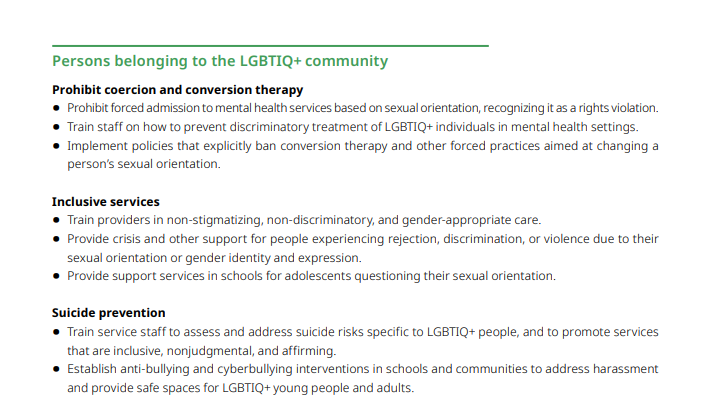
The recommendations under that heading also prohibit forced admission to mental-health services on the basis of sexual orientation and training to prevent discriminatory treatment.
The surrounding recommendations on the same page, under the separate heading “Inclusive services”, address non-discriminatory care, support for people experiencing rejection or violence, and services in schools for adolescents questioning their sexual orientation.
The WHO’s explicit recommendation to ban conversion therapy and other forced practices in this passage refers specifically to attempts to change a person’s sexual orientation. It should not be represented as expressly extending that particular recommendation to gender identity.
This is more than a general expression of concern about harmful interventions.
The WHO explicitly recommends prohibition.
However, the recommendation must be interpreted accurately.
The guidance does not require governments to adopt a particular criminal offence, prescribe imprisonment or reproduce the legal framework proposed in England and Wales.
It is a policy recommendation within guidance on mental-health systems.
WHO guidance can influence national health policies, professional standards, regulatory expectations and the development of legislation. It does not itself establish that a particular statutory offence is necessary or proportionate.
Three questions therefore remain.
- First, does opposition to coercive or abusive treatment justify every form of legal prohibition proposed?
- Second, what evidence establishes the point at which harmful conduct should become a criminal offence rather than being addressed through existing criminal, civil, safeguarding or professional frameworks?
- Third, how can legislation distinguish coercive interventions from legitimate, patient-led exploration of psychological distress, personal circumstances and treatment options?
This is particularly important when working with children and young people whose circumstances may involve mental-health difficulties, neurodevelopmental conditions, family relationships or safeguarding concerns.
Clinicians must remain free to undertake comprehensive assessments and explore competing explanations without being required to reach predetermined conclusions.
Equally, the protection of legitimate clinical exploration cannot excuse coercion, degradation or practices intended to impose unwanted outcomes.
The parliamentary question is not whether the WHO recommends banning conversion therapy. It does. The question is whether the particular offences and restrictions proposed by the UK Government are necessary, clearly defined and proportionate.
Primary source: WHO (2025), Guidance on Mental Health Policy and Strategic Action Plans: Module 2, page 66. https://www.who.int/publications/i/item/9789240106819
2. The Council of Europe: explicit recommendations for criminal legislation
On 29 January 2026, the Parliamentary Assembly of the Council of Europe adopted Resolution 2643, For a ban on conversion practices. The underlying report was prepared by Kate Osborne MP, a member of the UK Parliament.
The resolution recommends a comprehensive legislative approach to prohibiting conversion practices.
- Paragraph 1 describes conversion practices as measures intended to change, repress or suppress sexual orientation, gender identity or gender expression.
- Significantly, paragraph 2 itself identifies the practices covered by this definition.
These include psychological or behavioural counselling, spiritual and religious rituals, aversion methods, verbal abuse, coercion, isolation, forced medication, electric shocks, and physical and sexual abuse.
The inclusion of these different forms of conduct within one definition is important.
Violence, coercion, forced medication and sexual assault are materially different from voluntary counselling, religious discussion or psychological assessment. Although a common policy definition may group these activities together, criminal legislation requires greater precision when determining prohibited behaviour, intent and harm.
The resolution also recognises that supportive interventions by parents, religious institutions and qualified clinicians should not automatically be restricted where they do not seek the prohibited change or suppression.
This creates a central legal question:
How is the purpose of an intervention established, and how reliably can it be distinguished from legitimate disagreement, exploration, clinical judgement or safeguarding?
- A parent questioning a child’s proposed course of action is not necessarily attempting to change or suppress an identity.
- A clinician investigating underlying psychological distress is not necessarily practising conversion therapy.
- A person discussing the relationship between religious belief and personal conduct is not necessarily engaging in abuse.
Conversely, describing conduct as counselling or religious activity cannot provide immunity where it meets the elements of a properly defined criminal offence.
The difficulty is constructing an enforceable distinction without relying on assumptions about belief, identity, intention or professional disagreement.
Beyond criminal offences: protection orders, training and education
Resolution 2643 goes substantially beyond recommending criminal sanctions.
Paragraph 9.1.4 specifically calls on states to complement criminal legislation with civil measures such as “conversion therapy protection orders”.
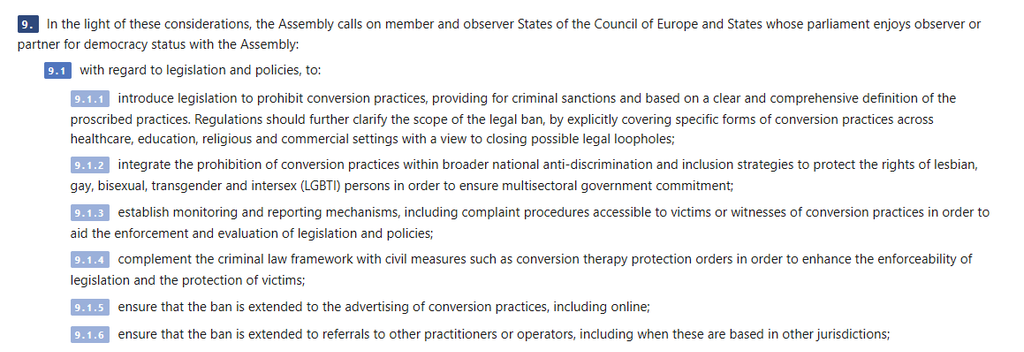
Further provisions recommend:
- Monitoring and reporting mechanisms, including complaints procedures.
- Professional codes of conduct and practical guidance.
- Training for healthcare professionals, social workers, educators, members of religious institutions, law-enforcement officers, the judiciary and prosecutors.
- Cooperation with civil society and professional organisations.
- Education concerning conversion practices, sexual orientation and gender identity.
- Research into implementation, prevalence and effectiveness.
These wider institutional recommendations are significant for safeguarding.
The consequences of legislation do not arise solely through prosecution or conviction.
They may also arise through statutory guidance, professional regulation, allegations, referrals, safeguarding assessments and expectations placed upon schools and healthcare providers.
For example, if training encourages professionals to identify suspected conversion practices, what thresholds should distinguish safeguarding concerns from legitimate parental disagreement, exploratory psychotherapy or religious discussion?
- Who investigates?
- What standard of evidence applies?
- What safeguards protect children, families and professionals where allegations are disputed?
The resolution is not binding UK legislation. Nor is the Council of Europe an institution of the European Union. Nevertheless, it represents a clear international recommendation for coordinated criminal, civil and institutional measures.
Primary source: Parliamentary Assembly of the Council of Europe (2026), Resolution 2643: For a ban on conversion practices, particularly paragraphs 1–2 and 9. https://pace.coe.int/en/files/35883/html
3. The European Union: an organised policy programme
The European Union has also developed a coordinated policy approach. A European Citizens’ Initiative calling for a ban on conversion practices gathered 1,128,063 verified statements of support and was formally submitted to the European Commission on 17 November 2025.
Its organisers sought binding EU legislation addressing practices directed at sexual orientation, gender identity and gender expression.
The initiative subsequently progressed through a public hearing in the European Parliament on 2 March 2026 and a parliamentary debate on 25 March.
On 13 May 2026, the European Commission adopted its formal response.
Rather than propose an immediately binding EU-wide prohibition, the Commission announced its intention to publish a Recommendation in 2027, encouraging member states to introduce national bans.
The planned Recommendation is expected to draw upon existing national legislative approaches, engagement with governments, an expert group on LGBTIQ+ equality, civil society organisations and research.
This represents an organised policy programme aimed at encouraging legislation across EU member states. It does not mean that the EU has already enacted a uniform criminal prohibition. Nor does it mean that the United Kingdom, which is not an EU member state, is legally required to implement the Commission’s proposed Recommendation.
Nevertheless, European initiatives can influence international policy expectations, professional discussion and exchanges between governments.
International agreement is not proof of legislative effectiveness
Where several governments adopt similar legal provisions, it may be tempting to regard their convergence as evidence that a particular approach is necessary or successful.
That inference requires scrutiny.
- Different jurisdictions may draw on the same international recommendations, research papers, professional statements, campaign materials or earlier laws.
- The subsequent adoption of similar legislation does not independently demonstrate effectiveness.
- Neither does condemnation of a practice by professional or international organisations establish the necessity of every proposed criminal sanction or civil restriction.
- Each jurisdiction must establish its own legal justification and evidence of proportionality.
Primary sources:
European Citizens’ Initiative, Ban on Conversion Practices in the European Union: https://citizens-initiative.europa.eu/ban-conversion-practices-european-union_en
European Commission, Communication C/2026/2991: https://eur-lex.europa.eu/legal-content/EN/TXT/?uri=oj:C_202602991
4. Australia: documented influence on UK policy development
Australia is particularly important because several states and territories have introduced conversion-practices prohibitions covering sexual orientation and gender identity.
Victoria’s Change or Suppression (Conversion) Practices Prohibition Act 2021, which commenced in February 2022, is a prominent example.
Queensland and the Australian Capital Territory have also adopted relevant legislation, although their definitions, mechanisms and enforcement arrangements differ.
The relevance to the UK is not speculative. In section EB 1.5, International context, of its June 2026 Draft Final Stage Impact Assessment, the UK Government confirms that officials undertook an internal review of all known national prohibitions and selected regional prohibitions.
The assessment identifies Australian legislation, including Victoria, Queensland and the Australian Capital Territory. It also records that officials regularly engage with international counterparts and monitor legislative approaches.
The Government’s assessment identifies several characteristics of legislation internationally:
- All known national legislative bans include transgender identity or gender identity alongside sexual orientation.
- Express parental exemptions are rare.
- Most legislative bans cover minors, with some providing additional protections for children.
- Legislative prohibitions in Europe, Canada and Australasia generally provide for maximum custodial penalties.
- Approaches to religion and extraterritorial conduct vary between jurisdictions.
The Government concludes that its draft legislation is broadly aligned with legislation in comparable countries, although it identifies exceptions reflecting the UK’s legal and policy approach.
This is a paraphrase of the Impact Assessment’s conclusion, rather than a direct quotation.
The assessment provides documentary evidence that international legislative comparison formed part of UK policy development.
It does not prove that officials copied individual clauses from Australia or that any international organisation directed the Government to legislate. Nevertheless, the Government’s explicit acknowledgement provides a legitimate basis for parliamentary scrutiny.
What has been learned from implementation?
Victoria provides a particularly relevant opportunity to examine how conversion-practices legislation operates after implementation.
On 2 February 2026, the Victorian Law Reform Commission began a statutory review of the Change or Suppression (Conversion) Practices Prohibition Act 2021.
The final report was due to be delivered to the Attorney-General by 28 August 2026.
At the time of writing, the Commission confirms that the final report has been delivered to the Attorney-General, but it has not yet been publicly released or tabled in Parliament.
Significantly, the review’s terms of reference explicitly require consideration of why no criminal offences have been prosecuted under the Act.
The Commission was asked to examine whether barriers exist to reporting offences to police, whether offences are appropriately framed, whether alternative offences are being prosecuted and whether other obstacles prevent prosecution.
This is particularly relevant to assessing the practical operation of similar legislation in England and Wales.
However, the review has important limitations. Its terms of reference exclude reconsideration of the purposes of the Act and the desirability of having criminal offences and a civil response scheme.
The absence of prosecutions does not, by itself, demonstrate that the law is either effective or ineffective. It could reflect deterrence, limited reporting, evidential difficulties, alternative enforcement mechanisms or other factors.
Equally, the existence of complaints or investigations does not necessarily establish that new criminal provisions are necessary.
Meaningful evaluation requires evidence of actual outcomes, including whether serious harm has been reduced, whether reported conduct could have been addressed under existing law and what consequences have arisen for lawful healthcare, counselling, family relationships and religious freedom.
The Victorian review therefore raises an important question for the UK Joint Committee: what evidence of actual legislative effectiveness, rather than simply the existence of comparable legislation, was considered when developing the draft Bill?
Primary sources:
Victorian Law Reform Commission, Change or suppression practices ban: statutory review. https://www.lawreform.vic.gov.au/project/change-or-suppression-practices-ban/
Victorian Law Reform Commission, Terms of reference. https://www.lawreform.vic.gov.au/publication/change-or-suppression-practices-ban-consultation-paper/terms-of-reference/
UK Government (2026), Draft Final Stage Impact Assessment, section EB 1.5. https://www.gov.uk/government/publications/draft-conversion-practices-bill/draft-final-stage-impact-assessment
5. The United Nations: recommendations for a global prohibition
The United Nations has contributed to the international policy movement through the work of its Independent Expert on protection against violence and discrimination based on sexual orientation and gender identity.
In 2020, Independent Expert Victor Madrigal-Borloz submitted the report Practices of so-called “conversion therapy” to the UN Human Rights Council. The report, published as A/HRC/44/53, examines conversion practices internationally, their reported effects, human-rights implications, existing prohibitions and remedies available to victims.
The Independent Expert called for a global prohibition, alongside action concerning professional regulation, accountability, education and support.
The report contributes to an international human-rights framework that has informed advocacy and public-policy discussion. However, it is not equivalent to a treaty provision requiring the UK Parliament to enact the June 2026 draft.
A recommendation from a UN independent expert, a WHO policy publication, a resolution of the Parliamentary Assembly of the Council of Europe and a binding international treaty are different instruments with different legal consequences.
Their content, authority and effect should be described accurately.
Primary source: UN Human Rights Council (2020), Practices of so-called “conversion therapy”, Report of the Independent Expert, A/HRC/44/53. https://digitallibrary.un.org/record/3870697/files/A_HRC_44_53-EN.pdf
6. The UK’s Draft Conversion Practices Bill: international policy meets domestic law
The UK Government’s draft proposes criminal offences addressing abusive conversion practices, including conduct connected with overseas practices, and introduces a system of conversion practice protection orders.
Its stated intention is to address serious abuse while protecting legitimate healthcare, exploratory conversations, parenting and religious expression.
Protect and Teach’s concern is not whether violence, coercion and abuse should be prevented. It is whether the proposed statutory framework sufficiently distinguishes abusive conduct from lawful activity and whether the available evidence establishes the necessity of this particular regime.
Our September 2026 Policy Analysis Paper No. 1 examined the draft legislation, supporting evidence, existing safeguarding and legal frameworks, human-rights implications and relevant international comparisons.
The review identified unresolved concerns relating to:
- Legal certainty: The definition of prohibited acts, required intention and statutory thresholds.
- Existing protections: Whether demonstrable gaps in existing criminal, civil, family-law and safeguarding provisions justify new offences.
- Parents and children: Protections for reasonable parental decision-making and proportionate disagreement involving welfare, healthcare and safeguarding.
- Clinical independence: Whether professionals can conduct comprehensive assessments and exploratory therapy without inappropriate restrictions.
- Professional consequences: Potential effects upon teachers, designated safeguarding leads, social workers, counsellors and pastoral advisers.
- Protection orders: The evidential and procedural safeguards applicable to preventive restrictions.
- Human rights: Compatibility with freedom of expression, freedom of religion and conscience, respect for private and family life and access to lawful healthcare.
The Government considers that its draft provides a targeted response to harmful behaviour that existing legislation does not adequately address.
Protect and Teach’s published analysis reaches a different conclusion: the available evidence does not establish the necessity and proportionality of the proposed criminal and preventive regime. That disagreement requires detailed parliamentary examination rather than reliance on international endorsement or ministerial assurances.
7. Safeguarding cannot become an exercise in enforcing contested assumptions
For Protect and Teach, the implications for children are central. Safeguarding decisions must remain grounded in evidence of actual harm, identifiable risk, individual circumstances and lawful professional assessment.
Professionals must be able to recognise and respond to violence, threats, coercion, humiliation and psychological abuse.
They must also be able to examine a child’s developmental stage, mental health, neurodevelopmental needs, family circumstances, relationships and wishes without assuming that questioning itself constitutes abuse.
A child’s welfare assessment should not be predetermined by the preferred terminology or policy position of an international institution, campaign organisation or government department.
Nor should parental disagreement automatically be regarded as evidence of harm.
At the same time, children must not be denied protection merely because abusive conduct occurs within a family, religious institution or therapeutic relationship.
The responsibility of Parliament is to establish a clear, enforceable and proportionate statutory boundary.
That boundary matters beyond criminal proceedings.
An uncertain prohibition may influence professional guidance, safeguarding referrals, training and institutional decisions before a court has had the opportunity to interpret the legislation. Such consequences should be carefully investigated rather than simply assumed or dismissed.
8. Ten additional questions arising from the international evidence
The following ten questions arise specifically from this examination of international policy development. They supplement, rather than reproduce, the nine parliamentary scrutiny questions identified in Protect and Teach’s existing work.
- International sources: Which WHO, UN, Council of Europe, EU and overseas legislative documents were considered during preparation of the UK draft?
- Official engagement: What meetings, correspondence or exchanges took place between UK officials, international institutions and overseas governments concerning definitions, penalties, enforcement and exemptions?
- Australian legislation: Which provisions from Victoria, Queensland and the Australian Capital Territory informed UK policy development, and what evidence supported their relevance to England and Wales?
- Evaluation: What independent evidence demonstrates that comparable legislation has reduced serious harm, rather than merely changing reporting, investigation or regulatory activity?
- Legal definitions: What steps were taken to ensure that different categories of conduct, including violence, coercion, counselling, religious discussion and clinical assessment, are not improperly conflated?
- Children and safeguarding: What assessment has been undertaken of the potential effects upon child-protection referrals, disputed parental decisions and the responsibilities of teachers, social workers and healthcare professionals?
- Protection orders: How has the experience of overseas preventive-order regimes informed the proposed UK system, and what safeguards will govern its application?
- Freedom and proportionality: How have Articles 8, 9 and 10 of the European Convention on Human Rights been considered alongside the protection of individuals from serious harm?
- Independent evidence: How has the Government distinguished international policy endorsement from evidence establishing the necessity of the particular legislation proposed?
- Review and accountability: What indicators, safeguards and review mechanisms will establish whether the legislation achieves its objectives without improperly restricting lawful activity?
These questions are relevant irrespective of whether a person supports or opposes conversion-practices legislation in principle.
Conclusion: the international movement is documented, but the UK legislation still requires justification
The documentary evidence demonstrates that conversion-practices prohibitions form part of a wider international policy movement.
- The WHO explicitly recommends banning conversion therapy, although its guidance does not prescribe the specific criminal-law approach proposed in England and Wales.
- The UN Independent Expert has called for a global prohibition.
- The Parliamentary Assembly of the Council of Europe has recommended criminal legislation, conversion therapy protection orders and wider institutional measures.
- The European Commission intends to recommend national bans in 2027.
- Australia has provided legislative examples, and the UK Government expressly acknowledges reviewing comparable international laws as part of its policy development.
These findings demonstrate international policy convergence and documented international legislative comparison.
They do not, on their own, demonstrate that the UK’s Draft Conversion Practices Bill is necessary, effective or sufficiently precise.
The authority of an international institution and the existence of legislation elsewhere cannot relieve Parliament of its responsibility to scrutinise the evidence, identify demonstrable gaps in existing law, protect fundamental rights and examine the implications for children, families and professionals.
Protect and Teach’s conclusion remains that the evidential and legal case for the June 2026 draft has not been established and that the Bill should not proceed in its present form.
International recommendations deserve examination. They are not a substitute for evidence.
Further Protect and Teach research
Why the Evidence Does Not Support the Draft Conversion Practices Bill
Protect and Teach’s Policy Analysis Paper No. 1, companion briefing and parliamentary scrutiny questions examine the evidence, law, safeguarding implications and international comparisons underlying the proposed legislation.
Draft Conversion Practices Bill: Live Tracker
Follow parliamentary proceedings, Joint Committee scrutiny, stakeholder publications, Government documents and continuing Protect and Teach research.
Primary sources
- World Health Organization (2025). Guidance on Mental Health Policy and Strategic Action Plans: Module 2, particularly page 66.
https://www.who.int/publications/i/item/9789240106819 - Parliamentary Assembly of the Council of Europe (2026). Resolution 2643: For a ban on conversion practices, paragraphs 1–2 and 9.
https://pace.coe.int/en/files/35883/html - European Citizens’ Initiative (2025). Ban on Conversion Practices in the European Union.
https://citizens-initiative.europa.eu/ban-conversion-practices-european-union_en - European Commission (2026). Communication C/2026/2991.
https://eur-lex.europa.eu/legal-content/EN/TXT/?uri=oj:C_202602991 - United Nations Human Rights Council (2020). Practices of so-called “conversion therapy”, Report of the Independent Expert, A/HRC/44/53.
https://digitallibrary.un.org/record/3870697/files/A_HRC_44_53-EN.pdf - UK Government (2026). Draft Conversion Practices Bill.
https://www.gov.uk/government/publications/draft-conversion-practices-bill - UK Government (2026). Draft Final Stage Impact Assessment, section EB 1.5, International context.
https://www.gov.uk/government/publications/draft-conversion-practices-bill/draft-final-stage-impact-assessment