
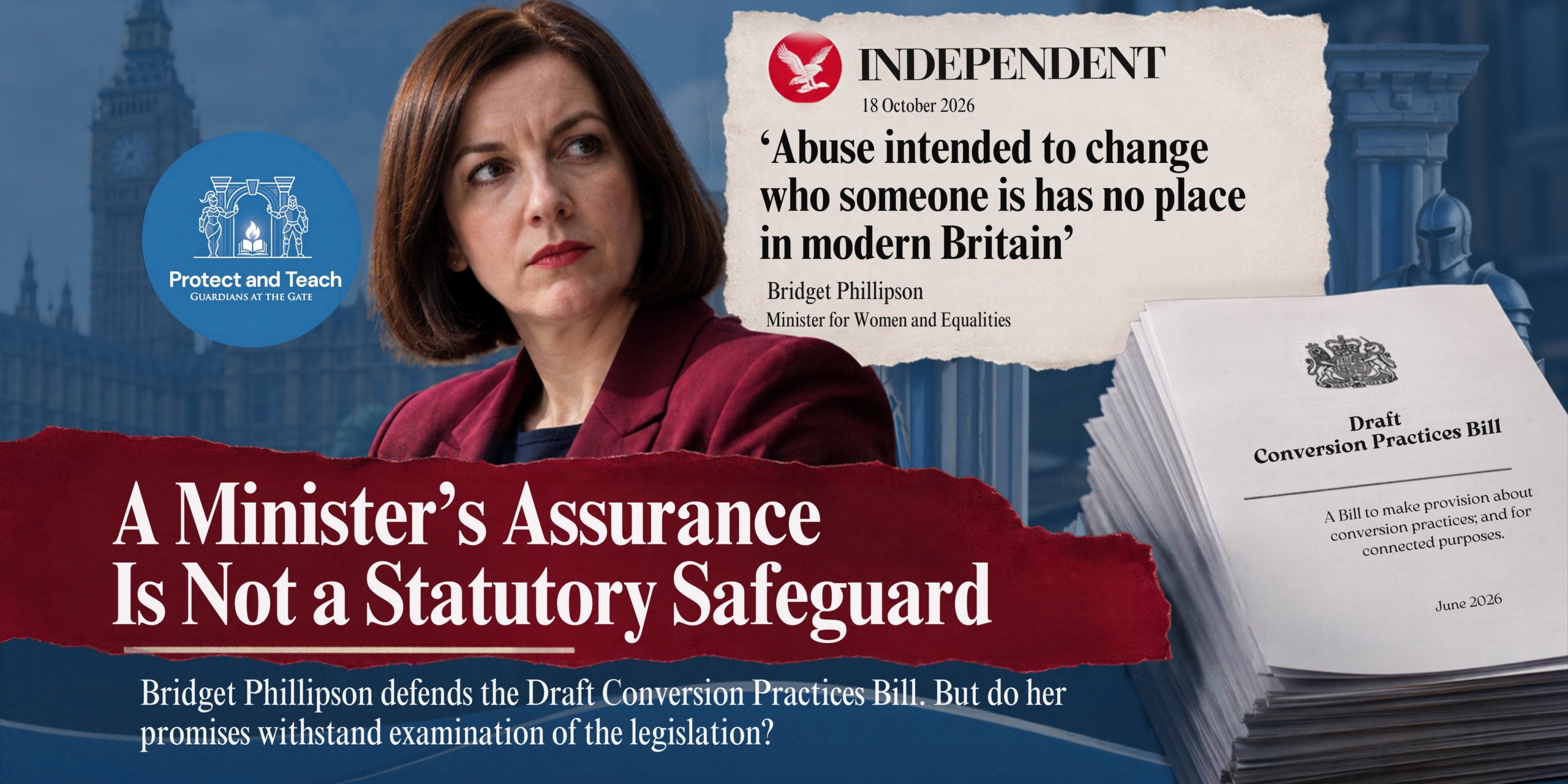
Bridget Phillipson says the Draft Conversion Practices Bill will protect parents, professionals and legitimate conversations. Protect and Teach examines the legislation Parliament is actually being asked to consider; and why ministerial assurances cannot cure its deficiencies.
Protect and Teach CIC | Policy Analysis | 19 October 2026
On 18 October 2026, Bridget Phillipson, Minister for Women and Equalities, published an article in The Independent defending the Government’s Draft Conversion Practices Bill. Read the original Independent article | Archived version
Her argument was intended to reassure those concerned about the proposed legislation. Parents, she said, would remain free to have challenging conversations with their children. Refusing to accept a child’s asserted identity or use preferred pronouns would not be criminalised. Religious expression, freedom of speech and legitimate therapeutic practice would remain protected.
She specifically stated that challenging conversations between parents and children, refusing to accept a child’s asserted identity, and declining to use preferred pronouns would not be caught by the legislation.
These seem like significant assurances. They concern the boundaries of parental responsibility, professional judgement, freedom of belief and the state’s power to intervene in private and family life.
But there is a fundamental difficulty.
A Minister’s assurance is not a statutory safeguard.
A newspaper article cannot amend legislation, create an exemption that Parliament has not enacted, bind a court to a Minister’s preferred interpretation, or guarantee how investigators, safeguarding authorities and courts will interpret contested conduct.
In September 2026, Protect and Teach published a 769-page examination of the Draft Conversion Practices Bill, including its evidential foundations, relationship with existing law, safeguarding implications and human-rights consequences.
Our conclusion was not that the Bill needed minor improvements.
Our conclusion was unequivocal: the Government had not demonstrated that its proposed legislative framework was necessary, sufficiently certain or proportionate. Protect and Teach recommended that the Bill be withdrawn, including its proposed criminal offences and Conversion Practice Protection Orders.
We support effective protection against violence, sexual abuse, threats, coercion, unlawful confinement, child cruelty and other genuinely abusive conduct. But we do not accept that the Government has established the necessity or proportionality of this proposed legislative framework.
Phillipson’s article does not resolve those objections. Instead, it exposes the central problem: the Government is asking the public to accept assurances about legal protections that are not always expressed with equivalent clarity in the statutory text.
If the Government is so confident that ordinary parental disagreement, legitimate exploratory conversations and the lawful exercise of professional judgement are protected, why should those concerned have to rely on ministerial assurances rather than sufficiently clear statutory boundaries?
The distinction matters because Parliament is not being asked merely to endorse a statement of principle. It is being asked to consider new criminal offences, preventative court orders and powers that could have serious consequences for individuals, families and professionals.
The question is not simply what the Minister says the Bill is intended to achieve, or merely the intentions Ministers attribute to it.
It is what the legislation actually provides.
Ministerial assurances versus the Draft Bill: what does the law actually say?
The following comparison distinguishes what Phillipson says, what the draft legislation provides and what Protect and Teach identifies as the resulting legal and safeguarding concerns.
Ministerial Assurances vs the Draft Bill
What Bridget Phillipson promises. What Parliament is being asked to enact. What Protect and Teach identifies as missing.
Bridget Phillipson’s newspaper article does not form part of the Draft Conversion Practices Bill. Her assurances do not create statutory exemptions, amend the proposed offences or bind a court to her preferred interpretation. Courts may consider certain ministerial statements in limited interpretative circumstances, but a newspaper article cannot rewrite legislation enacted by Parliament.
| What the Minister says | What the draft Bill provides | Legal status: protection or promise? |
|---|---|---|
| Parents may refuse preferred pronouns, decline to affirm a child’s asserted identity and have challenging conversations without being criminalised. | Clause 1 contains no express parental exemption or specific exclusion for pronoun refusal or non-affirmation. Clause 2 requires the additional elements of the criminal offence. | No express statutory exemption The Minister’s reassurance does not create one. Ordinary disagreement is not automatically criminal, but the promised protection is not written as a specific exemption. |
| Legitimate parenting and ordinary conversations will not be caught by the legislation. | Clause 1 makes abuse dependent upon all the circumstances. The non-exhaustive factors include psychological or emotional pressure and controlling or coercive behaviour. | No exhaustive statutory boundary The Bill does not comprehensively define the boundary between lawful parental guidance and abusive pressure. The Minister’s interpretation is not itself binding law. |
| The criminal threshold is high, requiring serious physical or psychological harm. | Clause 2 requires serious harm to physical or mental health, OR serious alarm or distress having a substantial adverse effect on usual day-to-day activities. | Statutory threshold exists, but the Minister’s account is incomplete Serious harm to health is not the only qualifying consequence. The threshold limits criminal conviction but does not itself prevent allegations or govern all preventative interventions. |
| Protection orders will prevent abusive practices before harm occurs. | Clause 4 and the Schedule permit preventative orders without a prior criminal conviction in every case. Orders can contain restrictions and requirements. The Schedule also provides for orders without notice in specified circumstances. | Express preventative powers Courts must apply the statutory safeguards, but the powers are not dependent upon a prior conviction in every case. Protect and Teach opposes this regime as unnecessary and insufficiently justified. |
| Legitimate healthcare and exploratory therapeutic practice are protected. | Clause 1 contains a healthcare exclusion subject to statutory conditions. It does not establish a general exemption for all parenting, counselling or pastoral activity. | Conditional statutory exclusion A protection exists, but its scope depends on the statutory wording. The Minister’s broader reassurance cannot extend that exclusion beyond its legal terms. |
| The legislation closes gaps in existing criminal law. | The draft creates additional identity-specific offences and a civil protection-order regime. The Government identifies potential limitations in existing legal protections. | Legislative necessity not established Protect and Teach’s 769-page analysis concludes that the Government has not demonstrated a sufficiently defined and material gap to justify this framework. |
| Freedom of expression, religious practice and decisions about parenting will not be impinged upon. | The Bill operates alongside existing human-rights law but contains no general exemption covering every activity described in the Minister’s assurance. | Existing rights, not a blanket statutory guarantee Convention rights remain relevant, but their application requires legal analysis. The Minister’s categorical assurance does not determine whether an interference could occur or be justified. |
THE CENTRAL LEGAL OBJECTION
The Bill expressly creates new criminal offences and preventative powers. Yet several protections Ministers publicly promise are not expressed with equivalent specificity in the legislation. Where safeguards do exist, their scope is governed by the statutory conditions.
A political assurance cannot fill a statutory gap.
Protect and Teach’s position is that Parliament should reject the proposed offences and Conversion Practice Protection Orders. Our recommendation is withdrawal of the Bill, not reliance upon further ministerial reassurance.
The table concerns the draft Bill published on 25 June 2026. It distinguishes express statutory provisions from ministerial assurances and Protect and Teach’s legal and policy assessment.
1. The fundamental question: why is new legislation necessary?
Phillipson begins by describing disturbing examples of humiliation, violence and coercion intended to change a person’s sexuality. Such conduct is indefensible.
Protect and Teach has consistently supported effective protection against genuinely abusive behaviour, whether committed against children or adults. But Parliament must distinguish between condemning harmful conduct and establishing the necessity of creating additional criminal offences.
Existing law already addresses numerous forms of violence, sexual abuse, threats, harassment, coercion, unlawful confinement and child cruelty, subject to the elements of the relevant offences.
The Government argues that gaps remain, including situations involving serious psychological or emotional harm that may not satisfy an existing offence.
Those claims deserve examination. But the existence of a possible gap does not establish that the Government’s chosen legislation is necessary, sufficiently precise or proportionate.
In Chapter 5 and Appendix B of our published analysis, Protect and Teach examined existing legal protections and the gaps claimed by the Government.
We did not assume that every reported harmful experience could necessarily be prosecuted under existing law. Rather, we asked whether the evidence established a sufficiently defined and material deficiency that justified the proposed new offences and preventative powers.
Our conclusion was that it did not.
The Government has not demonstrated that this particular legislative framework is required to protect people from identifiable abuse.
Parliament should require evidence of the conduct that existing law cannot adequately address, the scale of that deficiency, the reasons existing mechanisms are insufficient and the likely benefits and harms of the proposed response.
A manifesto commitment is not a substitute for that evidence. Nor is a Minister’s description of appalling behaviour proof that the Bill would prevent it.
2. Parental responsibility: a reassurance without an express exemption
Phillipson states that refusing to accept a child’s asserted identity or use preferred pronouns will not be caught by the legislation. This is one of the most consequential claims in her article.
Yet clause 1 contains no express parental exemption or specific exclusion for such refusals.
That does not mean ordinary disagreement automatically becomes a criminal offence. Clause 2 requires further elements, including a specified serious consequence. The absence of an express exemption means the Minister’s assurance must be assessed against the actual definitions and thresholds Parliament is being asked to enact.
The Bill defines conversion practices by reference to conduct intended to affect another person’s sexual orientation or transgender identity, including beliefs about that identity.
Whether the conduct is abusive depends upon all the circumstances, including non-exhaustive factors such as psychological or emotional pressure.
Protect and Teach is concerned that this creates insufficiently predictable boundaries for parents exercising lawful responsibilities.
A parent may decline to affirm an asserted identity, question a proposed intervention, seek further clinical advice or insist upon careful consideration of a child’s developmental and safeguarding needs.
These actions are not inherently abusive.
Nor should the ordinary exercise of parental responsibility be treated as abusive merely because it involves disagreement or causes distress.
The Government must explain how its proposed framework will distinguish lawful parental conduct from the abusive behaviour it intends to prohibit.
The absence of an express exemption does not prove criminal liability. But the Minister’s assurance does not create an exemption either.
For Protect and Teach, the problem is not resolved by asking parents to trust that authorities will always draw the distinction correctly.
Child safeguarding requires legal clarity before a dispute arises.
3. The definition of abuse: a boundary Parliament must examine
Phillipson presents the definition of abuse as a reassuring safeguard. But the draft Bill requires abuse to be assessed in all the circumstances, with statutory factors that include psychological and emotional pressure.
These concepts are not meaningless. Courts regularly assess contextual conduct and apply legal thresholds.
Nevertheless, their application in this proposed identity-specific framework raises difficult questions.
- When does persistent parental guidance become psychological pressure?
- How should a clinician’s exploration of competing explanations for distress be distinguished from an attempt to change an asserted identity?
- How should a safeguarding professional respond where a child’s wishes conflict with a parent’s assessment of risk?
These questions matter because the legislation would operate in settings where disagreement, distress and competing responsibilities may already exist.
Protect and Teach’s objection is not that all contextual legal tests are illegitimate.
It is that the Government has not demonstrated sufficiently predictable boundaries between genuinely abusive conversion practices and lawful parenting, counselling, safeguarding and professional judgement.
The serious-consequence requirement under clause 2 provides an important limitation on criminal conviction.
It does not supply a comprehensive definition of lawful conduct. Nor does it remove the potential for allegations, investigations or applications for preventative orders.
A criminal law that engages family relationships and professional responsibilities must be assessed for its practical effects, not merely its intended targets.
4. The serious-consequence threshold: what Phillipson leaves out
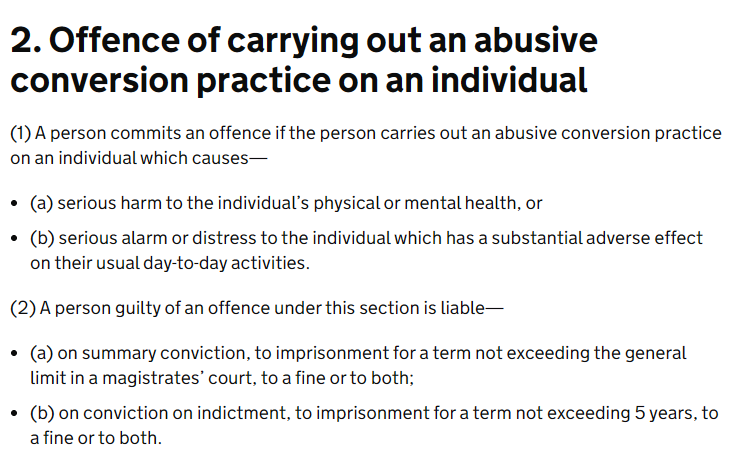
Phillipson says the legal threshold is high and describes the need to prove serious physical or psychological harm. The draft Bill does contain a substantial threshold.
But clause 2 provides two alternative qualifying consequences.
- The first is serious harm to physical or mental health.
- The second is serious alarm or distress having a substantial adverse effect on usual day-to-day activities.
Serious harm to health is therefore not the only route under the proposed offence.
This distinction is not a minor drafting technicality.
It is part of the legal test Parliament must scrutinise.
Protect and Teach does not suggest that ordinary upset or transient disagreement automatically satisfies the statutory requirements. It does not. It is equally important not to present the offence as though serious health harm were invariably required.
The public is entitled to an accurate explanation of the proposed criminal threshold.
And Parliament must consider whether the interaction between the definition of abuse, identity-related intention and the alternative serious-consequence requirements provides adequate legal certainty.
A Minister’s simplified account of an offence cannot replace the elements Parliament actually enacts.
Phillipson says the legal threshold is high and describes the need to prove serious physical or psychological harm.
The draft Bill does contain a substantial threshold.
But clause 2 provides two alternative qualifying consequences.
The first is serious harm to physical or mental health.
The second is serious alarm or distress having a substantial adverse effect on usual day-to-day activities.
Serious harm to health is therefore not the only route under the proposed offence.
This distinction is not a minor drafting technicality.
It is part of the legal test Parliament must scrutinise.
Protect and Teach does not suggest that ordinary upset or transient disagreement automatically satisfies the statutory requirements.
It does not.
But it is equally important not to present the offence as though serious health harm were invariably required.
The public is entitled to an accurate explanation of the proposed criminal threshold.
And Parliament must consider whether the interaction between the definition of abuse, identity-related intention and the alternative serious-consequence requirements provides adequate legal certainty.
A Minister’s simplified account of an offence cannot replace the elements Parliament actually enacts.
5. Protection orders: the powers that reassurance about prosecution does not answer
The Draft Conversion Practices Bill does not stop at creating criminal offences.
Clause 4 and the Schedule would establish Conversion Practice Protection Orders.
These orders could be used preventatively. A previous criminal conviction would not always be required.
The Schedule also provides for orders without notice in specified circumstances and permits courts to impose prohibitions, restrictions and requirements considered appropriate for the protective purpose.
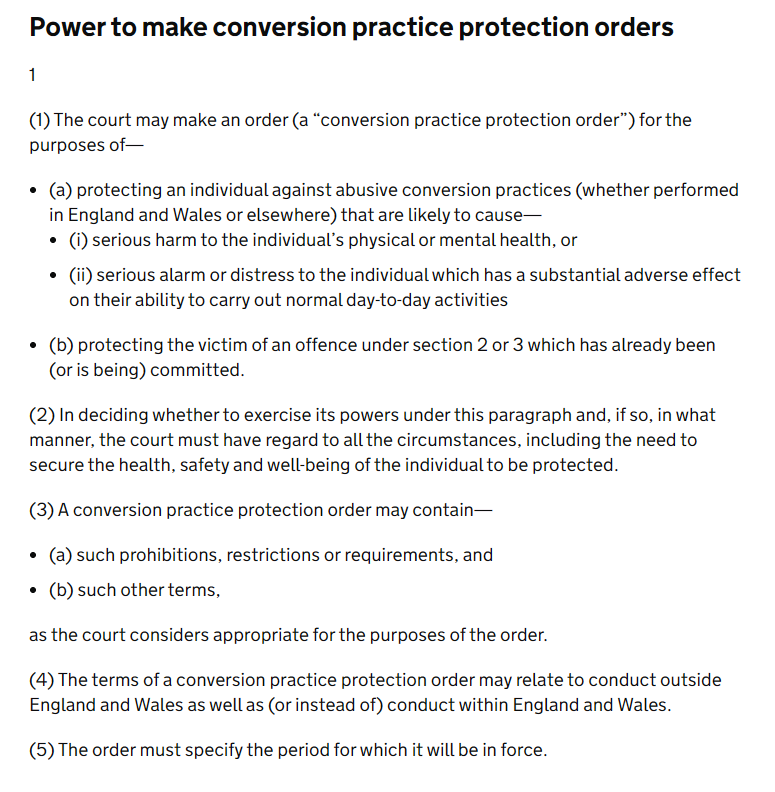
Breach without reasonable excuse would constitute a criminal offence.
The regime includes judicial decision-making and statutory safeguards, however, those safeguards do not remove the need to justify the powers themselves.
Protect and Teach is particularly concerned about the possible consequences for family relationships, communication, professional activity and lawful safeguarding decisions.
The important question is not whether every parental disagreement would produce an order.
It is whether the proposed regime is necessary and proportionate, whether its boundaries are sufficiently clear and whether its safeguards adequately prevent inappropriate intervention.
A Minister’s reassurance about the difficulty of securing a criminal conviction does not answer those questions.
The protection-order regime must be assessed independently of the prosecution threshold.
Our September analysis concluded that Parliament should reject the proposed Conversion Practice Protection Orders alongside the new offences.
That remains Protect and Teach’s position.
6. Healthcare and exploratory therapy: conditional protection is not a blanket guarantee
Phillipson says that legitimate healthcare and exploratory therapies will be protected.
Clause 1 contains a healthcare exclusion, subject to its statutory conditions.
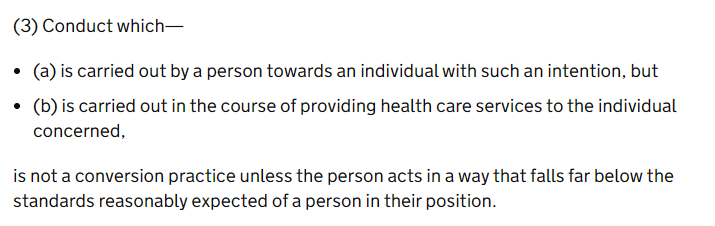
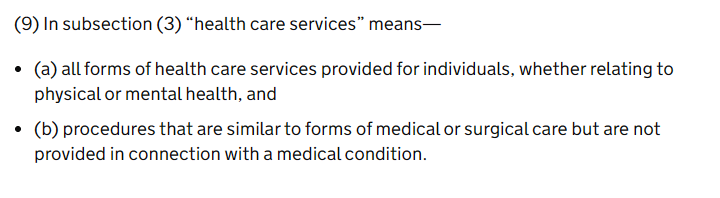
This is a real provision of the draft legislation, and it should be distinguished from assurances that have no equivalent express exemption. But its scope is determined by the words of the Bill, not by the breadth of the Minister’s statement.
Protect and Teach supports open-ended, evidence-informed therapeutic exploration.
Children and adults experiencing distress should be able to receive careful assessment that considers their individual circumstances, developmental needs, family relationships and any coexisting difficulties.
Professionals should be able to explore competing explanations and exercise appropriate clinical and safeguarding judgement without being required to arrive at a predetermined conclusion. Equally, professional status cannot justify violence, coercion or genuinely abusive treatment.
The challenge is to distinguish legitimate therapeutic and safeguarding practice from abuse without creating unnecessary uncertainty or deterrence.
Protect and Teach’s concern is that the proposed framework does not provide sufficiently reliable protection across all the settings in which legitimate conversations and interventions may occur.
A conditional healthcare exclusion cannot be treated as a general statutory guarantee for every form of lawful counselling, parental guidance or safeguarding activity.
7. Professional endorsements: support for preventing abuse is not approval of every clause
Phillipson invokes support from professional organisations and clinicians, including the British Psychological Society and Dr Hilary Cass.
That requires careful interpretation.
There is an important difference between opposing genuinely abusive conversion practices and endorsing the precise legal framework contained in this draft Bill.
A clinician or professional body may support protection from abuse without approving every definition, offence, exclusion or preventative power proposed by Ministers.
Parliament should therefore ask which organisations have formally endorsed the actual statutory provisions and which have expressed support only for the underlying objective.
Protect and Teach’s research examined the evidential basis advanced for the Bill rather than treating expressions of general support as proof of legislative necessity.
Professional authority cannot substitute for clause-by-clause scrutiny.
Nor should support for protecting vulnerable people be interpreted as agreement that this particular legislation is the appropriate means of doing so.
8. Freedom of belief, expression and family life: rights require more than promises
Phillipson states that the draft Bill will not interfere with freedom of expression, religious practice or decisions about parenting.
These are substantial claims.
The European Convention on Human Rights protects freedom of thought, conscience and religion, freedom of expression, and respect for private and family life, subject to the applicable legal qualifications. Those rights do not prohibit every form of state interference.
But restrictions must meet the relevant requirements of legality, legitimate aim, necessity and proportionality.
A Government’s assertion that rights will remain protected does not itself demonstrate that those requirements are satisfied.
The actual provisions, their foreseeable application and their interaction with existing legal duties must be examined.
Protect and Teach’s concern is especially acute where children are involved.
The state has legitimate responsibilities to protect children from abuse. Parents and professionals also have lawful responsibilities to protect children, assess risk and make difficult decisions.
Legislation must not create unnecessary conflict between those responsibilities or deter appropriate safeguarding activity.
The Government must demonstrate that its proposed powers are compatible with those responsibilities in practice, not merely assert that they will be.
9. Why “trust us” cannot be the basis of criminal legislation
There is a recurring feature of Phillipson’s defence. The Government identifies a concern and responds with an assurance about how the legislation is intended to operate.
Parents will be protected.
Legitimate conversations will be protected.
Professionals will be protected.
Freedom of expression and religious practice will be protected.
But the legal status of those assurances is crucial.
A Minister’s newspaper article does not form part of the Bill.
Even the Government’s own Explanatory Notes expressly state that they are not part of the draft legislation and have not been endorsed by Parliament.
Ministerial statements may, in limited circumstances, assist courts when interpreting ambiguous statutory language. They do not give Ministers a general power to rewrite legislation after it has been enacted.
The question for Parliament is therefore whether the protections Ministers describe are sufficiently secured by the actual legal framework.
Where they are not, the public cannot be expected to rely on confidence in the Minister’s intentions.
This is particularly important where the potential consequences include criminal investigation, restrictions imposed by a court and interference with family or professional relationships.
Parliament cannot legislate on the basis of “trust me, bro” and leave parents, professionals and the courts to discover afterwards what the law actually means.
The phrase may be informal. The principle is fundamental.
10. What Parliament must require of the Government
Protect and Teach believes the Government should be required to provide clear, evidence-based answers before the draft legislation proceeds.
Necessity: Which specific forms of serious abusive conduct are inadequately addressed by existing law, and what evidence demonstrates those gaps?
Legal certainty: How does the statutory definition reliably distinguish genuinely abusive conduct from lawful parental guidance, professional judgement and open-ended therapeutic exploration?
Parental responsibility: Where does the Bill expressly establish the protections Phillipson describes for non-affirmation, pronoun refusal and challenging conversations?
Criminal threshold: Why does the Minister’s explanation emphasise serious physical or psychological harm without clearly identifying the alternative serious-alarm-or-distress limb?
Protection orders: Why are preventative restrictions without a prior conviction necessary, and how will disproportionate interference with family relationships and lawful conduct be prevented?
Healthcare: What is the precise scope of the healthcare exclusion, and how are legitimate activities outside that exclusion protected?
Professional support: Which organisations have endorsed the actual provisions of the draft Bill, rather than the general objective of preventing abuse?
Safeguarding and human rights: What evidence demonstrates that the proposed framework will improve protection without creating unjustified chilling effects, professional uncertainty or interference with lawful responsibilities?
These questions go to the justification for the Bill itself.
They cannot be resolved simply by adding more reassuring language to a ministerial article.
Conclusion: Protect and Teach maintains its recommendation for withdrawal
Protect and Teach supports effective protection for children and adults against genuinely abusive conduct. We also support the proper exercise of parental responsibility, lawful professional judgement, freedom of belief and open-ended, evidence-informed therapeutic exploration.
These commitments are not mutually exclusive.
Our September 2026 policy paper examined whether the Draft Conversion Practices Bill provides a necessary, proportionate and sufficiently certain legal response to identifiable harm.
Across 769 pages, our conclusion was that the Government had not established that case.
Phillipson’s article does not supply the missing justification.
It offers interpretations about what the Government Minister asserts the Governments intentions are, but those assurances cannot resolve deficiencies in the proposed statutory framework.
The Bill expressly creates new criminal offences and preventative powers. The protections Ministers promise are not always expressed with equivalent specificity.
For Protect and Teach, that imbalance is a fundamental objection, not a minor drafting concern.
We therefore maintain our recommendation that the Draft Conversion Practices Bill be withdrawn.
Parliament should reject its proposed offences and Conversion Practice Protection Orders rather than replace them with a substantially similar identity-specific scheme.
The Government should instead prioritise effective enforcement of existing criminal, civil and safeguarding law, meaningful support for victims of identifiable abuse, appropriate professional accountability and targeted responses to demonstrable deficiencies.
The burden is on the Government to justify new criminal legislation.
It has not discharged that burden to Protect and Teach’s satisfaction.
A Minister’s assurance is not a statutory safeguard. And where the law does not clearly secure the protections Ministers promise, Parliament should not be asked simply to take their word for it.
Sources and further reading
Primary legislation and Government material
- HM Government, Draft Conversion Practices Bill, (25 June 2026), particularly clauses 1–4 and the Schedule.
- HM Government, Draft Conversion Practices Bill: Explanatory Notes,(2026).
- Bridget Phillipson, “Abuse intended to change who someone is has no place in modern Britain”, The Independent, 18 October 2026. Original article
- Archived copy.
Protect and Teach CIC, The Draft Conversion Practices Bill (England and Wales): An Evidence Review and Policy Analysis, Policy Analysis Paper No. 1, Version 1.0, September 2026, 769 pages.
Particularly relevant sections:
- Chapter 4 — The Government’s Case for New Legislation.
- Chapter 5 — Does Existing Law Already Criminalise the Harm?
- Chapter 6 — Evaluating the Evidence Base.
- Chapter 7 — Legal, Safeguarding and Human Rights Consequences.
- Chapter 8 — The Strongest Case for the Bill, and Why It Fails.
- Chapter 9 — Final Findings and Parliamentary Recommendation.
- Appendix A — Clause and Schedule Map.
- Appendix B — Existing-Law and Claimed-Gap Matrix.
- Why the Evidence Does Not Support the Draft Conversion Practices Bill, September 18, 2026
Protect and Teach’s recommendation: Withdraw the Draft Conversion Practices Bill and reject its proposed offences and Conversion Practice Protection Orders.
This article is a policy analysis of draft legislation published for pre-legislative scrutiny. It does not constitute legal advice.