
Policy Analysis | Protect and Teach CIC | 23 October 2026
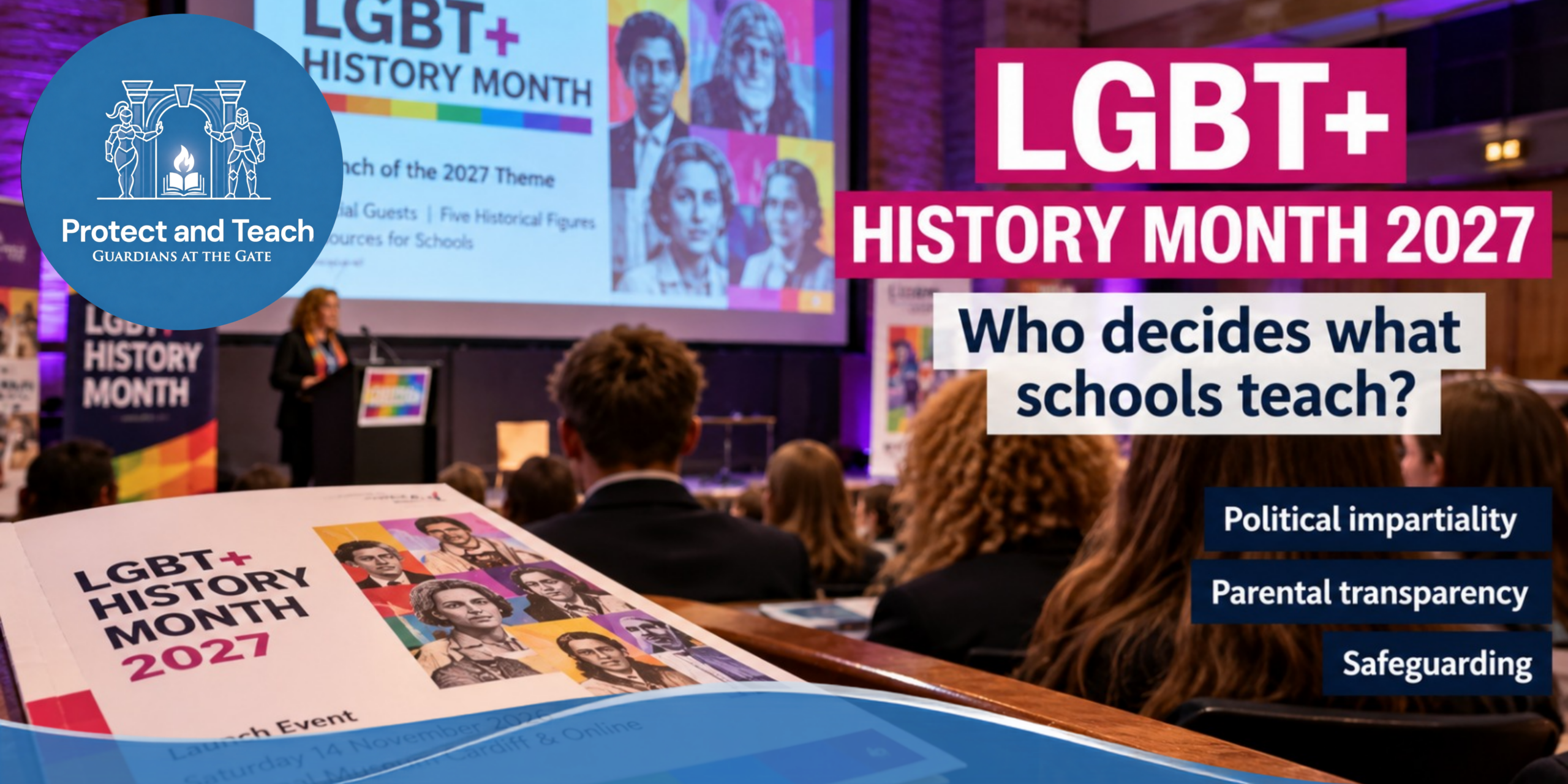
Schools OUT UK has circulated an invitation to the launch of the 2027 UK LGBT+ History Month theme on Saturday 14 November 2026 at the Reardon Smith Lecture Theatre, National Museum Cardiff. The circulated invitation states 6 pm; the organiser’s public Eventbrite listing specifies that the online event runs from 6.30 to 8 pm GMT. The in-person arrival or start time should therefore be confirmed directly with the organiser. The event will be livestreamed for online registrants.
According to the invitation, Schools OUT will explore the theme, reveal the 2027 LGBT+ History Month badge and invite guests to discuss five historical figures. It also refers to representatives from the Euro Games and a partnership for 2027. These particulars are drawn from the circulated invitation and have not all been independently corroborated against the public event listing.
Schools OUT presents its educational work as an opportunity to make LGBT+ history more visible in educational settings. That aim does not itself determine whether any particular classroom resource complies with schools’ legal duties. Equally, an invitation to a launch is not evidence that any school has breached those duties.
The central question is what schools do with the materials once they are available. An external organisation’s theme, badge or educational framing cannot replace a school’s independent assessment of political impartiality, factual accuracy, parental transparency and age-appropriateness.
1. The organisation and its stated purpose
Schools OUT describes itself as an LGBT+ education charity seeking to educate against prejudice and to “usualise” LGBT+ lives. The organisation founded UK LGBT+ History Month in 2004; the first month was celebrated in February 2005. It selects an annual theme, highlights five historical figures and offers educational resources to schools and other organisations.
Its stated approach includes visibility, inclusion and a whole-school perspective. These are declared educational and advocacy aims. Their existence does not, without examining particular content, establish either a breach of political impartiality or compliance with it.
Protect and Teach recognises that the histories and contributions of lesbian, gay and bisexual people can properly be taught as part of a rigorous curriculum. The relevant question is whether the actual historical claims, interpretations and any contemporary political propositions are presented accurately and in accordance with the duties applicable to the school.
2. The legal framework: political impartiality
For maintained schools in England, section 406 of the Education Act 1996 prohibits the promotion of partisan political views in teaching and certain partisan political activities involving junior pupils. Section 407 requires reasonably practicable steps to secure balanced presentation of opposing views when political issues are brought to pupils’ attention.
Academies and independent schools are subject to relevant requirements under the Education (Independent School Standards) Regulations 2014, with additional academy obligations arising through their funding arrangements as applicable. The precise legal route should be identified for each school type rather than treating every provision as identical.
The Department for Education’s Political impartiality in schools guidance addresses teaching, school-organised activities and the use of external organisations. It specifically considers external organisations offering educational materials for annual awareness or history months: schools must assess the content and ensure compliance with their own duties. A charity’s educational credentials or invitation cannot perform that assessment on the school’s behalf.
Crucially, teaching LGBT+ history, opposing bullying, and encouraging respect or compliance with equality law are not inherently partisan political activities.
The impartiality requirements become relevant where partisan political views are promoted or political issues are presented; a school must then apply the appropriate statutory test, including the requirement for balanced treatment where it applies.
3. What the invitation does and does not establish
The invitation concerns a future theme launch, a badge, historical figures and associated activities. It does not establish the detailed content of resources that schools might subsequently use, nor whether those resources will address political issues.
Before adopting any materials, a school should establish what historical sources support the claims made, whether contested interpretations are identified as such, what age groups the materials target, whether any external presenter will address pupils, and whether political issues are being raised. The invitation alone answers none of these questions.
In particular, the presence of discussion about gender identity does not automatically constitute a breach. Any concern about partisan presentation must be demonstrated by reference to the actual material and the way it is taught.
4. History, identity and the risk of partisan presentation
Historical study can examine same-sex relationships, changing language, social attitudes, discrimination, reform and the experiences of people whose lives did not fit the norms of their time. It should distinguish documented facts from inference and avoid presenting modern identity labels as unqualified historical certainties where the evidence does not support them.
A school may also examine how historians disagree about interpreting historical lives. Such disagreement is not necessarily a political issue for the purposes of sections 406 and 407. However, if materials move from historical explanation to advocacy for a particular partisan political position, the school must assess the legal implications and, where political issues are raised, secure appropriate balance.
The test is therefore the substance and delivery of the lesson, not the organisation’s branding or the mere use of the word “usualising”.
5. Parental responsibility and transparency
Parents should receive clear information about what their children are taught and which external resources are used, in line with applicable statutory requirements and guidance. Schools should explain the curriculum purpose, intended age group and source of materials and respond appropriately to requests to inspect them.
However, there is no general statutory right to withdraw a child from any LGBT+ History Month event, history lesson or themed assembly simply because it concerns LGBT+ topics.
Specific consultation, access and withdrawal rules apply in particular contexts, including relationships and sex education; their scope depends on the content and the law governing the activity. Schools should not suggest that a right of withdrawal exists where it does not, nor overlook one where it does.
Protect and Teach recommends timely, practical transparency so that parents can understand the materials and raise informed questions before delivery.
6. Safeguarding and professional judgement
Schools should assess external resources for factual accuracy, age-appropriateness, developmental suitability, accessibility and any identifiable safeguarding implications. Staff must take account of individual pupils’ needs and vulnerabilities, without assuming that learning about LGBT+ history is itself harmful.
A launch invitation is not a safeguarding risk assessment. Nor does it show that the resources, once published, will be unsuitable. The school remains responsible for checking actual content, the qualifications and role of any external presenters, and how sensitive or contested questions will be handled.
7. Conclusion and recommendation
The Schools OUT invitation is an announcement by an external charity, not a statutory instrument or an approval of future teaching materials. It does not alter the Education Act 1996, the Independent School Standards or the Department for Education’s guidance.
Schools considering resources associated with UK LGBT+ History Month 2027 should:
- Obtain and review the actual resources before use, including sources for historical claims.
- Identify the legal duties applying to their school type and assess whether any content promotes partisan political views or raises political issues requiring balanced treatment.
- Distinguish historical evidence and interpretation from contemporary political advocacy.
- Provide clear information to parents and apply relevant access and withdrawal rules accurately.
- Exercise independent professional judgement on age-appropriateness, external presenters and safeguarding.
An external agency’s assurance that its work is educational does not substitute for a school’s own legal and professional assessment.
Protect and Teach’s recommendation is that schools treat such invitations as the starting point for scrutiny, not as a substitute for it
Sources and further reading
- Schools OUT — organisation and educational approach.
- Schools OUT: UK LGBT+ History Month 2026 and its history.
- Schools OUT Eventbrite listing — 14 November 2026, online 6.30–8 pm GMT.
- Education Act 1996, section 406 and section 407.
- DfE: Political impartiality in schools.
- Education (Independent School Standards) Regulations 2014.
- DfE: Relationships, sex and health education statutory guidance.
- Schools OUT UK, Invitation to LGBT+ History Month Launch of the Theme 2027 (circulated October 2026; original invitation should be retained in the publication record).
Scope: This analysis concerns the legal and policy framework for schools in England. The event is being hosted in Wales, where a different educational framework applies. This article is not legal advice.
Protect and Teach CIC | October 2026