
A Protect and Teach analysis of climate education, political impartiality and parental rights in England
Climate change should be taught. It should be taught seriously, scientifically and honestly. What schools must not do is turn education into political mobilisation.
Protect and Teach exists to defend the developing mind and restore the conditions in which genuine education can flourish: evidence, reason, free inquiry and the cultivation of independent judgement. Protect and Teach is not taking a position in this article on the scientific question of anthropogenic climate change. This article is about the legal framework governing education in England, political impartiality, the distinction between education and advocacy, and the rights and legitimate interests of parents.
The question should always be:
Is the pupil being educated to understand and evaluate an issue, or is the pupil being directed towards a particular conclusion?
We are examining the law and educational framework in England, including:
- political impartiality in schools;
- the distinction between teaching and political advocacy;
- the requirements of the Education Act 1996;
- Department for Education guidance;
- the role of scientific evidence and uncertainty in science education;
- the position of parents who disagree with material being taught;
- and the importance of protecting the developing mind from political indoctrination.
Protect and Teach does not believe that difficult or controversial subjects should be removed from classrooms. We believe they should be taught properly. That means evidence, reason, critical thinking, appropriate context and the freedom to form an independent judgement.
Climate change is therefore an excellent case study for examining a much wider question:
When does education about a controversial subject remain education, and when can it become political advocacy?
That question matters regardless of where an individual parent, teacher, pupil, school or organisation stands on climate change.
Climate education must remain education
Climate change is a legitimate and important subject for education. Pupils should understand climate observations, scientific evidence, climate modelling, uncertainty, historical climate variability and the physical and technological questions surrounding energy and the environment. There is however, an important distinction between teaching about climate change and teaching pupils what they should believe, support or campaign for in response to it. Education does not end with presenting a conclusion. A proper science education also teaches pupils how scientific knowledge is constructed and evaluated. The National Curriculum for science states that pupils should develop their ability to evaluate scientific claims through critical analysis of methodology, evidence and conclusions.
That distinction is not merely philosophical. In England, it is reflected directly in the law and in Department for Education guidance.
Political impartiality is not optional
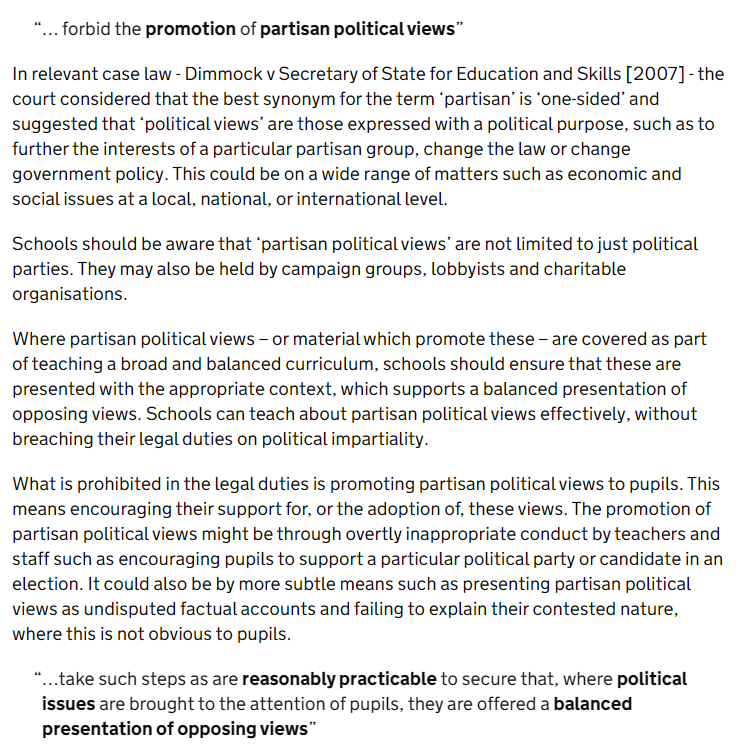
The political-impartiality framework in England is not a new political preference introduced by recent guidance. Sections 406 and 407 of the Education Act 1996 establish important safeguards concerning political impartiality in maintained schools.
The current DfE guidance, Political impartiality in schools, was updated on 21st March 2025. Importantly, the Department states that the guidance does not create new statutory requirements. It explains the existing legal duties and provides practical guidance for schools and teachers.
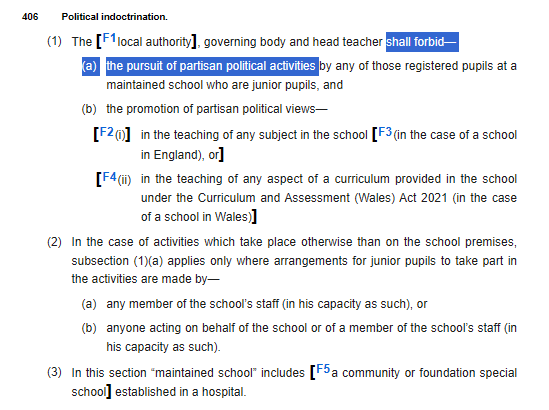
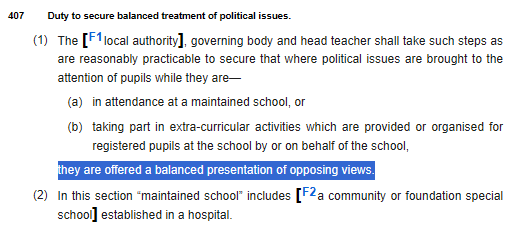
Section 406 prohibits the promotion of partisan political views in the teaching of any subject and places restrictions on partisan political activity involving junior pupils. Section 407 requires schools to take reasonably practicable steps to ensure that, where political issues are brought to pupils’ attention, they are offered a balanced presentation of opposing views.
These principles are not confined to party politics.
The DfE’s current guidance makes clear that partisan political views may also be held by campaign groups, lobbyists, charities and other organisations. The prohibition is not simply against telling pupils to vote for a particular political party. It also encompasses encouraging pupils to support or adopt a partisan political position.
For academies, the position is reinforced through funding agreements, while independent schools are subject to corresponding requirements under the Education (Independent School Standards) Regulations 2014. The DfE guidance states that the political-impartiality requirements apply across school types. This matters because political impartiality is not a demand that schools avoid difficult subjects.
Quite the opposite… Schools are expected to teach pupils about controversial and contested issues. The legal requirement is that they do so fairly and dispassionately, without promoting a particular partisan position.
The DfE’s own climate-change example
The Government’s guidance is unusually clear on this point. The DfE’s Political impartiality in schools guidance contains a specific scenario dealing with climate change. It states that teaching about climate change and the scientific facts and evidence behind it does not constitute teaching about a political issue. Political impartiality does not mean pretending that every proposition has equal evidential support.
The DfE then draws a second distinction. It states that where teaching covers potential solutions for tackling climate change, this may constitute a political issue because different political parties and campaign groups may hold partisan views about the best way to address climate change. That part of the subject should therefore be taught in a balanced manner, without teachers promoting the partisan political positions involved.
The Government’s separate Sustainability and Climate Change Strategy makes the same distinction: climate education is an important part of education policy, but debates concerning political and policy change must be handled consistently with schools’ legal duties on political impartiality.
This gives us a useful dividing line:
Teach the science. Teach the evidence. Teach the competing policy arguments. Do not turn pupils into political campaigners.
This creates an important distinction.
Scientific education might ask:
- What is the greenhouse effect?
- What observations have been made?
- How are climate measurements obtained?
- What do different datasets show?
- What are climate models?
- What assumptions do models make?
- What are the uncertainties?
- How have scientific explanations developed?
- What evidence supports particular conclusions?
Political and policy education might ask:
- What should governments do?
- How quickly should emissions be reduced?
- Should nuclear power be expanded?
- Should renewable energy be prioritised?
- Should carbon taxation be increased?
- Should particular industries be regulated?
- What costs and benefits arise from different approaches?
- Should particular technologies or behaviours be restricted?
- Should governments prioritise mitigation, adaptation, or both?
These second questions are not simply scientific questions. They involve political, economic, ethical and social judgements. They can absolutely be taught. When they are taught, the school’s political-impartiality duties become relevant.
If the lesson then becomes:
“Therefore, there is only one morally acceptable political response and pupils should support it.”
the teacher has moved beyond explaining scientific evidence. Schools should not use their institutional authority to instruct pupils which partisan political position they must adopt.
What does “balance” actually mean?
There is another important misconception worth correcting. Political impartiality does not require a teacher to give equal time to every conceivable position. The DfE says that a balanced presentation should be fair and dispassionate, and, where practical, expose pupils to a reasonable range of significantly different perspectives.
The guidance says that this may mean at least two substantially different perspectives rather than presenting numerous marginally different positions.
That distinction is crucial for climate education.
A teacher can say:
“This is the evidence supporting this position.”
They can then ask pupils:
“How strong is the evidence?”
“What assumptions are involved?”
“What are the limitations?”
“What evidence might challenge this conclusion?”
“How confident should we be?”
That is not political bias. It is critical thinking. Likewise, where political solutions are discussed, pupils can examine competing arguments without being told which one they must adopt.
What about parents who disagree with the teaching?
This is where the question becomes more complicated. A parent may fundamentally disagree with the scientific position being presented in a classroom.
That parent does not automatically acquire a legal right to require the school to teach their preferred scientific proposition as an equally established alternative.
Parental rights do not amount to a general parental veto over the curriculum… But that is not the end of the matter. Parents have legitimate interests in how education is delivered to their children. The law recognises an important parental dimension to education.
Article 2 of Protocol 1 to the European Convention on Human Rights, incorporated into UK law through the Human Rights Act 1998, provides that:
“In the exercise of any functions which it assumes in relation to education and to teaching, the State shall respect the right of parents to ensure such education and teaching in conformity with their own religious and philosophical convictions.”
This provision should not be misunderstood.
It does not give every parent an unrestricted right to determine the entire curriculum or demand that their child’s school teach every proposition in accordance with the parent’s personal beliefs. The European human-rights framework recognises that the State necessarily has a role in organising education.
The parental right is nevertheless significant. It provides an important protection against the State using education to impose particular religious or philosophical convictions on children in a manner incompatible with the Convention framework. The European Court of Human Rights has considered this principle particularly in cases concerning indoctrination and the treatment of parental convictions.
For the purposes of this article, the important principle is therefore not:
“Parents can decide what science their children are taught.”
It is:
“Parents are not irrelevant to questions about the nature, purpose and presentation of their children’s education.”
A parent who disagrees with anthropogenic climate change might reasonably ask a school:
- What exactly was taught?
- What evidence was presented?
- Was the material presented as scientific evidence, political opinion or moral instruction?
- Were pupils taught about the methodology and limitations of the evidence?
- Were scientific uncertainties accurately represented?
- Were campaign organisations involved?
- Were political policy positions presented?
- Were pupils encouraged to support a particular political response?
- Were pupils encouraged to participate in campaigning or political activity?
Those are legitimate educational questions. A parent does not have to establish that the school’s underlying scientific position is wrong before raising them.
The question can instead be:
Was the subject taught as education, or was education being used to promote a particular political or ideological response?
A parent does not have to agree with the school’s conclusion to raise a valid concern
This distinction deserves emphasis. Imagine two situations…
Situation one: disagreement about the scientific conclusion
A parent says:
“I don’t believe that human activity is responsible for contemporary climate change and I want the school to teach my child that this is equally established science.”
The school may legitimately respond that it is not required to present a proposition merely to create balance. That does not, by itself, demonstrate a breach of the parent’s rights.
Situation two: concern about political advocacy
A parent says:
“I accept that the school is entitled to teach the scientific evidence concerning climate change. My concern is that the lesson then told pupils that they have a moral obligation to support a particular political policy and encouraged them to campaign for it.”
That is a different question… The parent’s personal position on climate science is not decisive. The issue is whether the school has crossed the boundary from teaching into promoting a partisan political view.
The DfE’s own guidance makes this distinction.
External campaign organisations matter too…
This becomes particularly important where schools use materials or speakers from external organisations. The DfE makes clear that partisan political views are not limited to political parties.
They may also be held by:
- campaign groups;
- lobbyists;
- charities;
- and other organisations.
Schools can use external organisations and teach about partisan views. An important caveat; where partisan political material is introduced into teaching, the school remains responsible for ensuring that the legal requirements concerning impartiality are met.
This is particularly important in areas such as climate education because environmental organisations may combine:
- scientific information;
- political analysis;
- moral arguments;
- policy recommendations;
- campaigning;
- calls to action;
- and educational resources.
Those things are not necessarily interchangeable. A resource can therefore contain perfectly legitimate factual information while also containing campaigning material. Teachers and school leaders need to understand the difference, and know which it is using. Pupils should be able to distinguish them too. Parents should be able to ask what external resources have been used and for what purpose.
Activism can be studied without becoming the purpose of education
There is an important distinction between studying activism and doing activism because the school expects pupils to do so.
Pupils can study:
- environmental campaign movements;
- political protest;
- civil disobedience;
- public demonstrations;
- campaigning organisations;
- arguments for and against activism;
- the effectiveness of protest;
- and the role of activism in democratic societies.
That is education… What is not appropriate is for teachers to encourage pupils to join a particular campaigning organisation or participate in a specific political protest.
Education versus indoctrination
Education can say:
- “Here is a proposition.”
- “Here is the evidence supporting it.”
- “Here is how that evidence was obtained.”
- “Here are the limitations.”
- “Here are the questions that remain.”
- “Here is how different people interpret the evidence.”
- “Now examine it and reach a reasoned conclusion.”
Indoctrination operates differently. It says, explicitly or implicitly:
- “This is what you must believe.”
- “This is what a good person believes.”
- “Questioning this position is unacceptable.”
- “You have a moral duty to support this cause.”
- “You must take action.”
The boundary will not always be obvious. That is precisely why safeguards such as political impartiality matter.
When activism becomes the curriculum: An example: XP Trust
This issue is not merely theoretical. XP Trust publicly describes its curriculum as being built around three design principles:
activism, leadership and equity.
Its curriculum materials describe “Protecting Our Planet” as one of its major curriculum strands and state that climate change is treated as an existential threat and an imperative part of the curriculum. The Trust says that pupils acquire knowledge around this strand and use it to “actively” make a difference to the world.
XP Trust also explicitly describes pupils as agents of social change and says that its curriculum produces work intended to contribute to positive social change. None of this, by itself, establishes that XP Trust is breaking the law. A curriculum can contain activism, environmental projects, campaigns or real-world products without automatically becoming unlawful.
The legal question is more precise:
Are partisan political views being promoted to pupils, and where political issues are introduced, are pupils being given a fair and dispassionate presentation of the relevant competing perspectives?
That is the proper question to ask of any school or trust.
Children are not political instruments
There is another reason for maintaining this distinction. Children and young people can and do experience significant concern about climate change.
A 2025 YouGov survey of more than 600 primary-aged children commissioned by Greenpeace UK reported that 78% said they were worried about climate change, with 27% saying they were very worried. A separate survey of primary teachers commissioned by Greenpeace reported that 70% did not feel they had enough time in the school day to help pupils with climate-related concerns.
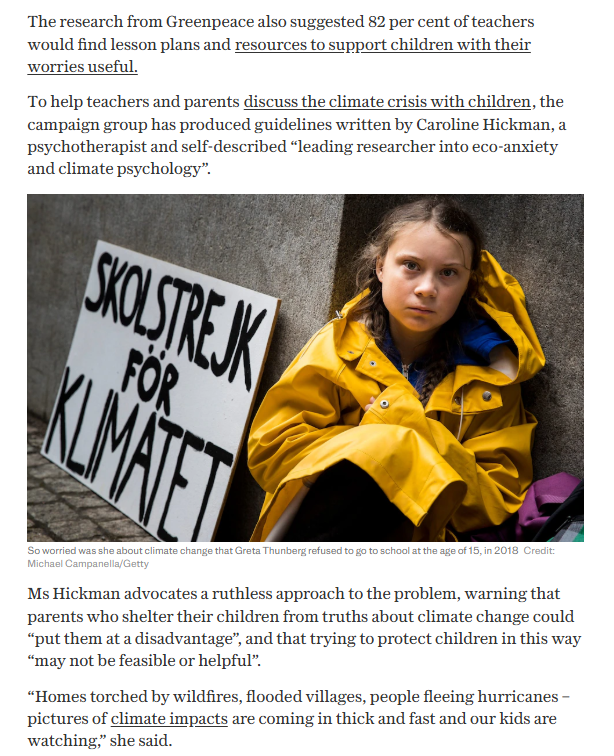
The survey demonstrates that climate-related worry exists; it does not demonstrate that schools caused that worry. Children encounter information about climate change through school, parents, television, social media, campaigning organisations and the wider culture…. The figures do reinforce an important educational principle:
How a subject is taught matters.
- Fear is not a substitute for knowledge.
- Guilt is not a substitute for understanding.
- And political mobilisation is not a substitute for education.
Children should be given the intellectual tools to understand difficult realities without being made to feel personally responsible for solving global political problems that adults and democratic institutions have responsibility for addressing.
Amanda Spielman’s warning remains relevant
This concern is not confined to Protect and Teach… In 2020, then Chief Inspector of Ofsted Amanda Spielman warned that climate teaching should be grounded in science. She argued that without that grounding, climate education could become a “morality tale” or “something quasi-religious”, and warned against schools and curricula being “commandeered” in support of social issues and campaigns.
The principle is bigger than climate change
This issue matters because the same principle applies far beyond climate change.
Schools teach children about war, poverty, economics, migration, sex and relationships, religion, political movements, social justice, international affairs, environmental policy and many other subjects that can become politically contested.
The answer cannot be to remove difficult subjects. Nor can it be to decide that because an issue is important, one particular political interpretation should automatically become the school’s interpretation.
The answer is education. This is not a principle that should be applied selectively.
- If a school promoted a left-wing political position, the principle should apply.
- If it promoted a right-wing political position, the principle should apply.
- If it promoted an environmental campaign, the principle should apply.
- If it promoted opposition to an environmental campaign, the principle should apply.
- If it promoted a religious or anti-religious position, the same educational principles should apply within the relevant legal framework.
- If it promoted a particular economic ideology, the same question should be asked.
The issue is not:
“Does Protect and Teach agree with the position?”
The issue is:
“Is the school educating pupils about the issue or using its authority to promote a partisan position?”
- Teach the evidence.
- Teach the history.
- Teach the arguments.
- Teach pupils how to interrogate sources.
- Teach them to distinguish fact from opinion, evidence from assertion and analysis from advocacy.
Then allow them to think… That is what political impartiality is intended to protect.
Our concern is not with children learning about the world. It is with children being told, implicitly or explicitly, what their place in that world must be.
References and further reading
Department for Education — Political impartiality in schools (updated 21 March 2025) DfE: Political impartiality in schools The principal current Government guidance. It expressly addresses climate change, political balance, external agencies, campaigning and pupil political activity.
Department for Education — Sustainability and Climate Change: A Strategy for the Education and Children’s Services Systems DfE Sustainability and Climate Change Strategy The strategy explicitly recognises climate education as an important part of education while stating that political and policy debates must comply with political-impartiality duties.
Education Act 1996 — Section 406 Education Act 1996, s.406
Education Act 1996 — Section 407 Education Act 1996, s.407
Gelmini, S. (2025). Majority of under-12s worried about climate change, survey shows. Greenpeace UK — Majority of under-12s worried about climate change, survey shows (2025) Greenpeace UK survey report. Reports YouGov polling commissioned by Greenpeace UK concerning climate-related worry among primary-aged children and teachers’ experiences.
Hennessy, L. J. (2025). “The purpose of activism is to educate”: Young people’s climate activism as and for education in the youth strike movement in England. British Educational Research Journal. British Educational Research Journal — Hennessy An academic study examining climate activism as a form of education and the participants’ calls for educational reform.
Pountney, R. (2025). “Let’s talk about the weather”: The activist curriculum and global climate change education. British Educational Research Journal.
British Educational Research Journal — Pountney Examines activist approaches to climate education and the possibility of transformative activist curricula.
Spielman, A. / Ofsted — climate education comments (2020)
Contemporaneous reporting of Amanda Spielman’s warning that climate teaching should be grounded in science rather than becoming a “morality tale” or “quasi-religious”. Kent Online: Ofsted: Teaching climate change without science could become ‘morality tale’ Reported in multiple outlets including Kent Online.
XP Trust — Our Curriculum XP Trust: Our Curriculum XP Trust’s own published description of its curriculum, including its “Protecting Our Planet” strand, activism and emphasis on students making a difference.
XP Trust — Values and Ethos XP Trust: Values and Ethos XP Trust’s published description of activism, social change and its “Climate Emergency” curriculum strand.
Additional supporting surveys and reporting on climate anxiety and school practice appear in The Telegraph, UCL research summaries, and Royal Meteorological Society climate literacy surveys (2024–2025).