
17 November 2026 | Protect and Teach CIC | Education Policy
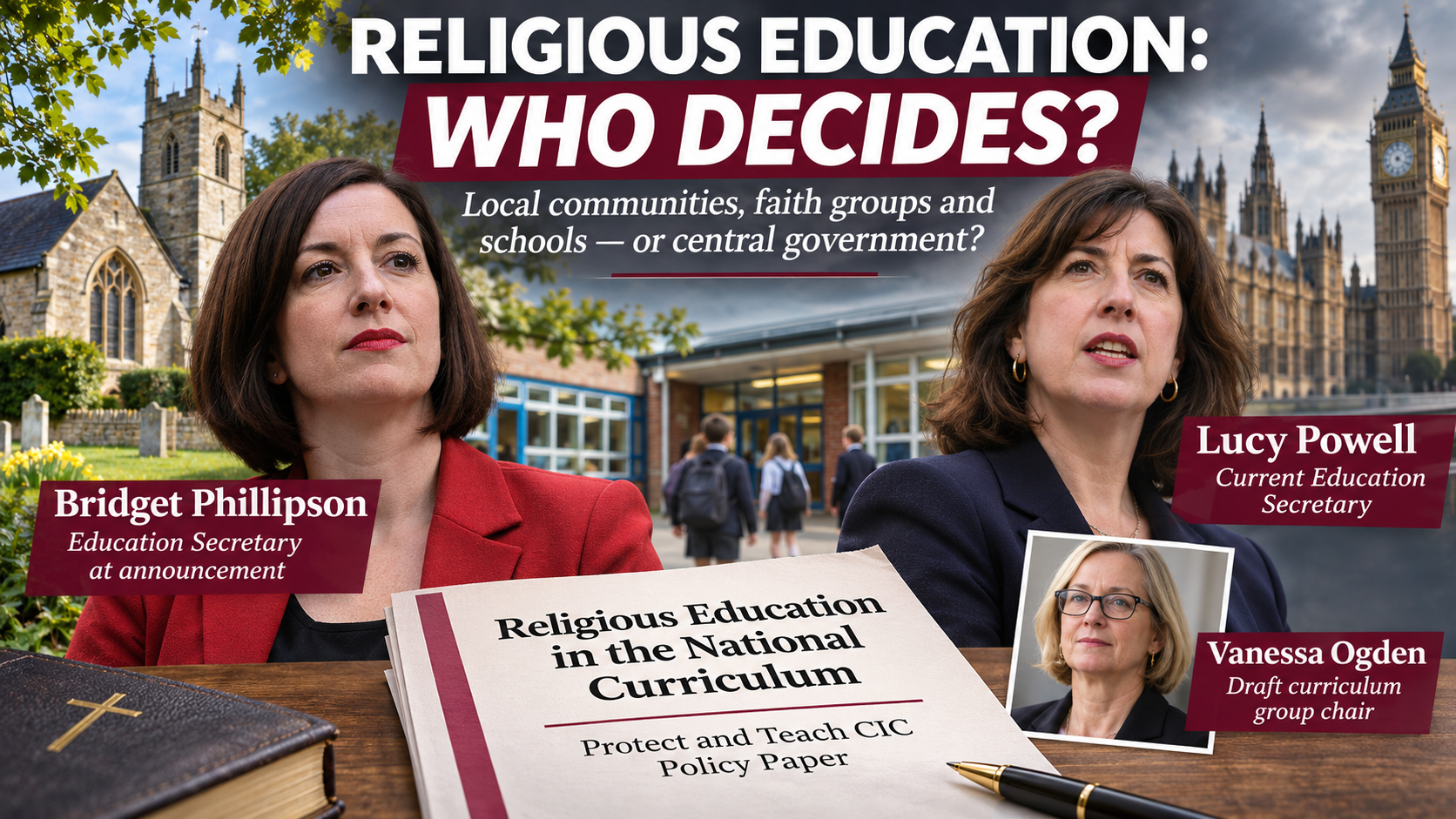
Protect and Teach CIC has written to education, faith and community representatives expressing concerns about the Government’s proposal to bring Religious Education (RE) into England’s National Curriculum.
The correspondence, circulated by Cathy Mudge, Director of Protect and Teach CIC, on 16 November 2026, is accompanied by a policy analysis prepared by Protect and Teach CIC.
Entitled Religious Education in the National Curriculum: A Constitutional Change Without a Constitutional Debate, the paper examines the potential legal consequences of the proposals, the Government’s claims of sector consensus and the safeguards that may be needed to preserve the distinctive character of Religious Education.
Our concern is not simply what may be taught in RE lessons. It is also about who decides what children learn, how those decisions are made and what legal protections will remain.
What is changing?
Religious Education is already a compulsory part of the basic curriculum in maintained schools in England, although parents retain a statutory right of withdrawal.
However, RE is not currently a National Curriculum subject.
In community schools and relevant foundation and voluntary schools without a religious character, the syllabus is determined locally through an Agreed Syllabus Conference (ASC) and adopted by the local authority.
This longstanding framework allows local representatives, including teachers, faith communities and councillors, to participate in determining the content of Religious Education.
Standing Advisory Councils on Religious Education (SACREs) have a related but distinct statutory advisory role.
The Government intends to consult on bringing RE into the National Curriculum. Depending on the legislative arrangements ultimately adopted, this could substantially alter or remove the current system of locally agreed syllabuses.
The proposed statutory changes have not yet been finalised.
Protect and Teach believes the implications for local accountability, religious education and parental understanding require a dedicated public debate.
Why is Protect and Teach concerned?
Our policy analysis identifies four central areas requiring scrutiny.
1. The future of locally determined Religious Education
- Moving RE into the National Curriculum could fundamentally alter the responsibilities currently exercised through Agreed Syllabus Conferences.
- These arrangements have historically provided a mechanism for local communities to contribute to the subject’s content.
- Any proposal to replace that system should explain what will happen to those responsibilities and why national prescription would be preferable.
2. The existing recognition of Christian traditions
- Section 375(3) of the Education Act 1996 requires locally agreed RE syllabuses to reflect the fact that Britain’s religious traditions are predominantly Christian while taking account of the teachings and practices of other principal religions.
- This is an existing statutory requirement, not a proposal to require children to adopt religious beliefs.
- Protect and Teach is asking what equivalent protection would exist under a new National Curriculum framework, alongside appropriate safeguards for schools with a religious character.
3. The Government’s claim of sector consensus
- The Government has stated that a sector group reached consensus over the proposed RE curriculum.
- However, concerns have been raised by participants and organisations, including the Religious Education Network, regarding the transparency of the drafting process, opportunities for scrutiny and consideration of alternative approaches.
- Protect and Teach believes the Government should explain how consensus was established and publish sufficient information for the public to assess the process.
4. The meaning of ‘personal worldviews’
- The proposed approach includes consideration of religious and non-religious worldviews.
- Studying different religious and philosophical perspectives can form a legitimate part of education.
- However, our paper raises concerns about insufficiently defined references to personal worldviews and whether these might blur the distinction between academic study and the promotion of contemporary political positions.
- Protect and Teach is seeking clear boundaries and appropriate guidance on existing political-impartiality duties, alongside relevant Prevent responsibilities.
The letter circulated by Protect and Teach CIC
The following correspondence was circulated by Cathy Mudge on 16 November 2026, alongside the policy analysis.
Subject: Religious Education in the National Curriculum — A Constitutional Change Without a Constitutional Debate
Dear All,
Protect and Teach CIC is a community interest company working on safeguarding and evidence-informed education in England. We enclose our letter on the proposed changes to Religious Education, which we hope will interest your organisation and perhaps you can help us challenge the upcoming review.
The Government intends to bring Religious Education into the National Curriculum, with a consultation expected later this year. This could bring an end to the long-standing system of locally agreed RE syllabuses, which local communities, faith groups and churches help to shape through Agreed Syllabus Conferences.
Our attached policy paper sets out what would change in law and why the claim of sector “consensus” needs scrutiny. It also explains why the vague language around “personal worldviews” risks contested political ideas being taught in RE.
We are asking for statutory protection for faith schools’ distinctive character and the requirement that RE reflects Christian traditions, a separate consultation on RE’s legal framework, clear links to schools’ existing political-impartiality duties and Prevent, and full transparency about how the draft was written.
Please read it and share it with anyone involved in RE locally, including SACRE (the local RE advisory council) members, churches and governors.
Cathy Mudge
Director, Protect and Teach CIC
www.protectandteach.org
Read the accompanying policy paper
Religious Education in the National Curriculum: A Constitutional Change Without a Constitutional Debate
Protect and Teach CIC
November 2026
This four-page policy analysis examines:
- The current statutory arrangements for Religious Education.
- The proposed move into the National Curriculum and its possible implications for local determination.
- The Government’s claim of sector consensus.
- The role of religious and non-religious worldviews.
- The statutory protections and transparency Protect and Teach is seeking.
[DOWNLOAD THE FULL POLICY PAPER — PDF]
What happens next?
- The Government is expected to consult on its proposed RE curriculum and associated legislative arrangements.
- Protect and Teach will examine the published proposals when they become available and consider the implications for schools, teachers, parents, faith communities and local RE bodies.
- We encourage those involved in Religious Education to familiarise themselves with the existing legal framework and the potential implications of reform.
Improving the quality and consistency of Religious Education is a legitimate objective. But a change to the longstanding legal arrangements deserves proper consultation, transparent evidence and careful parliamentary scrutiny.
Sources and further reading
- Department for Education — Curriculum and Assessment Review: Government Response
- Parliamentary written answer on the proposed RE curriculum — 2 November 2026
- Education Act 1996 — Section 375
- Education Act 1996 — Sections 406 and 407
- Religious Education Network — National Curriculum Position Paper
- Christian Concern — Groups Challenge RE Consensus Claim
Protect and Teach CIC remains committed to safeguarding, evidence-informed education, parental transparency and the protection of the developing mind.