
Live tracker: This page will be updated as the Department for Education publishes further detail, responds to Protect & Teach’s questions, or new information becomes available. Items will be updated as their status changes.
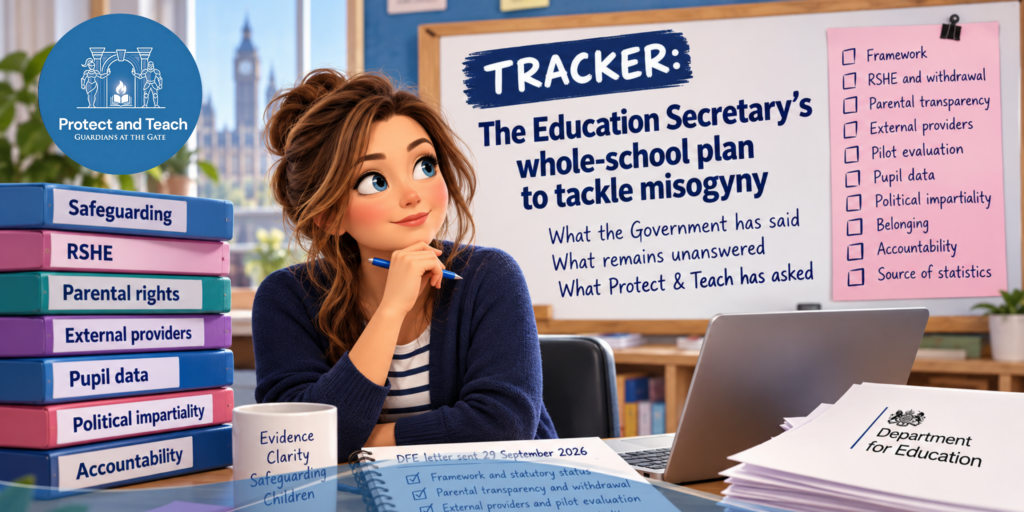
Tracker: the Education Secretary’s whole-school plan to tackle misogyny
On 26 September 2026 the Department for Education announced a whole-school approach to tackling misogyny, led by Education Secretary Lucy Powell. Protect and Teach welcomes genuine efforts to keep girls safe from harassment and abuse. This page sets out what the government has said, with sources, the questions that remain unanswered, and what Protect and Teach has formally asked the Department for Education. We will update it as more detail is published.
Last substantive update: 20 November 2026 · Last checked: 20 November 2026
What’s new — 20 November 2026
Current position DfE’s 4 November response remains the clearest confirmed account of the proposed whole-school framework: optional practical support, not statutory or non-statutory guidance, and not a specific Ofsted inspection expectation. The September announcement remains the published starting point; a final framework and named school-pilot delivery details have not been established in this review.
11 November — new parliamentary scrutiny Shivani Raja MP tabled questions on (a) age-appropriate relationship resources and parental rights (42144), (b) how the separate National Taskforce will engage boys and young men and evaluate impact (42152), and (c) potential overlap between the £15 million Misogyny Prevention Fund and school relationships education funding (42140). These are questions, not confirmed policy changes; their answer status requires continued checking. 42144 · 42152 · 42140.
Local provision — separate from the national DfE framework Derbyshire Services for Schools advertises a 30 November online session, Supporting Boys and Tackling Misogyny, involving Beyond Equality and a whole-school self-assessment audit. This is a local training offer; it does not establish that the provider has been selected for the DfE’s national pilots or advisory group. Local course details.
4 November — Direct DfE response to Protect and Teach The Department answered Protect and Teach’s 29 September letter, including its Freedom of Information request. The whole-school approach is an optional practical resource, not statutory or non-statutory government guidance or departmental advice. Settings covering Key Stages 2–5 may adopt some or all of it. Read the detailed findings below.
4 November — Parental rights clarified DfE states that parents’ access to RSHE materials applies wherever RSHE content is delivered, and that existing sex-education withdrawal provisions continue to apply to RSHE content in the whole-school approach.
4 November — Ofsted question answered Parliamentary answer 30636 confirms that using the framework will not be a specific Ofsted inspection expectation.
FOI decisions and outstanding matters DfE withheld emerging definitions under section 35(1)(a) FOIA and selected Objective 1 delivery organisations under section 22 pending publication; advisory-group arrangements and certain pilot details were not held. The letter identifies the underlying survey and sample sizes.
Primary documents: DfE’s 4 November response (PDF) · Protect and Teach’s published analysis.
What’s next — matters to monitor
- Framework: publication date, final definitions, resources and any opportunity for consultation.
- £150,000 RSHE advisory group: membership, terms of reference, interests and outputs.
- £16 million VAWG programme: delivery organisations, participating settings, evaluation protocol, pupil-data safeguards and published outcomes.
- Parliamentary answers: check questions 42140, 42144 and 42152 for substantive responses.
- Schools and parents: distinguish optional framework materials from statutory RSHE, safeguarding responsibilities and political-impartiality duties; monitor how parental access and withdrawal provisions work in practice.
- FOI follow-up: keep the DfE’s 4 November FOI decisions and any future disclosure or internal-review outcome separate from speculation about unpublished material.
Monitoring note: The £15 million national prevention fund, the £16 million school VAWG programme and the £150,000 advisory group are distinct announcements unless official evidence establishes a funding relationship.
4 November 2026 — DfE responds directly to Protect and Teach
Departmental correspondence In a letter dated 4 November 2026, Deputy Director Shreena Kotecha responded to Protect and Teach’s 29 September questions and dealt with relevant requests for recorded information under the Freedom of Information Act 2000. This is a departmental policy response and FOI decision, not a new statutory instrument.
Status, scope and accountability
The whole-school approach is not designed as statutory or non-statutory government guidance, nor departmental advice. It is a flexible practical framework comprising classroom materials, case studies, videos and guides for leaders, teachers, governors, trustees, parents and carers, for Key Stages 2–5. Schools and colleges may integrate some or all resources into existing arrangements; there is no expectation to create standalone teams, purchase programmes or adopt a prescribed package. The approach is distinct from, and does not amend, the statutory RSHE guidance. DfE says it is not designed to be linked to funding, safeguarding or compliance requirements, or Ofsted expectations. Parliamentary answer 30636 separately confirms no specific Ofsted inspection expectation.
Parents’ access and withdrawal
DfE confirms that parents should be able to view all RSHE curriculum materials on request, regardless of the context in which RSHE content is delivered. It expects schools to differentiate relationships education from sex education and apply the existing legal provisions and guidance on parental withdrawal to RSHE content delivered within the whole-school approach. Parents may request withdrawal from sex education, subject to the existing rules; there is no general right to withdraw from relationships or health education or relevant science curriculum content. DfE says the whole-school approach is not intended to take sex education beyond RSHE lessons. This does not establish a new blanket withdrawal right from assemblies, mentoring or pastoral activity.
£16 million programme, providers and evaluation
The VAWG Prevention Programme combines DfE and Home Office funding and is delivered through the Youth Endowment Fund (YEF), with delivery organisations funded through YEF. It runs July 2026–March 2029 across schools and colleges in England, working with children and young people aged 10–18. It includes teacher support, healthy-relationships training through external providers and targeted responses to harmful behaviour. YEF and an independent evaluator commissioned by YEF will develop the evaluation approach; DfE points to YEF’s published information on Objectives 1 and 2 and data handling. Further scrutiny of actual protocols, outcomes and safeguards remains appropriate.
Boys, safeguarding and political impartiality
DfE says the whole-school approach does not identify boys as a risk group or presume problematic attitudes on the basis of sex. Objective 2 targets emerging concerns about individual attitudes or behaviours. The framework will not itself prescribe external-provider due diligence or restate political-impartiality duties. DfE nevertheless confirms that existing KCSIE safeguarding responsibilities and political-impartiality obligations continue to apply to external organisations, resources, lessons, assemblies, enrichment and pastoral activities. Schools remain responsible for compliance.
Evidence source now identified
The September announcement’s figures derive from DfE’s May 2026 Parent, Pupil and Learner Voice (Omnibus) survey, published 24 September, with fieldwork 13–20 May. DfE gives a sample of 1,926 KS3, KS4 and 16–19 learners consenting to the relevant questions for the 50% statistic, and 684 KS4 pupils for the 30% statistic. The published survey and methodology should be used when interpreting the results; the sample sizes alone do not establish representativeness or causal findings.
Freedom of Information decisions — information still outstanding
- Definitions: emerging definitions and related policy-development information withheld under FOIA section 35(1)(a), following a stated public-interest test. Final content remains under development.
- RSHE Advisory Group: DfE states that requested membership, terms, selection, interests, remuneration, meetings and outputs information was not held at the time of its search. It intends to publish membership and terms of reference when arrangements are finalised. The group will advise; DfE retains commissioning and quality-assurance responsibility.
- Programme pilots: requested participating-school information and programme content were not held by DfE. Names of selected delivery organisations were withheld under FOIA section 22 as intended for future publication. Objective 1 organisations had been selected; the Objective 2 assessment was ongoing. This is not confirmation that the pilots have already been delivered.
Further scrutiny: publication of final resources and definitions, advisory-group membership and conflicts, delivery organisations and schools, the independent evaluation design and pupil-data safeguards. DfE’s letter offers an internal review route within two calendar months of 4 November for dissatisfaction with the FOI decision; this is an option, not a review already requested.
29 October 2026 — New national funding and DfE parliamentary clarification
27–28 October — £15 million national misogyny prevention fund
Confirmed funding announcement and Budget On 27 October the Office for Equality and Opportunity announced a £15 million, three-year fund, to be administered through the Office for the Impact Economy and intended to support the separate National Taskforce for Tackling Misogyny. The 28 October Budget confirmed £15 million to mobilise additional business, investor and philanthropic funding. Government says organisations will be able to bid for grants to deliver prevention programmes, potentially including mentoring, workplace training and communications activity.
Do not conflate funding streams: this national fund is not described as replacing, increasing or financing the £150,000 DfE RSHE advisory group or the £16 million school VAWG Prevention Programme. No grant award, school provider selection or school-specific evaluation arrangement is established by this announcement. The government lists Women’s Aid’s existing Expect Respect programme as an example of related sector work, not a newly awarded grant.
Further questions: Will funded activity enter schools or reach pupils through external providers? If so, what procurement, safeguarding, political-impartiality, parental-access, data-protection and evaluation arrangements will apply? Will grantees and awards be published?
19 October — Parliamentary answer confirms schools and colleges in proposed framework
Answered parliamentary question In written answer 33503 to Dr Scott Arthur MP, Georgia Gould stated that DfE is developing a whole-school framework for schools and colleges, and referred to £16 million to pilot targeted school interventions from the next academic year.
Implementation timetable requires clarification The 26 September DfE announcement said two programmes had begun work that week. The 19 October answer refers to piloting interventions from the next academic year. These statements could refer to preparatory work and later school delivery, or to different phases or projects. The published wording does not resolve this. Seek named pilots, delivery dates, providers, target settings, evaluation protocol and clarification of whether the £16 million commitments are the same workstreams.
Ofsted inspection question subsequently answered Written question 30636 was unanswered on 29 October but was answered on 4 November: using the framework will not be a specific Ofsted inspection expectation.
Key
- Confirmed
- In an official government publication
- Reported
- Published or reported by media or stakeholders, not an official government publication
- Awaited
- Promised or expected, detail not yet published
- Open question
- Not yet answered by the government
- Protect and Teach asked
- Formally put to the Department for Education
29 September 2026: Protect and Teach wrote to the Department for Education seeking clarification on the framework, parental transparency and withdrawal, external providers, pilot evaluation, pupil data, political impartiality, belonging, accountability and the source of the statistics cited in the announcement.
4 November 2026 — response received: DfE provided policy answers and FOI decisions. See what was answered, withheld or not held. Parliamentary question 30636 was also answered separately on 4 November.
Earlier developments and parliamentary checks — 23 October 2026
Stakeholder intervention80+ organisations call for action on sexual violence in schools
The End Violence Against Women Coalition (EVAW) reports that more than 80 organisations from the violence against women and girls and education sectors wrote to the Prime Minister on 5 October 2026. EVAW published its announcement on 6 October.
The coalition calls for urgent action to prevent sexual violence in schools, a properly resourced whole-school approach, strong relationships, sex and health education, and engagement with specialist organisations.
The coalition letter is stakeholder advocacy: it is not confirmation that DfE has appointed the signatories to the £150,000 advisory group, awarded them contracts, selected them to deliver the pilots or approved further funding.
EVAW also reports that it sent a separate briefing and recommendations to the Secretary of State for Education.
Questions for further scrutiny
- Which organisations will participate in developing or delivering programmes?
- How will they be selected, funded and subject to due diligence?
- How will safeguarding responsibilities and parental transparency be maintained?
- How will schools uphold political impartiality where genuinely political issues are addressed?
- How will effectiveness be measured against actual safeguarding and safety outcomes?
Parliamentary written question — subsequently answered
As checked on 23 October 2026, written question 30636, asked by Callum Anderson MP on 9 October, was then marked awaiting response in the official parliamentary record. It asked whether Ofsted would consider implementation of the new misogyny framework during school inspections. Update: DfE answered on 4 November, confirming no specific inspection expectation.
The listed due date was an administrative target, not an Ofsted policy decision. By contrast, Dr Scott Arthur MP’s written question 33503 was answered on 19 October 2026. The answer is summarised in the 29 October update above.
Official implementation context — checked 23 October 2026
Earlier parliamentary answer In a 24 February 2026 written answer, DfE described £11 million for three RSHE/healthy-relationships pilots and work with Connect Futures on extreme-misogyny resources. This predates the September announcement of two programmes under a £16 million VAWG Prevention Programme. The available publications do not establish whether these are the same projects, overlapping workstreams or separate allocations. DfE should reconcile the figures, providers, delivery dates and evaluation plans.
Still awaited As at the earlier 29 October check no published DfE announcement was identified naming the £150,000 advisory group’s members, the September pilots’ delivery organisations, an independent evaluation protocol or a parental-transparency policy specific to whole-school activity.
Jurisdiction: This tracker concerns England’s DfE school programme. Scottish Government proposals for misogyny legislation are a separate legislative workstream and are not presented as amendments to this plan.
12 October parliamentary statement — separate National Taskforce for Tackling Misogyny
Confirmed parliamentary statement In written ministerial statement HCWS362, Bridget Phillipson, acting as Minister for Women and Equalities, described a cross-government National Taskforce for Tackling Misogyny, focused on prevention, culture change and harmful gender norms in communities, workplaces, services and online spaces. A corresponding Lords statement is HLWS371.
Named standing participants include representatives of Young Women’s Trust, Equimundo, the End Violence Against Women Coalition and Girlguiding, alongside Tracy Brabin and academic Dr Kaitlyn Regehr (the parliamentary statement spells the first name “Kaityln”). The statement also describes partnerships with major employers.
Important distinction: This is not the £150,000 DfE RSHE expert advisory group announced on 26 September. Membership of the national taskforce, or EVAW’s participation in it, does not establish membership of the schools advisory group, a contract to deliver the two school pilots, or any role in approving school teaching resources. Those questions remain unanswered.
Government has said
Taken from the DfE press release and a Guardian interview, both 26 September 2026. Quotes are exact.
-
Confirmed
A “practical framework” for schools
“Schools will be supported with a practical framework to tackle misogyny with resources including practical guides, teacher training and parent support.”
-
Confirmed
A whole-school culture of “respect and belonging”
The approach aims to “create a culture of respect and belonging, and embed positive attitudes from classroom teaching and enrichment activities to pastoral support and interactions beyond the school gates.”
-
Confirmed
Builds on the revised RSHE guidance
DfE says the plan “builds on the government’s strengthened Relationships, Sex and Health Education curriculum now being taught in schools”. The revised RSHE statutory guidance came into effect on 1 September 2026.
-
Confirmed
£150,000 RSHE expert advisory group
A new group “bringing together expert organisations and practitioners” that “will develop new resources to support teachers delivering sensitive and complex topics confidently.”
-
Confirmed
Two pilots under the £16m VAWG Prevention Programme
Two programmes “have also begun work this week”: one with secondary pupils on attitudes to healthy relationships, one with boys “to challenge harmful attitudes and negative online influences”. They will be tested “before being rolled out to further schools.”
-
Confirmed
Work with the Youth Endowment Fund
The government is working with the Youth Endowment Fund, which is running programmes with children aged 12 to 16 “to promote respect, build resilience and provide positive role models.”
-
Awaited
Media literacy through future curriculum reform
Strengthened teaching on media literacy is promised “through future curriculum reforms”. No timetable is given.
-
Confirmed
Evidence cited by DfE
“New data shows that half (50%) of girls reported hearing misogynistic comments from other pupils during a week at school in May”, and “nearly a third (30%) of year 10 and 11 pupils” had recently heard comments that made them worry about girls’ safety. The source was subsequently identified by DfE on 4 November as its May 2026 Parent, Pupil and Learner Voice survey; see the update above.
-
Confirmed
Part of wider government work on misogyny
DfE links the plan to a new partnership with major employers announced the same day by the Minister for Women and Equalities, Bridget Phillipson.
-
Reported
Powell: schools would be “required” to act
Powell said schools would be required to “embed healthy relationships and belonging into every part of school life, not just RSHE [relationships, sex and health education] lessons”. The Guardian also reported that she would say schools must go further than the misogyny strategy announced earlier this year.
-
Reported
Powell: “We simply cannot just teach our way out of misogyny”
“Schools with strengthened RSHE teaching but no wider culture shift will not shift attitudes.”
-
Note the wording: the Guardian reports Powell saying schools would be “required” to act. The DfE release says schools “will be supported with a practical framework”. DfE clarified on 4 November that the framework is optional practical support, not a new statutory requirement.
-
Confirmed
No new legislation or consultation named
The DfE release does not name any new legislation or public consultation for this package.
-
Reported
Conference speech published by LabourList
LabourList published Powell’s conference speech in full on 27 September. It discusses education, belonging, school culture and curriculum reform, but does not contain the specific misogyny/RSHE announcement. The schools detail on this tracker therefore remains sourced to the DfE release and Guardian interview.
Still unanswered
Questions remaining after the DfE response of 4 November; resolved questions are recorded above.
- Open question
Publication date
When will the framework document be published, and will a draft be open for comment?
- Open question
Advisory group
Who will sit on the £150,000 RSHE expert advisory group, how will members be chosen, and what exactly will it produce? This group must not be confused with the separately announced National Taskforce for Tackling Misogyny.
- Open question
Parents’ access to materials
DfE confirms access to RSHE materials regardless of delivery context. How will schools operationalise access and distinguish RSHE materials from other whole-school content?
- Open question
Right to withdraw
DfE confirms existing withdrawal provisions apply to RSHE content within the approach. How will schools explain and implement these boundaries in practice?
- Open question
Definitions
What definitions will appear in the final resources? DfE withheld emerging definitions under FOIA section 35(1)(a).
- Open question
“Beyond the school gates”
What role are schools expected to play in pupils’ “interactions beyond the school gates”?
- Open question
Pilot evaluation
How will the two pilots be evaluated, by whom, and will the evaluation look for harms as well as benefits? Will results be published before wider rollout?
- Open question
Rollout
What does rollout “to further schools” mean in scale and timing, and which types of school will be covered?
- Open question
External providers
Which organisations will deliver the pilots? DfE withheld selected Objective 1 provider names under FOIA section 22 pending publication; Objective 2 selection was ongoing.
Protect and Teach’s questions to DfE — response received
Our letter was sent on 29 September 2026 and answered on 4 November. The questions below are preserved as a historical record of what we asked; the response and outstanding matters are analysed above:
-
Protect and Teach asked
Publish and classify the framework
Confirm when the practical framework will be published, whether it is statutory or non-statutory, which settings it covers, and which elements schools will actually be required to implement.
-
Protect and Teach asked
Clarify parental transparency and withdrawal
Explain what parents can see when related material is delivered through assemblies, enrichment, mentoring, pastoral or behaviour work, and how sex-education withdrawal arrangements will operate within a whole-school model.
-
Protect and Teach asked
Name the advisory group
Publish the membership, organisations represented, terms of reference, selection process, declarations of interest and commissioned outputs of the £150,000 RSHE expert advisory group.
-
Protect and Teach asked
Identify and evaluate the pilots
Name the commissioning and delivery organisations, participating areas or schools where publishable, programme content and funding, and publish robust evaluation arrangements including unintended or adverse effects.
-
Protect and Teach asked
Scrutinise external providers
Confirm the due-diligence expectations for external organisations, including campaigning activity, evidence, safeguarding, access to materials, pupil data and political impartiality.
-
Protect and Teach asked
Explain pupil data collection
Set out whether pupils will complete questionnaires or assessments, what information will be collected, whether it is identifiable, who sees it and how long it is retained.
-
Protect and Teach asked
Avoid stigmatising boys
Explain how the Government’s own commitment not to stigmatise boys will be reflected in the boys-focused pilot and wider framework, with responses based on individual behaviour and evidence.
-
Protect and Teach asked
Uphold political impartiality
Confirm how existing impartiality duties will apply wherever the programme enters genuinely political or contested territory, including content delivered by charities or campaign organisations.
-
Protect and Teach asked
Define “misogyny” and “belonging”
Provide workable definitions and explain whether belonging will connect to the Pupil Engagement Framework, Ofsted, school improvement or other accountability mechanisms.
-
Protect and Teach asked
Identify the evidence and funding
Explain the £16 million VAWG Prevention Programme and identify the source, sample, fieldwork and publication status of the headline statistics cited by DfE.
Sources
- Department for Education and Rt Hon Lucy Powell MP, “Education Secretary unveils plan for schools to tackle misogyny”, press release, 26 September 2026. DfE press release.
- Jessica Elgot, “Labour must reunite progressive voters to win the next election, says Lucy Powell”, The Guardian, 26 September 2026. Guardian article.
- Department for Education, “Relationships and sex education (RSE) and health education”, statutory guidance; revised version in effect from 1 September 2026. RSHE guidance.
- Education Act 1996, section 406 (political indoctrination) and section 407 (duty to secure balanced treatment of political issues). Section 406 · Section 407.
- Department for Education, “Political impartiality in schools”, guidance. DfE guidance.
- LabourList, “Deputy leader Lucy Powell addresses party conference – her speech in full”, 27 September 2026. LabourList.
- Protect and Teach, “Beyond the RSHE lesson: what Lucy Powell’s new whole-school misogyny plan could mean for schools and parents”, 27 September 2026. Protect and Teach article.
- End Violence Against Women Coalition, “80+ expert organisations call on government to act on sexual violence in schools”, published 6 October 2026, reporting a letter dated 5 October. EVAW publication and signatories.
- UK Parliament, Bridget Phillipson, written ministerial statement HCWS362, 12 October 2026, on the separate National Taskforce for Tackling Misogyny. Official statement. The named participants are not thereby confirmed as members of the DfE schools RSHE advisory group.
- UK Parliament, written question 30636, Callum Anderson MP, asked 9 October 2026: whether Ofsted will consider the new misogyny framework during inspections. Official question and answer status (answered 4 November 2026).
- Department for Education, parliamentary answer to Alison Bennett MP, 24 February 2026: earlier VAWG/RSHE pilot commitments and Connect Futures resources. Official answer. This is background and should not be assumed to identify the September pilots.
- Office for Equality and Opportunity, Government launches first ever misogyny prevention fund, 27 October 2026.
- HM Treasury, Budget 2026, 28 October 2026, confirming £15 million for the Office for the Impact Economy.
- UK Parliament, Written question 33503 and DfE answer, answered 19 October 2026.
- Department for Education, Shreena Kotecha, response to Protect and Teach, 4 November 2026 (policy and FOI).
- Protect and Teach, DfE responds to Protect and Teach: misogyny framework will be optional, but key questions remain.
- UK Parliament, written answer 30636, answered 4 November 2026, on Ofsted and the framework.
- UK Parliament, Shivani Raja MP, written questions 42140 (funding overlap), 42144 (age appropriateness and parental rights) and 42152 (engagement with boys and evaluation), tabled 11 November 2026; response status subject to recheck.
- Derbyshire Services for Schools, Supporting Boys and Tackling Misogyny: Introducing a Whole-School Self-Assessment Audit, advertised for 30 November 2026; local training, not confirmation of a national pilot provider.