
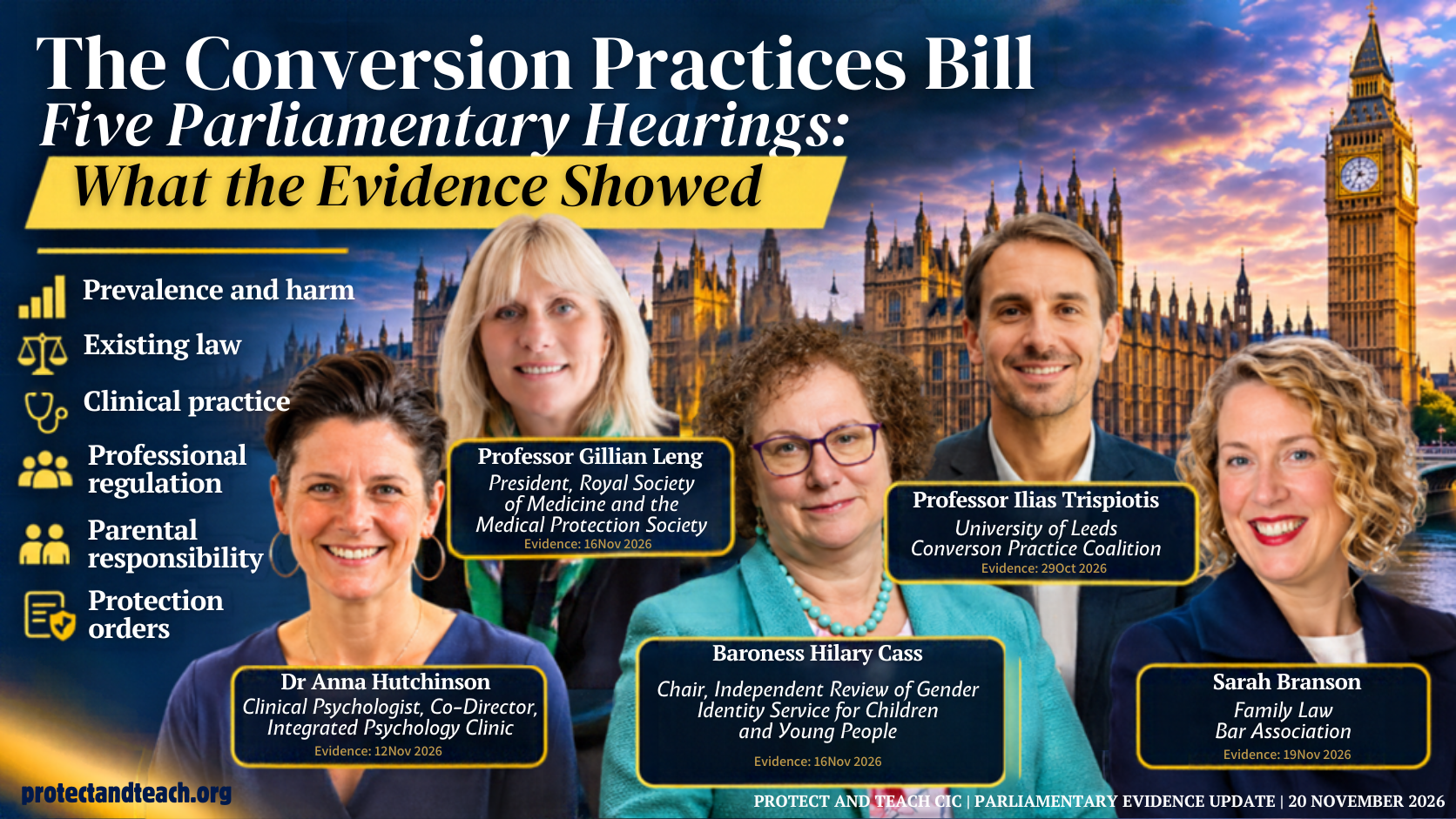
Protect and Teach CIC | Parliamentary Evidence Update | 20 November 2026
In September 2026, Protect and Teach CIC published a 769-page evidence review of the Draft Conversion Practices Bill (England and Wales). Following five parliamentary oral evidence sessions between 29 October and 19 November, we examine what witnesses actually established, whether the evidence addressed the deficiencies identified in our original report, and which questions Parliament has still not answered.
Introduction: the missing evidence of legislative necessity
When Protect and Teach CIC published its evidence review in September 2026, our central conclusion was clear: the Government had not demonstrated the necessity of creating a new criminal offence.
Our concern was not that serious abuse should go unpunished. Violence, sexual abuse, unlawful threats, coercion and other conduct satisfying existing criminal offences are already prohibited, regardless of the perpetrator’s beliefs or motivations. The issue was whether the Government had demonstrated a material category of serious abusive conduct that existing criminal, civil, family-law, safeguarding and regulatory mechanisms could not adequately address.
Our report examined the proposed legislation, the Government’s supporting evidence, existing legal protections, human-rights considerations, clinical practice, parental responsibilities and the proposed Conversion Practice Protection Orders (CPPOs).
Particular attention was given to two questions:
- Appendix B (pp. 702–720): What precisely is the alleged gap in existing law, and has the Government demonstrated it through identifiable cases?
- Appendix C (pp. 721–741): Does the evidence establish the prevalence, seriousness, causation and preventability of conduct that would satisfy the proposed offence?
Our answers to those questions led to our recommendation that the Bill should be withdrawn, and that Parliament should reject its offences and protection orders in their entirety and not replace them with a substantially similar identity-specific scheme.
Since publication, Parliament’s Joint Committee on the Draft Conversion Practices Bill has held five oral evidence sessions, hearing from campaigning organisations, individuals describing personal experiences, clinicians, professional regulators, a parents’ charity, an independent social researcher and family-law specialists. Those hearings offered an important opportunity to test the Government’s case.
The purpose of this update is not to repeat our September arguments. It is to establish whether the subsequent evidence answered them. Our conclusion, having examined the hearings, is that the central evidential deficiencies remain.
1. Prevalence and harm: did Parliament receive the missing evidence?
What our September report established
The Government’s Draft Final Stage Impact Assessment estimated that approximately 75,000–93,000 people annually in England and Wales experience conversion practices. Our report (Chapter 6, section 6.5.2, and Appendix C) examined how that estimate was constructed.
The calculation drew upon a 2024 Opinium survey, commissioned by Stonewall, of 2,000 LGBT+ adults across England, Scotland and Wales. The Government selected two reported categories, being told to ingest ‘purifying’ substances and being given ‘pseudo-scientific counselling sessions’, and added their percentages to produce a central rate of approximately 4.7%. An adjustment of plus or minus 0.5 percentage points produced a range of 4.2%–5.2%, which was then applied to the 2021 Census estimate of 1,784,842 LGBT+ people in England and Wales.
The resulting figure was therefore a modelled estimate, not an observed count of offences, victims of criminal conduct, police reports or prosecutions. The impact assessment itself acknowledged the absence of robust and representative prevalence estimates for conversion practices.
Our analysis identified several methodological deficiencies. The underlying survey covered three nations, whereas the Bill concerns England and Wales. Respondents could select multiple categories, but the published calculation did not demonstrate the overlap between the two selected categories. The Government stated that overlap had been minimised without supplying the underlying calculation. The adjustment around the central rate was not presented as a conventional confidence interval derived from the survey’s sampling characteristics.
Most importantly, the survey did not establish whether the reported experiences met all the elements of the proposed criminal offence: the specified intention, conduct amounting to abuse and the serious consequence required by the Bill.
Our report also examined the Government’s projected economic benefits. The impact assessment estimated approximately £783 million in benefits over ten years, £60 million in costs and £724 million in net present social value. We identified substantial assumptions concerning the prevalence of relevant conduct, the proportion of adverse mental-health outcomes attributable to it, the effectiveness of criminalisation and the extent of any unintended consequences.
Reported experiences, population prevalence, criminal conduct, causation and the effectiveness of legislation are different evidential propositions.
What did the parliamentary evidence establish?
The 29 October hearing provided an opportunity to test whether organisations advocating for the Bill could substantiate the claims questioned in September. The central evidential gap remained.
Stonewall (Q2) cited the Government’s National LGBT Survey, which reported that 5% of respondents had been offered conversion practices and 2% had undergone them. It also introduced new YouGov polling of approximately 3,500 LGBT adults, reporting that 4% had been offered conversion practices and 1% had undergone them. Neither set of headline figures established how many experiences satisfied the proposed offence’s requirements concerning intention, abuse and serious consequences, nor how many involved conduct not already covered by existing law.
Witnesses on later panels raised similar questions about the data. Dr Anna Hutchinson, clinical psychologist, noted on 12 November that the survey did not define conversion practices and relied on self-reporting, leaving uncertainty about what respondents had actually experienced (Q103). Independent social researcher Matilda Gosling told the Committee on 19 November that some prevalence research cited alongside the Bill had not defined conversion practices, and questioned where the gap in existing law lay (Q236).
Galop (Q3) described cases involving alleged physical mistreatment, restrictions on freedom, threatened homelessness and failures in safeguarding responses. These accounts warrant appropriate investigation and intervention. However, they were not accompanied by a systematic analysis demonstrating why existing criminal offences, family-law protections or safeguarding powers could not address the conduct.
One account was particularly revealing. Galop described a young lesbian woman who, it said, was forced to bathe in holy water, publicly shamed and dragged along a church floor, physically abused by her parents and left homeless. Galop said social workers failed to recognise the circumstances as conversion practices and advised that she return to her extended family.
If accurately reported, this raises serious questions about the recognition of abuse and the adequacy of the safeguarding response. The physical mistreatment described was also capable of engaging existing criminal law. On the second panel, Helen Joyce of Sex Matters pointed to assault as an obvious consideration (Q50).
Would creating a new criminal offence remedy a failure by professionals to recognise and respond to conduct already capable of intervention? A failure of implementation is not automatically evidence of a gap in the law.
Professor Ilias Trispiotis, representing the Ban Conversion Practices Coalition, argued that conversion practices fall between existing criminal offences (Q4). However, identifying limitations in individual offences does not establish that the same conduct is lawful under the wider legal framework.
The hearing also exposed an important weakness in claims about the Bill’s likely effectiveness. Asked about other jurisdictions, Professor Trispiotis acknowledged that there had been few prosecutions and that reliable numbers were difficult to obtain (Q4). That does not establish that those laws have failed. But neither does it demonstrate that criminalisation has reduced prevalence or prevented the conduct.
Of particular concern, the Committee also heard arguments for widening the proposed offence. At Q10–13, Professor Trispiotis challenged the distinction between abusive and non-abusive conversion practices, arguing that conversion practices were inherently abusive and that the separate abuse requirement was unnecessary. He maintained that removing it would not lower the criminal threshold. That proposal did not answer our September concerns about the breadth and certainty of criminal liability. Instead, it raised the possibility of removing a limiting requirement from the offence before the necessity of the offence as drafted had been demonstrated.
The Committee heard further personal testimony at the 2 November hearing from Deputy Jayne Ozanne and Ian Smith. Such accounts can provide evidence of individual experiences. They cannot, without appropriate methodology, establish national prevalence, legal classification or the causal effect of the proposed legislation.
What remains unanswered?
The hearings did not establish:
- A reliable prevalence figure for conduct satisfying the proposed offence.
- The proportion of reported experiences already covered by existing criminal or protective law.
- The proportion of adverse outcomes causally attributable to conduct meeting the statutory definition.
- The number of incidents likely to be prevented by the legislation.
- Demonstrated evidence that comparable criminal offences have produced the anticipated safeguarding benefits.
These are the questions identified in Appendix C of our September report.
Evidence that harm occurs is not, without further analysis, evidence that this particular criminal offence is necessary or effective.
2. Existing law: did witnesses identify the missing criminal offence?
What our September report established
Appendix B examined the principal criminal, civil, family-law, safeguarding and regulatory mechanisms already available. These included offences relating to assault, sexual abuse, harassment, threats, false imprisonment, child cruelty and controlling or coercive behaviour, alongside protective family-law remedies and professional regulation.
Our report did not claim that every harmful or distressing interaction is criminal. It acknowledged that individual legal mechanisms have different thresholds and limitations. For example, controlling or coercive behaviour has statutory relationship requirements, and harassment generally requires a course of conduct. But those limitations must be examined within the legal framework as a whole.
A gap in one offence is not proof that the conduct falls outside every other offence or protective mechanism.
Our report therefore proposed a case-by-case test (Appendix B, B.12). For each alleged gap, the Government should identify the conduct, the relationship between the parties, the person’s age and vulnerability, the harm caused, the evidence available and the existing legal mechanisms considered. It should then explain why those mechanisms were inadequate, whether the failure concerned law or implementation, and how the proposed offence would produce a better and proportionate outcome. Appendix B concluded that the Government had not supplied that analysis.
What the 29 October evidence added
Professor Trispiotis identified limitations in existing legislation (Q5), including the relationship requirements of the controlling-or-coercive-behaviour offence and the scope of harassment and hate-crime provisions. These are limitations affecting particular laws. The evidence did not demonstrate that serious conduct satisfying the proposed Bill would necessarily escape the combined protection of existing offences and remedies.
On the second panel, Dennis Kavanagh of the Gay Men’s Network argued that “it would be better to look at the laws that we already have” and, “where there are gaps”, to make “targeted responses to existing legislation” (Q50). Helen Joyce suggested that “there may be a problem with the police not understanding the laws that they already can use” (Q50).
There is a fundamental distinction between:
- Conduct that existing law does not adequately prohibit or address.
- Conduct that existing law prohibits or addresses, but which is not reported, recognised, investigated or acted upon effectively.
Only the first establishes a potential substantive legal gap. The second may require improved professional training, reporting, safeguarding procedures, access to remedies or enforcement. A new offence cannot be assumed to resolve those problems.
What the 19 November evidence added
At the 19 November hearing, Lord Scriven put a hypothetical case to Sarah Branson of the Family Law Bar Association (Q205): parents subjecting their 14-year-old gay son to “repeated deliverance sessions, sleep deprivation and isolation from friends”.
Branson answered: “Yes. That would constitute, in my view, significant harm attributable to the care provided by the parents”, giving the court jurisdiction to make care or supervision orders. This matters because the example involved serious alleged mistreatment of a child, precisely the type of conduct Parliament should seek to prevent. Yet existing family-law intervention could already be engaged.
The discussion then turned to a different scenario (Q206): parents planning to send their 15-year-old abroad for a conversion programme. Branson said that existing family law has no injunctions “to prevent certain practices”, although the High Court’s inherent jurisdiction can be used “to prevent significant harm”. She had “not seen any examples of that”, and said that “if the policy decision that those practices need to be outlawed is made”, there is “a gap” around preventive orders.
That is a narrow point about preventive remedies, and Branson framed it as conditional on a policy decision that is for Parliament. It is not evidence that the principal criminal offence is necessary. A possible limitation in the availability or design of preventive remedies should be assessed on its own terms. It should not be used as an unexamined justification for a wider criminal offence.
Comparison with September
The 29 October and 19 November evidence identified limitations in particular legal mechanisms but did not demonstrate a material category of serious abusive conduct satisfying the proposed offence that falls outside the combined protection of existing criminal, civil, family-law and safeguarding provisions.
The hearings did not provide the case-by-case legal-gap analysis requested in Appendix B of our September report. The central claim of legislative necessity therefore remains unsubstantiated.
3. The 12 November evidence: clinical practice and professional uncertainty
What our September report identified
Our September analysis examined whether the proposed legislation sufficiently protected legitimate clinical exploration, professional judgement and appropriate care. The concern was particularly important where children and young people present with complex needs, including gender-related distress, mental-health difficulties, neurodevelopmental conditions or safeguarding concerns.
The Cass Review had emphasised the importance of appropriate assessment and therapeutic exploration without predetermined outcomes. Our report questioned whether the Bill provided sufficiently clear boundaries between prohibited conduct and legitimate clinical practice.
What Parliament heard
The 12 November evidence did not present a settled professional position.
Dr Igi Moon (Chair, Memorandum of Understanding on Conversion Therapies) and Dr Alison Berner (President, British Association of Gender Identity Specialists) supported the Bill and its healthcare exemption. Dr Moon said that in her view the Bill would not chill therapists “because of the regulatory standards” (Q85). Both said much would depend on regulation and guidance; Dr Berner said “the devil will be in the detail of the guidance” (Q97).
Dr Anna Hutchinson warned that “everyday practitioners on the frontline would have to be taken to court in order to work out what the definition of the abuse is” (Q112), and that “the Bill will mean that clinicians will not want to work in the field, which will expose young people who are questioning their gender to substandard care” (Q122).
Dr Lisa Morrison, Chief Regulation and Standards Officer at the British Association for Counselling and Psychotherapy, said that ordinary parenting, family discussions and pastoral conversations “do not in themselves constitute conversion practices”, but that this “is possibly something that needs greater exploration in the draft Bill” (Q126).
The important distinction is between what legislation may ultimately be interpreted to permit and how professionals may respond to uncertainty before that interpretation is established. A clinician does not need to be convicted for uncertainty about possible complaints, investigation or criminal liability to affect professional practice.
Did this resolve our September concerns?
No. The hearing demonstrated disagreement about whether the proposed safeguards would be sufficient. It did not establish that legitimate therapeutic exploration would inevitably be criminalised, and we do not claim that. But neither did it establish that the statutory language provides the certainty required for professionals undertaking complex clinical assessments. The burden remains on those proposing criminal legislation to explain clearly how legitimate professional practice will be protected.
4. The 16 November evidence: Cass, Leng and the regulators
The 16 November hearing provided some of the most significant evidence relevant to our September findings.
Baroness Hilary Cass
Our report had examined the relationship between the proposed legislation and the findings of the Cass Review, particularly the importance of careful clinical assessment and open-ended exploration.
Baroness Cass explained that her earlier supportive comments had been based on the principles the then Minister described to her, because she had not seen the Bill: it was sent to her “about 15 minutes before they wanted the press comment” (Q128). Having now studied it, she said: “I unfortunately do not think that it is anywhere near tight enough to avoid serious unintended consequences” (Q128).
Asked directly, “Do you support this Bill as drafted?”, she answered: “No”, adding: “I cannot support the Bill in its current form” (Q149).
Baroness Cass was clear that she remains “supportive of trying to do something about conversion practices” (Q149). Her objection was to the drafting and its consequences for care, not to action of any kind. Her evidence nonetheless strongly supports the concerns we raised in September about legal certainty and the protection of legitimate clinical exploration. Asked whether, even with statutory guidance, there would be “a real chilling effect from the very fact of passing legislation”, she replied: “Yes, I am afraid so” (Q140).
Professor Gillian Leng
Professor Gillian Leng (President, Royal Society of Medicine, and President, Medical Protection Society) said that clinicians must “feel absolutely empowered to have open, honest conversations” (Q139). On whether healthcare is where the problem lies, she said conversion practice in healthcare “is rare and rogue, and there are already ways of dealing with healthcare professionals who cross that line” (Q148).
The regulators
The Committee heard from Dr Arun Chopra (Care Quality Commission), Andrew Smith (Health and Care Professions Council) and Mark Swindells (General Medical Council).
They described existing professional standards and fitness-to-practise processes. On complaints in this area, Andrew Smith said “the numbers are very low at the moment” and “we have not seen numbers of referrals so far in this area” (Q176). All three said it was difficult to predict how complaints would change if the Bill passed (Q176).
The limits of regulation that were raised concerned practitioners outside statutory regulation. Professor Leng said a solution for unregulated practitioners “is probably cross-cutting, not just about this” (Q154). Regulatory limitations of that kind may justify examining the adequacy of oversight. They do not, by themselves, demonstrate the necessity of a broad criminal offence.
Comparison with September
Baroness Cass’s position was particularly significant because it showed that concerns about the draft were not confined to organisations opposing the legislation on wider policy grounds.
The evidence corroborated substantial aspects of our September analysis, and did not establish that the proposed offence would improve clinical protection or resolve existing regulatory limitations.
5. The 19 November evidence: family law, parental responsibility and legal certainty
The 19 November hearing examined the proposed legislation through the practical experience of family-law professionals. Our September report had warned that uncertain statutory language could affect ordinary parenting, safeguarding decisions and professional responsibilities. The hearing brought those concerns into sharper focus.
Unfamiliar legal thresholds
At Q189, Sarah Branson said the Bill’s language “is not language that I recognise as a family lawyer”. Family courts work to the “significant harm” threshold in section 31 of the Children Act 1989, and she did not know “whether the test is less or more than evidence of ‘significant harm’”.
At Q203–204, Branson said: “‘Abusive’ is doing quite a lot of heavy lifting, but it is not clearly defined”. She added: “We as lawyers say, ‘What did Parliament intend?‘ Well, it looks as if Parliament intended for someone else to define what ‘abusive’ means.”
Shabana Jaffar, Head of Legal at Cafcass, agreed: the terminology is “very unfamiliar to family practitioners” and the definitions are “quite wide in some aspects and subject to interpretation” (Q204).
Where legislation may affect family relationships, professional interventions and criminal liability, uncertainty over the applicable threshold has practical consequences.
Ordinary family discussions
At Q211, Shabana Jaffar told the Committee that “The natural discussions that would take place within families could potentially be prohibited or controlled in some way because parents are worried about falling within the definition of exerting unreasonable controls over the views their children may be expressing.”
Sarah Branson asked why, if open-ended exploration, assessment and advice are not meant to be prohibited, the Bill does not say so: “It is fixable, isn’t it? It is about how it is drafted” (Q211).
When Lord Isaac pointed out that the offence has three hurdles (Q212–214), Branson replied that “the chilling effect is about unintended consequences”: “If the effect on the individual is that they feel like they cannot do their job, then make it clearer” (Q214). That distinction, between what a conviction requires and what uncertainty does to ordinary behaviour, was central to our September concerns.
Parents routinely make decisions involving boundaries, household expectations, financial support, medical appointments, education and the welfare of their children. Those decisions may involve disagreement, and sensitive questions about sexuality, gender identity, relationships or religious beliefs. Disagreement is not automatically abuse. Nor should an ordinary parental decision become a potential criminal matter merely because it conflicts with a child’s stated understanding of identity.
Not every witness agreed. Des Johnson of FFLAG, a charity supporting parents of LGBT+ people, said there is “nothing in this Bill” that “should have a chilling effect on messy, cautious parenting” (Q214).
But he offered no evidence that the drafting gives parents and professionals the certainty the lawyers said was missing.
What about ordinary parenting decisions?
The Committee explored this further at Q217–225, examining how the proposed offence might apply to ordinary parental decisions.
Sarah Branson discussed examples including restricting screen time, setting household boundaries and withdrawing pocket money. Such decisions can involve emotional or financial pressure, depending on the circumstances, but they are also familiar aspects of parenting.
The concern was not that these decisions would automatically constitute criminal offences. It was whether the Bill sufficiently distinguished ordinary parental authority, including decisions a child might find upsetting, from conduct intended to cause serious harm.
The Committee also considered whether parents who did not affirm a child’s stated gender identity might face investigation. The discussion did not establish that such parents would be committing an offence. It did, however, expose uncertainty about how allegations might be assessed before the criminal threshold was determined.
The distinction matters: a high threshold for conviction does not necessarily prevent uncertainty, allegations or investigations affecting lawful parental decisions.
Children and criminal liability
At Q247, the Chair, Lord Hope, raised the application of the proposed offence to children. Branson noted that the age of criminal responsibility is 10 and said: “It is up to you to make a policy decision about whether you expect 10 and 11-year-olds to be criminalised as a result of trying to change. If you do not, then you need to make it clearer. It is not clear and it probably needs to be.” Jaffar added: “The Bill as drafted is currently silent on the potential consequences for a child in that scenario and that is a concern.”
This is a particularly serious drafting issue. If Parliament does not intend ordinary interactions between children to fall within the criminal framework, that intention should be clearly reflected in the legislation rather than left to assumption.
Comparison with September
The family-law evidence substantially corroborated concerns identified in our report about legal certainty, parental responsibility, safeguarding practice and the consequences of uncertain statutory language. As Branson put it: “the fact that we are debating what the Bill means and what it says, and we are lawyers, means that it should be made clearer” (Q248).
The question is not simply whether Parliament intends to criminalise ordinary family conversations. It is whether the legislation clearly prevents those conversations and lawful parental decisions from being drawn into criminal processes. The 19 November evidence did not establish that the drafting provides that certainty.
6. Protection orders: preventive intervention requires separate justification
Our September report examined the proposed Conversion Practice Protection Orders separately from the principal criminal offence. This distinction is essential. The proposed offence requires proof of specified criminal elements. A preventive order operates differently: it restricts conduct in anticipation of potential harm, and does not necessarily require a conviction for the principal offence.
Existing law already contains preventive mechanisms, including forced-marriage protection orders, female genital mutilation protection orders and non-molestation orders. The issue is therefore not whether preventive orders can ever be justified. It is whether this particular framework is necessary, sufficiently defined and proportionate.
What the hearings added
On 19 November, Branson and Jaffar discussed how the proposed orders might operate in family proceedings (Q238–245). Branson proposed that the leave requirement for applicants be tightened along the lines of section 91(14) of the Children Act to deal with vexatious claims (Q238). Jaffar warned that “children may be brought into yet another aspect of a parental dispute” (Q239). Branson said the Bill’s provision allowing a non-party to appeal “does not make any sense to me” (Q245).
Branson also identified a possible protective benefit. From her experience of FGM orders, she said preventive orders can sometimes keep a child safely at home instead of removing them into care (Q243–244). That point is relevant and should be acknowledged. But it does not answer whether the proposed CPPO framework is necessary or appropriately drafted, and it does not establish that the principal criminal offence is justified.
If Parliament identifies a specific deficiency in existing preventive powers, that deficiency should be demonstrated and addressed directly, through general, conduct-based law, not by building an identity-specific scheme. It should not become a substitute for proving the necessity of a broader criminal offence.
A potential argument for a narrowly targeted preventive remedy is not evidence that the proposed criminal offence and associated CPPO framework should proceed.
7. September findings compared with parliamentary evidence
The following table summarises the principal findings of our September review and the evidence heard during the five parliamentary sessions. It is an assessment by Protect and Teach CIC, not a statement of findings formally adopted by the Joint Committee.
| Issue examined in September | What Parliament subsequently heard | Protect and Teach CIC’s assessment |
|---|---|---|
| Legislative necessity — No demonstrated material gap requiring a new criminal offence. | Witnesses identified limitations in particular mechanisms but did not supply a complete case demonstrating the necessity of the proposed offence. | Legislative necessity not demonstrated |
| Prevalence — Government estimates did not measure conduct satisfying the criminal threshold. | Additional polling and testimony did not establish a reliable figure for conduct meeting all elements of the proposed offence. The impact assessment acknowledged the absence of robust prevalence estimates. | Statutory prevalence not established |
| Harm and causation — Reported harm and statistical associations did not establish the causal assumptions used in the impact assessment. | Personal testimony added descriptions of harm but did not validate the Government’s causal or prevention estimates. | Causal and preventive effects not demonstrated |
| Existing criminal law — Serious abuse is already capable of intervention under multiple existing mechanisms. | Individual legal limitations were discussed. Branson confirmed that a serious hypothetical case could engage the significant-harm framework (Q205). | September finding not displaced |
| Safeguarding failures — Poor recognition or enforcement must be distinguished from deficiencies in legislation. | Galop’s testimony included an alleged failure by social workers to respond appropriately to serious mistreatment. | Concern reinforced |
| Clinical exploration — Unclear boundaries could discourage legitimate practice. | Clinical witnesses disagreed about the adequacy of the proposed safeguards. | Adequacy of statutory safeguards not established |
| Cass Review — Open-ended exploration and appropriate care require clear protection. | Baroness Cass said she could not support the Bill in its current form (Q149). | Concern corroborated |
| Professional regulation — Existing regulatory powers and their limitations must be examined before criminalisation. | Regulators described existing standards and low numbers of complaints. Professor Leng described the problem in healthcare as rare and involving practitioners acting outside accepted standards. | Existing mechanisms identified; necessity of additional criminal law not demonstrated |
| Parental responsibility — Undefined concepts could affect lawful family decisions and conversations. | Branson and Jaffar raised practical concerns about family-law thresholds and statutory uncertainty, including ordinary parenting decisions (Q211–225). | Concern corroborated |
| Children and criminal liability — The scope of the offence requires clear limits. | Branson and Jaffar raised concerns about the lack of clarity concerning children of criminal-responsibility age (Q247). | Statutory protection not clarified |
| Protection orders — Preventive restrictions require separate justification and safeguards. | Family-law witnesses identified practical uncertainties and potential benefits but did not establish the necessity of the proposed framework. | Concerns corroborated; necessity not demonstrated |
| Effectiveness — The Government had not demonstrated that criminalisation would produce the projected benefits. | Limited prosecution data from other jurisdictions and further testimony did not establish a measurable preventive effect. | Preventive effectiveness not demonstrated |
What the comparison shows
The parliamentary evidence has provided further descriptions of reported mistreatment, identified practical limitations in existing mechanisms and exposed differences between professional witnesses. But it has not supplied the missing evidential chain identified in September:
What conduct is occurring? How frequently? What harm does it cause? Why can existing law not address it? How would the proposed offence improve protection?
These questions remain fundamental to the justification for criminal legislation. The hearings have not demonstrated that the Government’s original case satisfies them.
8. Conclusion: the September findings remain unanswered
Protect and Teach CIC’s September report concluded that the Government had not demonstrated the necessity of the Draft Conversion Practices Bill. Five parliamentary evidence sessions have now provided an opportunity to challenge that conclusion.
The Committee has heard accounts of serious mistreatment, arguments concerning limitations in existing law and evidence about professional practice, safeguarding and family relationships. Some of the most telling evidence came from witnesses who were not campaigning against the Bill: the author of the Cass Review, and family lawyers who told the Committee they were there neither to support nor oppose it.
Yet the fundamental deficiency remains.
Parliament has not been shown a material category of serious abusive conduct that requires conversion-specific criminal law, supported by evidence demonstrating why existing mechanisms are inadequate and how such a law would produce a better outcome.
Parents must be able to discuss difficult questions with their children. Clinicians must be able to undertake appropriate assessment and exploration. Teachers and safeguarding professionals must be able to exercise professional judgement. Individuals must remain free to express religious, philosophical and other beliefs, including disagreement. Those freedoms do not excuse violence, sexual abuse, unlawful threats or conduct satisfying other existing offences. But neither should the criminal law be extended into lawful conversations, beliefs and disagreement merely because they concern sexuality or gender identity.
Protect and Teach CIC therefore maintains the recommendation in our September report. The Draft Conversion Practices Bill should be withdrawn, and Parliament should reject its offences and Conversion Practice Protection Orders in their entirety. No conversion-specific legislation is needed, in this Bill or any replacement, and nothing in five sessions of evidence has shown otherwise.
Genuine abuse should be dealt with through clear, generally applicable, conduct-based law, properly enforced, whatever the beliefs, identities or motivations of those involved. If a specific gap in that general law is ever demonstrated, the answer is a targeted change to the general law, not a new identity-specific offence or order
The absence of evidence justifying this Bill is not an invitation to widen its definitions, remove limiting thresholds or create broader criminal liability. It is a reason to reject the proposed legislation.
Parliament must legislate against demonstrable abusive conduct, not make the criminal law a mechanism for enforcing agreement about contested beliefs or identity. That was the principle underlying our September review. The evidence presented to Parliament has not displaced it.
Follow the live parliamentary scrutiny
We are maintaining a live tracker of the Draft Conversion Practices Bill, including official Government and Parliament developments, Joint Committee scrutiny, unresolved questions, Protect & Teach publications and selected stakeholder evidence. View the Live Tracker
Sources and further reading
Protect and Teach CIC –The Draft Conversion Practices Bill (England and Wales): An Evidence Review and Policy Analysis, Policy Analysis Paper No. 1, September 2026, Version 1.0, 769 pages. Relevant sections include:
- Chapter 5 — Does Existing Law Already Criminalise the Harm? (p. 68)
- Chapter 6 — Evaluating the Evidence Base (p. 76)
- Chapter 7 — Legal, Safeguarding and Human Rights Consequences (p. 125)
- Chapter 8 — The Strongest Case for the Bill, and Why It Fails (p. 392)
- Chapter 9 — Final Findings and Parliamentary Recommendation (p. 662)
- Appendix B — Existing-Law and Claimed-Gap Matrix (pp. 702–720)
- Appendix C — Evidence and Methodology Audit (pp. 721–741)
Read the full September 2026 report (PDF)
UK Parliament – Joint Committee on the Draft Conversion Practices Bill
The following are official parliamentary oral evidence transcripts. Question numbers in this article refer to these records.
29 October 2026 — Session 1 (Q1–57) Stephen Kiely (Stonewall), Kai O’Doherty (Galop), Professor Ilias Trispiotis (Ban Conversion Practices Coalition); Dennis Kavanagh (Gay Men’s Network), Helen Joyce (Sex Matters) and Dermot Kehoe (LGB Alliance). Read the 29 October transcript
2 November 2026 — Session 2 (Q58–79) Deputy Jayne Ozanne OBE and Ian Smith. Read the 2 November transcript
12 November 2026 — Session 3 (Q80–126) Dr Igi Moon, Dr Alison Berner, Dr Lisa Morrison and Dr Anna Hutchinson. Read the 12 November transcript
16 November 2026 — Session 4 (Q127–187) Baroness Hilary Cass, Professor Gillian Leng, Dr Arun Chopra, Andrew Smith and Mark Swindells. Read the 16 November transcript
19 November 2026 — Session 5 (Q188–248) Des Johnson (FFLAG), Shabana Jaffar (Cafcass), Sarah Branson (Family Law Bar Association) and Matilda Gosling (independent social researcher). Read the 19 November transcript
HM Government
Draft Conversion Practices Bill and supporting documents, published 25 June 2026 and updated 1 September 2026. Includes the draft legislation, explanatory notes, Draft Final Stage Impact Assessment and Draft Equality Impact Assessment. Government publications — GOV.UK search Draft Conversion Practices Bill and supporting documents (published 25 June 2026, updated 1 September 2026): explanatory notes, Draft Final Stage Impact Assessment and Draft Equality Impact Assessment.
Source note
The parliamentary oral evidence transcripts were published initially as uncorrected evidence and may subsequently be amended. Witness testimony is distinguished throughout from independently established facts and the conclusions of Protect and Teach CIC.
The assessments and recommendations in this article are those of Protect and Teach CIC and should not be attributed to the Joint Committee or individual witnesses unless expressly stated.