
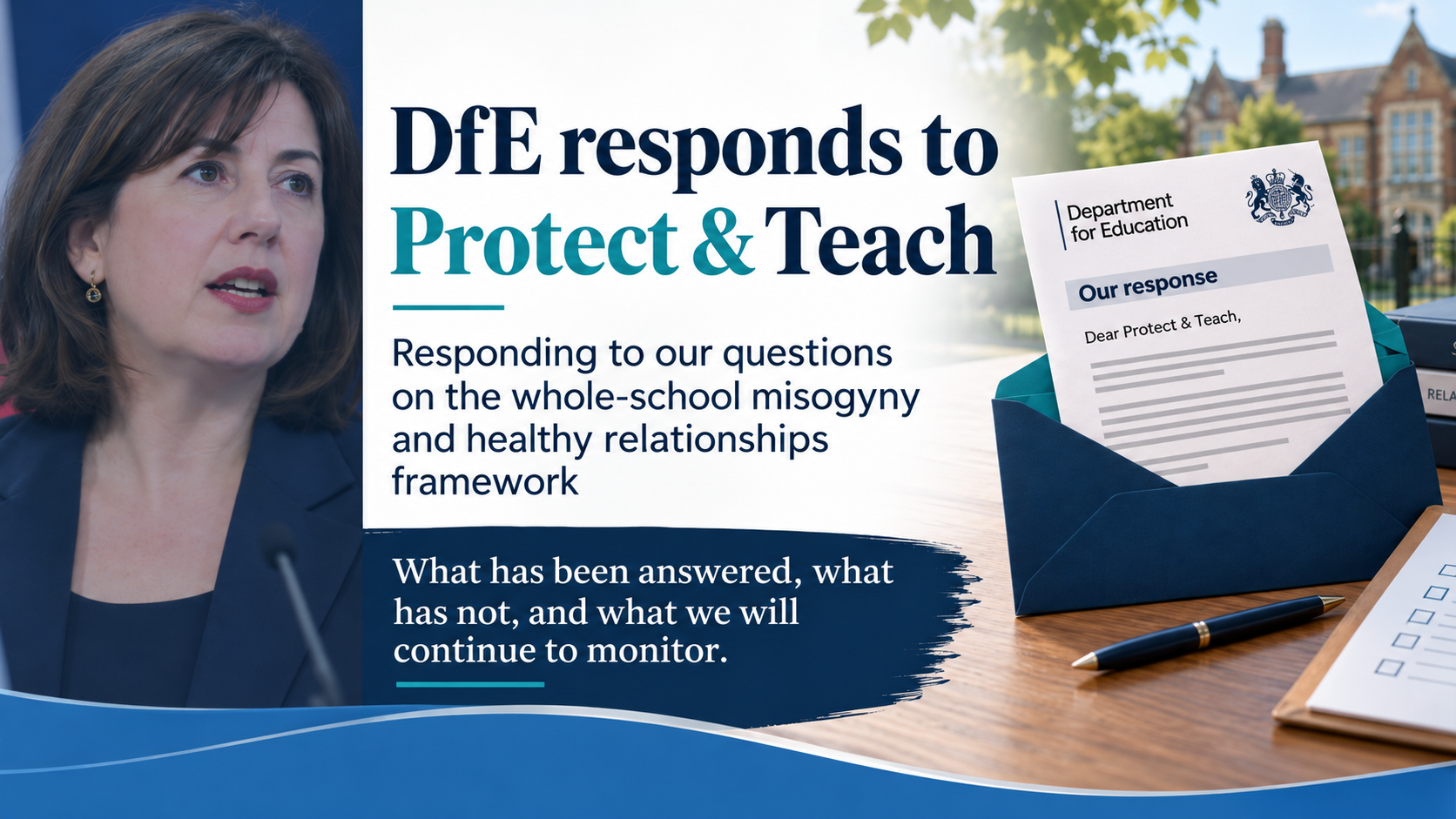
The Department for Education has confirmed that its proposed whole-school misogyny framework will not impose new statutory requirements, and that existing parental rights, safeguarding responsibilities and political impartiality duties continue to apply. However, information about operational definitions and the organisations selected to deliver publicly funded interventions remains withheld.
Protect and Teach CIC | 6 November 2026
On 29 September 2026, Protect and Teach CIC wrote to the Department for Education (DfE) seeking detailed clarification about the Government’s proposed whole-school approach to tackling misogyny and promoting healthy relationships in schools.
Our questions concerned the framework’s legal status, parental transparency, withdrawal rights, safeguarding, external organisations, political impartiality, the evidence supporting the policy, and the arrangements for publicly funded programmes involving children and young people.
On 4 November, we received a substantive response from Shreena Kotecha, Deputy Director of the DfE’s Counter-Extremism and Non-School Education Division.
The response provides several important assurances. It also identifies areas where decisions have not yet been finalised, information is not held by the Department, or disclosure has been refused under the Freedom of Information Act 2000.
Protect and Teach welcomes the clarification provided. Nevertheless, important questions remain about what schools will eventually be given, how materials will be implemented, who will deliver interventions, and how children and families will be protected.
Read the Department for Education’s response in full
For transparency, Protect and Teach CIC is publishing the Department’s response in full, enabling parents, educators, policymakers and other interested readers to examine the answers and explanations for themselves.
[Read or download the DfE’s response to Protect and Teach CIC – 4 November 2026 (PDF)]
Department for Education | Reference: 2026-0092157 | Signed by Shreena Kotecha, Deputy Director, Counter-Extremism and Non-School Education Division.
1. The framework will be optional, not a new statutory requirement
One of our principal questions concerned the legal and practical status of the proposed framework. The original announcement described an ambitious whole-school approach extending beyond classroom lessons into school culture, behaviour, safeguarding, pastoral support and other activities.
We asked whether schools would be required to implement the framework, whether it would constitute statutory or non-statutory guidance, and what additional obligations might arise.
The Department’s answer is explicit:
“The whole-school approach has not been designed as statutory or non-statutory government guidance, nor departmental advice.”
It further explains:
“Settings will be able to adapt and integrate some or all of the approach within their existing curriculum, training, and safeguarding arrangements.”
The DfE states that schools are not expected to create additional standalone teams or initiatives, or purchase programmes to use the resources. The approach is intended for settings covering Key Stages 2 to 5.
This is an important clarification. The framework is being developed as a flexible package of resources, rather than as an additional body of statutory requirements.
A separate parliamentary answer on 4 November reinforced this position. Responding to written question 30636 from Callum Anderson MP, Education Minister Georgia Gould confirmed that schools and colleges could choose whether to use the resources in full, in part or not at all. The Minister also confirmed that adopting the framework would not be a specific Ofsted inspection expectation.
Protect and Teach’s assessment
This substantially resolves our original question about whether schools would be compelled to adopt the framework.
However, optional resources can still exert considerable practical influence, particularly when they carry government endorsement and are promoted through established school systems.
It will therefore remain important to examine the final materials, how they are presented to school leaders, and whether their voluntary status is communicated clearly.
2. Existing RSHE guidance and parental rights remain in place
Our correspondence raised a concern about the movement of relationships and sex education content beyond identifiable RSHE lessons.
A whole-school approach may involve assemblies, mentoring, pastoral support, pupil-led activities, external visitors and behaviour interventions. This makes it particularly important that parents understand what is being taught, when and by whom.
The Department confirms:
“It is distinct from the statutory RSHE guidance and is not intended to replace or amend it.”
The response acknowledges that the revised RSHE statutory guidance came into effect on 1 September 2026 and that schools must have regard to it.
On parental transparency, the Department states:
“The RSHE statutory guidance is clear that schools should ensure that parents are able to view all curriculum materials used to teach RSHE on request.”
Crucially, it adds:
“This applies regardless of the context in which RSHE content is being delivered.”
That clarification is particularly significant.
Schools cannot simply treat RSHE content as outside the transparency arrangements because it happens to be delivered through an assembly, a wider initiative or another school activity.
The DfE also confirms that existing parental withdrawal provisions remain applicable wherever sex education is being taught.
It explains:
“The whole-school approach is not intended to duplicate the RSHE curriculum or to take sex education beyond RSHE lessons.”
What remains unresolved?
The Department has clarified the governing principles, but the practical distinction between RSHE content and other activities remains important.
- For example, how will schools identify the point at which an activity described as pastoral support, healthy-relationships work or safeguarding awareness is delivering RSHE content?
- How will parents receive advance information about sex education, and how will schools distinguish it from relationships education when activities overlap?
The DfE’s response gives schools a clear reminder of their existing obligations. It does not provide detailed operational examples explaining how those boundaries should be managed in the proposed framework.
Protect and Teach will assess whether the final resources provide sufficient clarity.
3. Boys must not be treated as a risk group simply because they are male
Protect and Teach also asked how the proposed approach would avoid stereotyping or stigmatising boys and young men.
Protecting children from harassment and abuse is an established safeguarding responsibility. Teaching pupils about respectful relationships, prejudice and misogyny also forms part of the statutory RSHE framework.
However, these responsibilities must not be used to justify policing pupils’ beliefs, treating legitimate disagreement as misconduct, or imposing interventions without clear definitions, reliable evidence and appropriate safeguards. Any intervention must distinguish between harmful conduct and assumptions made about pupils simply because of their sex.
The Department provides an important assurance:
“The whole-school approach does not identify boys as a risk group or assume problematic attitudes on the basis of sex.”
It further states:
“It explicitly recognises that most young people do not hold misogynistic beliefs and directs schools to focus on individual behaviours, attitudes and evidence rather than identity.”
The DfE says the approach also recognises challenges experienced by boys and young men, including stereotypes directed towards them.
Protect and Teach’s assessment
This is a welcome statement of principle. It recognises that boys should not be presumed to hold harmful beliefs, and that safeguarding and behavioural responses must be evidence-led and proportionate.
The key test will be whether the final classroom materials, staff guidance and targeted interventions reflect these assurances.
Particular care will be needed where programmes seek to identify emerging attitudes or behaviours among children aged 10 to 18.
4. The Department has not disclosed its proposed operational definitions
One of the most consequential outstanding matters concerns definitions. Our September letter asked how the framework would define misogyny, harmful attitudes, healthy relationships, belonging and negative online influences.
These terms matter because they may influence how teachers understand pupils’ words, behaviour, attitudes and relationships.
The Department states:
“The whole-school approach remains under development, and the final content has not yet been determined.”
It then explains:
“The information requested below is being withheld under section 35(1)(a) of the Freedom of Information Act 2000, which allows for the withholding of information if it relates to the formulation or development of government policy.”
The DfE argues that releasing emerging material before the review process is complete could inhibit development or create a misleading impression of settled government policy. It has applied the statutory public-interest test and concluded that the case for withholding the information presently outweighs the case for disclosure.
What can already be established?
The May 2026 Parent, Pupil and Learner Voice survey contains a published explanation of what respondents should understand by misogynistic comments: expressions of hatred towards girls and women, or a belief that boys and men are superior.
However, a survey definition is not necessarily the same as the operational definition that might eventually appear in guidance for school staff.
We therefore cannot assume that the Department has adopted that wording for classroom activities, behaviour interventions or safeguarding decisions.
Protect and Teach’s assessment
Schools need sufficient clarity to recognise genuine harassment and harmful behaviour without conflating them with legitimate discussion, disagreement, unpopular opinions or ordinary developmental challenges.
The distinction is particularly important when children are being encouraged to discuss relationships, social attitudes and potentially contested issues.
We recognise the Department’s explanation that its work is ongoing. We will monitor publication of the final materials and assess whether the definitions ultimately provided are clear, proportionate and appropriate for use with children.
At this stage, we are not pursuing a further FOI request or internal review. We will reconsider whether additional information is required if significant matters remain unresolved following publication.
5. Political impartiality applies beyond classroom lessons
Protect and Teach specifically asked whether the framework would address political impartiality, including when schools use external organisations.
The Department responds:
“The approach will not set out schools’ duties regarding political impartiality.”
However, it expressly confirms that existing duties continue to apply, including across teaching activities delivered beyond conventional lessons.
Its response identifies curriculum teaching, assemblies, enrichment, pastoral provision, behaviour interventions and external providers as contexts in which political-impartiality requirements remain relevant.
The Department also states:
“Schools remain responsible for ensuring that teaching, resources and external contributors are consistent with their legal obligations.”
Protect and Teach’s assessment
This is an important confirmation of the existing legal position.
Government-supported materials do not remove schools’ own responsibilities, nor does the involvement of an external organisation transfer those responsibilities away from school leaders and governing bodies.
Political impartiality does not prohibit schools from teaching pupils to respect others, recognise abuse or understand the law. It does require appropriate safeguards when political issues are presented or promoted.
The question for the final framework will be whether its resources adequately support schools in recognising and maintaining those distinctions.
6. External providers: existing safeguarding duties apply, but no additional framework-specific due diligence is proposed
The Department has also addressed our concerns about external organisations delivering educational activities.
It confirms:
“The whole-school approach does not set out expectations for schools to commission external organisations for provision and will therefore not include recommendations with regard to due diligence.”
It directs schools instead to their existing responsibilities under Keeping children safe in education.
This distinction matters. The optional whole-school framework is not itself intended to establish an external-provider commissioning programme.
Separately, however, the Government is funding interventions delivered through the Youth Endowment Fund.
Protect and Teach’s assessment
Existing safeguarding duties remain in force, but schools need to understand what appropriate due diligence looks like in practice.
This includes reviewing the suitability of materials, safeguarding arrangements, staff competence, handling of disclosures, parental information and any sensitive data collected.
Schools should also be satisfied that external content is accurate, age-appropriate and consistent with their legal responsibilities.
The Department’s answer establishes that existing duties continue. It does not provide a new, framework-specific assurance process for external providers.
We will examine the eventual resources and delivery arrangements to establish how these responsibilities are addressed.
7. The £16 million prevention programme: delivery organisations selected, but not yet named
The DfE confirms that its Violence Against Women and Girls (VAWG) Prevention Programme is supported by £16 million of combined Department for Education and Home Office funding.
The programme is administered through the Youth Endowment Fund (YEF), with work scheduled across the period July 2026 to March 2029.
It contains two broad objectives:
- Objective 1: Testing approaches to promote healthy and respectful relationships, including support for delivering updated RSHE.
- Objective 2: Testing targeted responses to emerging inappropriate or problematic attitudes and behaviours concerning gender norms and relationships.
Protect and Teach asked which organisations would deliver the interventions, which schools would participate and what programme content would be used.
The Department says that information about participating schools and programme content was not held by DfE following a search of its records.
It also confirms that delivery organisations have already been selected for Objective 1.
However, their identities have been withheld under section 22 of the Freedom of Information Act 2000, on the grounds that the information is intended for future publication.
The Department explains:
“While organisations have been selected to deliver pilots under Objective 1, the assessment process for Objective 2 is still ongoing.”
It says publishing the Objective 1 names separately would result in piecemeal disclosure before the wider programme arrangements are ready to be announced.
Protect and Teach’s assessment
The Department has established that delivery partners have been selected for part of the programme, but their identities remain unpublished.
This should not be confused with the claim that there are no selected providers, or that the names do not exist.
Nor should the fact that some information is not held by the Department be interpreted as evidence that delivery arrangements do not exist elsewhere.
Parents, schools and the wider public have a legitimate interest in knowing which organisations have been commissioned or funded to work with children, what interventions they will deliver and how their suitability has been assessed.
We will monitor the promised publication and examine the organisations and materials when the information becomes available.
8. What will happen to pupils’ data?
The DfE’s response directs readers to YEF’s published programme guidance and FAQs for information about evaluation and pupil data handling.
Those materials provide considerably more detail about the proposed research arrangements.
- YEF indicates that applicants may be required to participate in randomised controlled trials. Depending on the agreed evaluation design, schools, year groups or classes may be allocated to intervention and comparison groups.
- YEF also states that primary evaluation outcomes will relate to pupils, with teacher outcomes potentially included as secondary measures.
- According to its published FAQs, independent evaluators are responsible for appropriate data collection and secure storage, and evaluations require ethical approval.
- The FAQs further explain that pseudonymised data from YEF efficacy studies is transferred to its data archive for longer-term research.
- Pseudonymised data is not necessarily anonymous data. Appropriate data-protection arrangements therefore remain important.
What still requires clarification?
The publicly available general programme documentation does not, by itself, establish the final arrangements for every participating pilot.
In particular, Protect and Teach will look for confirmation of:
- The precise information collected from participating pupils, including whether sensitive personal information is involved.
- How parents and pupils will be informed about research participation, data use and any applicable consent or other participation requirements.
- The organisations responsible for determining the purposes and means of data processing.
- The safeguards governing retention, transfer, research reuse and access to pupil-level data.
- Procedures for identifying and responding to distress, harmful disclosures or other safeguarding concerns during evaluation.
- How adverse or unintended effects will be assessed alongside claimed benefits.
These are questions about planned safeguards, not allegations that YEF or participating organisations have breached data-protection law.
Protect and Teach considers transparent research governance especially important where interventions involve children, personal relationships, attitudes and sensitive safeguarding-related issues.
9. The proposed £150,000 RSHE advisory group: governance arrangements remain unfinished
The original Government announcement also included plans for a £150,000 RSHE advisory group and accompanying teacher-support arrangements.
Protect and Teach requested details of its membership, terms of reference, selection process, declarations of interest, remuneration, meeting arrangements and intended outputs.
The Department explains that the proposed group will advise on the areas where teachers most need practical support. It states that responsibility for commissioning, developing and quality-assuring resulting products will remain with DfE.
However, concerning the requested governance information, the Department responds:
“Following a search of the Department’s paper and electronic records, I have established that this information is not held by this Department.”
It adds:
“The arrangements for the Advisory Group are still under development.”
The Department intends to publish the group’s membership and terms of reference once arrangements have been finalised.
Protect and Teach’s assessment
The response does not establish that the advisory group has been cancelled, or that the proposed allocation has been withdrawn. It establishes that the requested governance information was not held by the Department at the time of its records search.
Given the group’s potential influence over resources used by teachers across England, its eventual composition, expertise, selection arrangements and declarations of interest will be matters of legitimate public interest.
We will revisit these questions when the Department publishes the promised details.
10. The headline statistics: the source is now confirmed
The DfE has identified the evidence behind the headline statistics cited in the original announcement.
The figures came from the May 2026 Parent, Pupil and Learner Voice survey, conducted between 13 and 20 May and published on 24 September 2026.
- The Department confirms that the sample for the figure concerning female pupils and learners hearing misogynistic comments was 1,926.
- The sample for the Key Stage 4 statistic concerning comments that caused concern about women’s and girls’ safety was 684.
- The published results show that 50% of female pupils and learners reported hearing comments they considered misogynistic on at least some days during the previous week.
- Among Key Stage 4 respondents, 30% reported hearing comments that made them worry about the safety of women and girls on at least some days during the same period.
- These figures describe pupils’ self-reported experiences of comments heard at school or college.
They are not direct measurements of the number of pupils committing abuse, nor evidence that a particular educational intervention will be effective.
Protect and Teach’s assessment
We welcome the Department’s identification of the original data and sample sizes.
The findings warrant serious attention. However, evidence of a problem and evidence that a proposed intervention will solve it are two separate questions.
A robust approach requires both accurate interpretation of the original research and independent evaluation of the responses adopted.
11. What has been resolved and what remains unanswered?
The Department’s response has resolved several important questions raised in our original correspondence.
- It has confirmed that the whole-school framework is optional, that it does not replace RSHE statutory guidance, and that existing parental transparency and withdrawal arrangements continue to apply.
- It has also confirmed that schools retain their political-impartiality and safeguarding responsibilities, that boys should not be presumed to present a risk because of their sex, and that the framework is not linked to new Ofsted or funding requirements.
- The source of the original survey statistics has been identified.
Nevertheless, the following matters require further scrutiny as the programme develops:
Operational definitions: The definitions that may inform the final framework have not been disclosed.
Final educational materials: The complete resources have not yet been published, so their content and consistency with the Department’s assurances cannot be fully assessed.
Delivery organisations: The selected Objective 1 providers have not yet been publicly identified.
Pilot content and participating settings: Details of particular programmes and schools remain outstanding.
Research and data protection: General YEF arrangements are published, but project-specific implementation and safeguards require examination.
RSHE advisory group: Membership, governance arrangements and the status of the proposed funding require confirmation.
Implementation: Schools will need sufficient clarity about parental transparency, external-provider oversight and the distinction between RSHE teaching and wider school activities.
12. Protect and Teach’s position: safeguarding requires evidence, transparency and accountability
Protect and Teach supports effective action to prevent sexual harassment, violence, exploitation and abuse.
Children and young people should be able to learn in environments where they are safe, treated with dignity and supported to develop healthy, respectful relationships.
However, safeguarding policy must be evidence-informed and its implementation must be proportionate, lawful and transparent.
The Government’s objectives do not remove the need to examine the methods by which they will be pursued.
Nor should legitimate scrutiny of educational resources, external providers, pupil data or parental involvement be mistaken for opposition to protecting children from harm.
The Department’s 4 November response provides welcome clarity on several points. Those assurances should now be reflected in the final materials and the arrangements governing their use.
Protect and Teach will continue to monitor publication of the whole-school framework, the RSHE advisory group’s governance details, the selected VAWG programme providers, participating schools, research safeguards and evaluation findings.
We will record the information withheld under the Freedom of Information Act 2000 and review whether further requests are necessary if important information remains unavailable when the relevant decisions and materials are published.
The central principle remains straightforward: protecting children requires more than good intentions. It requires clear definitions, appropriate safeguards, reliable evidence, accountable providers and informed parents.
Follow the live tracker
We are maintaining a live tracker of the Government’s whole-school misogyny and healthy relationships plan, including what has been confirmed, what remains unanswered, and what Protect & Teach has formally asked the Department for Education.
Sources and further reading
Protect and Teach CIC
- Our original correspondence to the Department for Education — 29 September 2026
- Department for Education response to Protect and Teach CIC, 4 November 2026, reference 2026-0092157, signed by Shreena Kotecha.
- Live tracker — The Education Secretary’s whole-school plan to tackle misogyny
Official Government and parliamentary sources
- UK Parliament — Written question 30636, answered 4 November 2026
- Department for Education — Parent, Pupil and Learner Voice: May 2026
- Department for Education — Relationships, Sex and Health Education statutory guidance
Youth Endowment Fund