
New departmental guidance addresses external providers, regulated activity, programme suitability, safeguarding disclosures, parental transparency and withdrawal from external activities.
27 November 2026 | Protect and Teach CIC
Who is responsible for checking the organisations that enter our children’s schools? Who assesses the materials they deliver? What happens if a child makes a safeguarding disclosure during an externally delivered programme? And what information should parents receive before their child participates?
These are questions that Protect and Teach CIC has been examining as part of its wider research into safeguarding, external educational providers and parental participation.
On 24 November 2026, the Northern Ireland Department of Education published updated guidance which directly addresses many of these issues.
The publication represents an important development not only for schools and families in Northern Ireland, but also for those examining safeguarding arrangements across the United Kingdom.
1. What has been published?
The Department of Education has published two documents:
- Circular 2026/22: Safer Recruitment and Pre Engagement Checks for People Working, Volunteering and Providing Commissioned Services in Schools, EOTAS centres, Early Years Settings, Youth Settings, Managing Authorities and other educational settings.
- Safeguarding Assurance for External Individuals and Organisations Engaged by Schools and Education Settings, incorporating an External Provider Safeguarding Assurance Checklist (listed on the Department’s publication page as “External Providers Invited Commissioned by Schools and Settings Directly – Safeguarding Checklist”). The checklist is a sample document that settings are invited to tailor to their own needs.
The circular replaces six previous departmental circulars (2006/07, 2006/25, 2012/19, 2013/01, 2024/10 and 2025/06) and reflects current safeguarding legislation and policy requirements.
The accompanying checklist focuses specifically on external individuals and organisations invited or commissioned directly by educational settings to work with children and young people. The circular should be considered alongside the wider Northern Ireland child protection and safeguarding framework issued under Circular 2026/17. The checklist document is to be read in conjunction with the circular.
2. The legislative change behind the guidance
On 1 September 2026, section 140 of the Crime and Policing Act 2026 came into force in Northern Ireland, under article 3 of the Crime and Policing (2026 Act) (Commencement No. 1) Order (Northern Ireland) 2026.
This amended Schedule 2 to the Safeguarding Vulnerable Groups (Northern Ireland) Order 2007, removing the previous supervision exemption from regulated activity involving children.
Protect and Teach previously examined the corresponding changes in England and Wales under section 139 of the same Act, which also came into force on 1 September 2026.
The Northern Ireland provisions operate through its own safeguarding legislation and AccessNI vetting arrangements.
What does regulated activity mean?
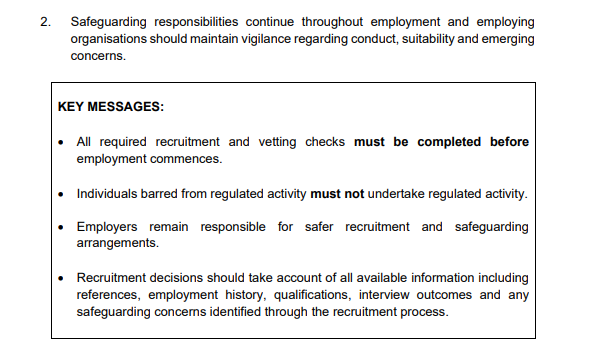
- Regulated activity is a legally defined category of work involving children or, under separate provisions, adults.
- An individual who is barred from regulated activity involving children must not undertake that activity.
- The nature of the work, frequency of contact, circumstances of delivery and other statutory criteria determine whether a particular role falls within the definition.
- Previously, certain activities undertaken under appropriate supervision could fall outside regulated activity because of the supervision exemption.
- That exemption has now been removed.
- Where the relevant statutory conditions are satisfied, the presence of a teacher or another member of staff no longer provides that exemption.
Does every visitor now require an enhanced AccessNI check?

No. The legislative change does not mean that every person entering a school automatically requires an enhanced criminal record check.
Schools must assess the actual activities being undertaken rather than relying solely on job titles, employment arrangements or whether someone will be supervised.
A person attending an occasional meeting, delivering supplies or visiting a school for an event may require different safeguarding arrangements from someone regularly teaching, instructing or supervising pupils. The circular says that visitors of that kind, such as people attending meetings or events or delivering goods, would not ordinarily be regarded as engaged in regulated activity, although their access should still be managed (Circular 2026/22, paragraphs 2.24 and 2.25).
Supervision remains an important safeguarding measure. It simply cannot be relied upon as the former exemption from regulated activity.
3. Which external organisations are covered?
The accompanying safeguarding checklist applies where a school or education setting directly arranges external provision involving children and young people.
The Department identifies examples of external roles which may require a school to use the checklist, including:
- Sports coaches, including those employed by the IFA, Ulster Rugby or the GAA;
- External tutors;
- Dance instructors;
- Health and wellbeing programme facilitators;
- Voluntary and community organisations delivering programmes to support the curriculum;
- Charities;
- Mentors;
- Youth workers not employed by the Education Authority;
- Other external personnel.
- The list is not exhaustive.
Importantly, the checklist distinguishes between organisations commissioned directly by schools and services arranged through statutory or managing authorities.
Services commissioned through the Education Authority, the Council for Catholic Maintained Schools or other public bodies, whose staff remain employed and managed by those bodies, for example Health and Social Care Trusts, the Public Health Agency, the PSNI or the Department for the Economy Careers Service, are not covered by this particular checklist.
This does not mean that those services are exempt from safeguarding requirements. Rather, different arrangements apply to recruitment, vetting and the provision of safeguarding assurance. The checklist notes that the Education Authority or CCMS will ensure that required checks are in place for external providers they contract directly, and that schools may wish to verify this. Circular 2026/22 deals with those arrangements separately.
Schools remain responsible for appropriate local safeguarding arrangements.
4. Safeguarding is about more than criminal record checks
One of the most important features of the new checklist is the distinction between the suitability of an individual and the suitability of the programme they are delivering.
An appropriate criminal record check is an important safeguarding measure, but it cannot establish whether every aspect of an educational programme is suitable for children.
A person may have undergone all the required vetting checks while the programme they deliver still requires careful examination.
Questions that follow from this distinction include:
- Is the content appropriate for the children involved?
- Does it comply with relevant educational and safeguarding requirements?
- Have children’s developmental needs and vulnerabilities been considered?
- Are appropriate arrangements in place if a child becomes distressed?
- Have the resources and methods of delivery been assessed?
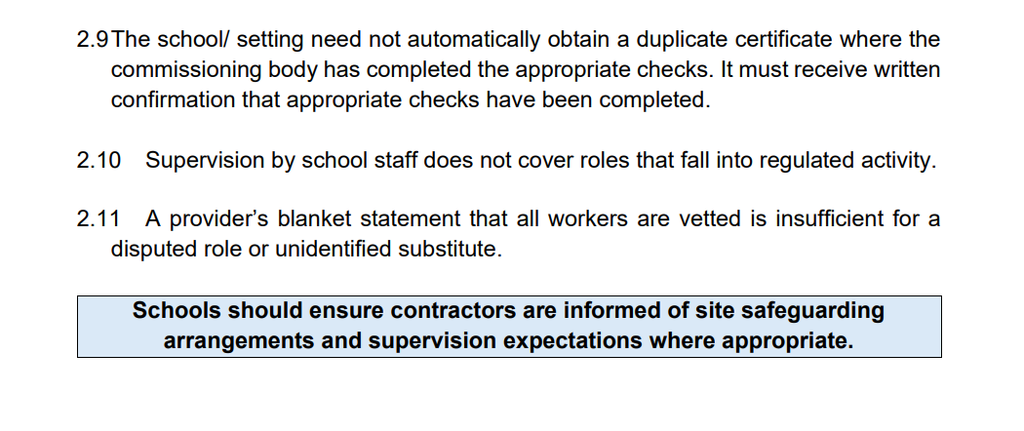
- Does the provider understand the school’s safeguarding procedures?
The Department’s guidance separates these considerations rather than treating vetting as sufficient evidence of overall suitability.
For Protect and Teach, this is a particularly important recognition of the wider preventative role of safeguarding.
Safeguarding must consider not only who is delivering a programme, but also what is being delivered, how it is delivered and what happens afterwards.
5. Schools should review existing external provision
The guidance is not limited to organisations that schools intend to engage in the future.
The Department also expects schools to review relevant existing arrangements involving recurring external provision that were in place before 1 September 2026, particularly where those arrangements previously relied on supervision to fall outside regulated activity. This matters because schools may have longstanding relationships with external organisations.
A provider may have delivered the same programme for several years. An organisation may have become a familiar part of the school calendar. Staff may have assumed that previously approved safeguarding arrangements remained sufficient.
However, a longstanding relationship does not remove the need to reconsider arrangements following a legislative change.
The checklist should also be reviewed where there is a material change, including changes to the provider or personnel, the nature, frequency or location of delivery, the age or needs of the pupils involved, or arrangements for one-to-one, online or unsupervised contact.
This moves safeguarding assurance beyond an initial approval decision towards continuing oversight.
6. Sensitive programmes and safeguarding disclosures
Perhaps one of the most significant aspects of the new guidance concerns programmes addressing sensitive subjects.
These include matters such as healthy relationships, domestic or sexual abuse, exploitation, mental health, suicide or self-harm, bullying, online harm, violence, substance use and other issues that may prompt children to disclose safeguarding concerns.
Such programmes may have considerable educational and preventative value.
However, they can also lead to children recognising experiences of harm, disclosing abuse, expressing distress or identifying concerns about their own safety or wellbeing.
Appropriate safeguarding arrangements must therefore be considered before delivery begins. Before delivery, the Department says that the setting and provider should agree arrangements for responding to disclosures, passing concerns promptly to the school’s Designated Teacher for Child Protection and ensuring that appropriate support or signposting is available. The checklist also says that the external person must not investigate concerns or promise confidentiality.
External organisations and separate reporting pathways
The guidance also addresses the risk of external providers operating their own safeguarding reporting arrangements separately from those of the school.
External providers should not bypass the school’s Designated Teacher arrangements unless this is legally required or forms part of an agreed statutory safeguarding pathway.
In Protect and Teach’s view, this distinction is particularly important where an external organisation delivers a school-based programme but also offers wider services, such as online support, mentoring or counselling.
The Department’s wording does not address independently accessed services, and it does not automatically establish that every independent service accessed by a child must report all confidential information to a school.
Different statutory, clinical and professional confidentiality obligations may apply to independently accessed services. Nevertheless, where an organisation is delivering provision within the scope of the Department’s external provider guidance, safeguarding responsibilities and reporting arrangements should be clearly established.
Children should not be left uncertain about who is responsible for their safety or what will happen if they disclose a concern.
7. Parental transparency and withdrawal from external activities
The Department’s accompanying guidance contains a particularly significant paragraph, under the heading “Alignment with Departmental Policies, Guidance and Statutory Obligations”, concerning communication with parents and carers.
It refers to a previous communication sent to schools on 2 September 2026, which it describes as outlining that any engagement of external organisations is undertaken in accordance with all relevant Departmental policies, guidance and statutory obligations.
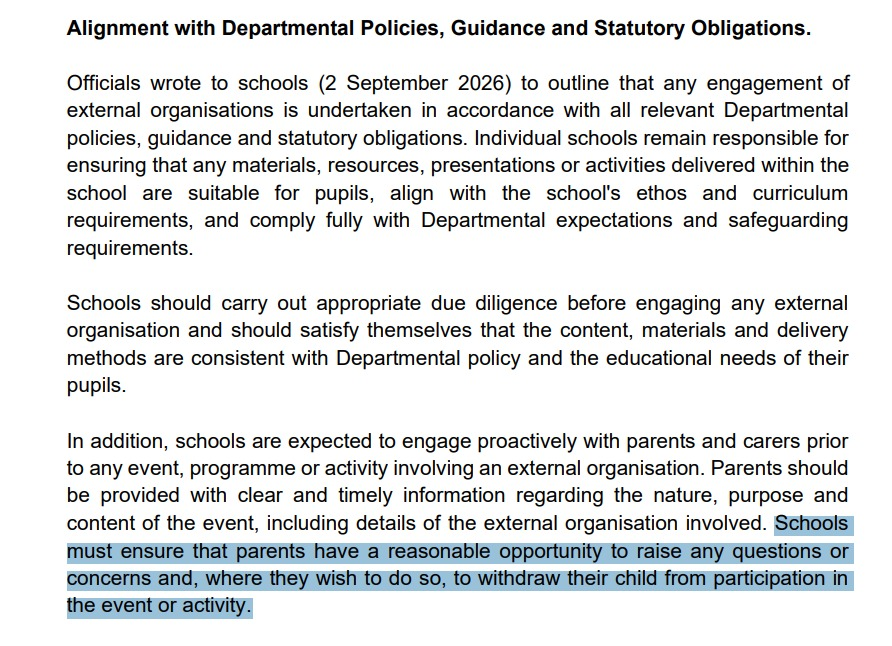
The November document also states that schools are expected to engage proactively with parents and carers before external organisations deliver events, programmes or activities.
Parents should receive clear and timely information identifying the organisation involved and explaining the nature, purpose and content of the activity.
The document also expressly states that schools must ensure that parents have a reasonable opportunity to raise any questions or concerns and, where they wish to do so, to: “withdraw their child from participation in the event or activity.” Safeguarding Assurance for External Individuals and Organisations Engaged by Schools and Education Settings, page 4 of the PDF.
This is an important distinction between informing parents and enabling meaningful parental participation. Information provided after an event has taken place cannot give parents the same opportunity to ask questions or make informed decisions beforehand.
Does this establish a general right to withdraw from the curriculum?
No. The provision concerns external events and activities within the scope of the departmental guidance. It should not be interpreted as creating an unrestricted statutory entitlement to withdraw a child from any compulsory curriculum subject.
The distinction between the curriculum itself and the involvement of a particular external organisation is important. The checklist document is departmental guidance, rather than legislation, and does not establish a new general statutory right to withdraw a child from compulsory curriculum subjects.
Separate statutory withdrawal provisions already exist in Northern Ireland. These include:
- The right of parents to withdraw their children from Religious Education and collective worship in grant-aided schools, addressed in Department of Education Circular 2026/09.
- Provisions under the Curriculum (Circumstances in which a Pupil may be Excused from Sexual and Reproductive Health and Rights Education) Regulations (Northern Ireland) 2023, allowing parents to request that pupils be excused from specified statutory content concerning sexual and reproductive health and rights at Key Stages 3 and 4.
These provisions should be distinguished from the Department’s November 2026 expectations concerning withdrawal from externally delivered events and activities.
Protect and Teach considers that further clarification would be valuable concerning how these arrangements operate where externally delivered programmes contribute to mandatory curriculum requirements.
8. Accountability does not transfer to an external organisation
Schools may engage external organisations because they provide specialist knowledge, additional resources or expertise that may not otherwise be available. Such contributions can be valuable. However, outsourcing the delivery of a programme does not remove the school’s safeguarding responsibilities.
The new guidance establishes a framework through which providers can be assessed, safeguarding assurances recorded and decisions made concerning approval.
The accompanying checklist provides for a decision of approved, approved subject to conditions or not approved, together with the recording of relevant conditions and a review date where required. Its introduction also refers to the option to defer a decision. The Department also says that the checklist is intended to support proportionate decision-making and should not result in the unnecessary cancellation of valuable external or voluntary provision.
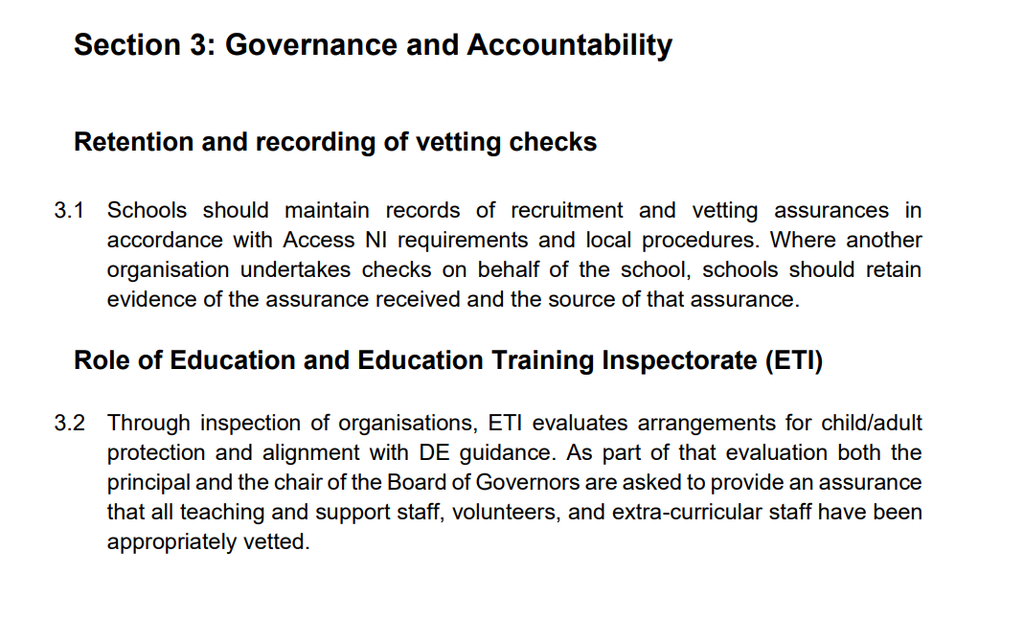
Boards of Governors should also obtain assurance that external providers are being assessed consistently, that the programme offered by the provider is in line with departmental policies and guidance, and that concerns arising during external provision are reported and acted upon.
This is an important governance issue. Governors do not need to personally deliver or assess every individual lesson. They do, however, need appropriate assurance that effective systems exist to assess and oversee external provision.
In Protect and Teach’s view, the reputation of a provider, its charitable status, its funding arrangements or its existing relationships with schools cannot substitute for appropriate safeguarding assurance.
9. What about external resources where nobody visits the school?
Protect and Teach’s wider research has identified that external influence within education is not limited to organisations physically entering school premises. Schools may also use externally produced lesson plans, online presentations, staff training packages, model policies, accreditation schemes and curriculum resources.
The new Northern Ireland checklist principally concerns external individuals and organisations working directly with children.
It should not therefore be assumed that every publisher, software company or supplier of teaching materials automatically falls within its scope.
However, the accompanying departmental guidance also reiterates schools’ wider responsibilities for the suitability of educational materials, resources and presentations. It says that individual schools remain responsible for ensuring that any materials, resources, presentations or activities delivered within the school are suitable for pupils (page 4 of the PDF).
This distinction raises an important question for our continuing research:
How are schools assessing external educational content when the organisation supplying it has little or no direct contact with pupils?
The absence of a visiting adult does not remove the need to examine the suitability of the material being delivered.
10. Implications for the rest of the United Kingdom
Education and safeguarding arrangements differ across England, Wales, Scotland and Northern Ireland.
- England operates under Keeping Children Safe in Education and its own statutory curriculum guidance.
- Wales has its Keeping Learners Safe framework and separate Relationships and Sexuality Education requirements.
- Scotland operates its own child protection framework, curriculum guidance and Protecting Vulnerable Groups (PVG) scheme.
- The Northern Ireland external provider checklist does not automatically apply in England, Wales or Scotland.
Sections 139 and 140 of the Crime and Policing Act 2026 apply to England and Wales and to Northern Ireland respectively. Scotland operates under its own separate disclosure and regulated roles framework.
Nevertheless, Northern Ireland’s external provider checklist provides a useful comparative example of how safeguarding assurance can be documented, particularly in relation to programme suitability, sensitive content, parental communication and recorded approval decisions.
Protect and Teach has previously raised questions with the Department for Education concerning external organisations, safeguarding and parental transparency in connection with England’s proposed whole-school framework addressing misogyny and healthy relationships.
The Northern Ireland guidance provides further material for examining how comparable issues are addressed across the four nations.
11. Further questions requiring clarification
Protect and Teach welcomes greater clarity concerning the responsibilities of schools and external providers. However, the publication of guidance is only one stage. Its implementation, consistency and effectiveness will also matter.
Questions that warrant further examination include:
- How will existing external providers be reassessed and within what timescales?
- How will schools demonstrate that sensitive programme content has been appropriately examined?
- How will parental withdrawal arrangements operate where external provision contributes to compulsory education?
- How will safeguarding arrangements apply to online programmes and subsequent contact between pupils and external organisations?
- What information will parents be able to obtain about completed provider assessments?
- How will governors and inspectors evaluate implementation?
- What action will follow where external provision is found to be unsuitable?
Circular 2026/22 also identifies host families and work experience placements as matters for separate guidance (paragraph 5).
Protect and Teach will consider these developments within its wider research into safeguarding, educational provision and the responsibilities of external organisations.
12. Practical support for parents and carers
Alongside this research, Protect and Teach CIC has developed a series of eight template letters to help parents and carers obtain information about external organisations and third-party educational resources.
Two templates have been prepared for each of the four UK nations:
- A general request for information about external organisations and resources.
- A targeted request concerning a named external organisation.
The letters reflect the different legal, educational and safeguarding frameworks across England, Wales, Scotland and Northern Ireland.
The Northern Ireland templates have been developed to reflect the Department of Education’s latest external provider guidance, including its provisions concerning programme suitability, safeguarding disclosures, parental notification and withdrawal from external activities.
The resources will be published shortly on the Protect and Teach website and are intended to support informed, constructive parental enquiries rather than presume wrongdoing by schools or external providers.
Protect and Teach’s position
External organisations can make valuable contributions to children’s education and wellbeing. The issue is not whether external organisations should be permitted to contribute. It is whether their involvement is subject to appropriate safeguarding assurance, educational scrutiny, transparent decision-making and meaningful parental communication.
Effective safeguarding requires more than checking the adults who enter a school. It requires examining the content children encounter, the circumstances in which it is delivered, the potential risks involved and the arrangements for responding when concerns arise.
The Northern Ireland Department of Education’s November 2026 publications provide a useful framework for examining those responsibilities. The next question is how consistently these expectations will be translated into practice.
Primary sources and further reading
1. Department of Education, Northern Ireland: Circular 2026/22 and External Provider Safeguarding Assurance Checklist, published 24 November 2026: https://www.education-ni.gov.uk/publications/circular-202622-safer-recruitment-and-pre-engagement-checks-people-working-volunteering-and-providing-commissioned-services-schools-eotas-centres-early-years-settings-youth-settings-managing-authorities-and-other-educational-settings
Direct link to Circular 2026/22 (PDF): https://www.education-ni.gov.uk/sites/default/files/2026-11/Circular%202026%2022%20Safer%20Recruitment%20and%20Pre%20Engagement%20Checks%20for%20People%20Working%2C%20Volunteering%20and%20Providing%20Commissioned%20Services%20in%20Schools_1.PDF
Direct link to Safeguarding Assurance for External Individuals and Organisations Engaged by Schools and Education Settings (PDF): https://www.education-ni.gov.uk/sites/default/files/2026-11/External%20Providers%20Invited%20Commissioned%20by%20Schools%20and%20Settings%20Directly%20-%20Safeguarding%20Checklist.PDF
2. Crime and Policing Act 2026: section 140: https://www.legislation.gov.uk/ukpga/2026/20/section/140
3. Crime and Policing Act 2026: section 139, England and Wales: https://www.legislation.gov.uk/ukpga/2026/20/section/139
4. The Crime and Policing (2026 Act) (Commencement No. 1) Order (Northern Ireland) 2026: https://www.legislation.gov.uk/nisr/2026/153
5. Safeguarding Vulnerable Groups (Northern Ireland) Order 2007: https://www.legislation.gov.uk/nisi/2007/1351/contents
6. Department of Education: Child Protection and Safeguarding in Education: https://www.education-ni.gov.uk/articles/child-protection-and-safeguarding-education
7. Department of Education, DE Circular 2026/17: Child Protection and Safeguarding in Education, Guidance for Schools and Education Settings, issued 27 August 2026: https://www.education-ni.gov.uk/publications/de-circular-202617-child-protection-and-safeguarding-education-guidance-schools-and-education-settings
8. Department of Education, Circular 2026/09: Arrangements for withdrawal from Religious Education and Collective Worship in all grant-aided schools, issued 3 February 2026: https://www.education-ni.gov.uk/publications/circular-202609-arrangements-withdrawal-religious-education-and-collective-worship-all-grant-aided-schools
9. The Curriculum (Circumstances in which a Pupil may be Excused from Sexual and Reproductive Health and Rights Education) Regulations (Northern Ireland) 2023: https://www.legislation.gov.uk/nisr/2023/222/made
Related Protect and Teach publications
What’s New with DBS Checking; involving children, from September 2026
Keeping Children Safe in Education 2026: What Schools, Governors and Parents Need to Know
DfE Responds to Protect and Teach: Misogyny Framework Will Be Optional, but Key Questions Remain
Protect and Teach CIC: Guardians at the Gate
Defend the developing mind
This article provides general information and independent policy analysis. It is not a substitute for individual legal or professional advice.