
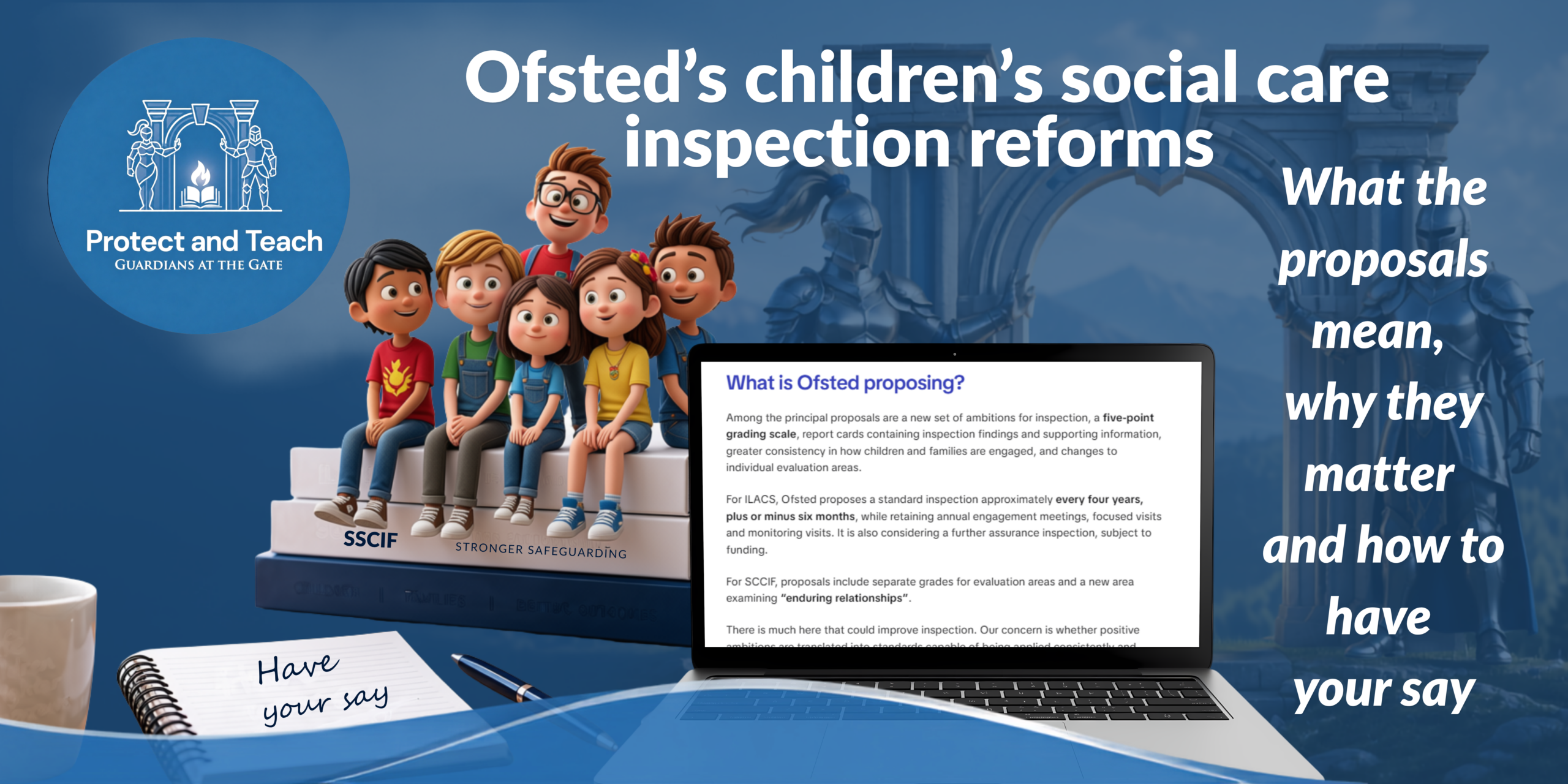
Ofsted is consulting on significant changes to the way it inspects children’s social care in England. Protect and Teach has reviewed the proposals through a safeguarding lens: will the changes make it easier to identify when children are unsafe, when services are failing and when vulnerable children are at risk of further harm?
Read Ofsted’s full consultation and supporting documents
Respond to the consultation here: https://www.smartsurvey.co.uk/s/ofstedsocialcare2026
The consultation closes at 11:59pm on 28 September 2026.
Protect and Teach supports effective, proportionate and accountable external inspection of children’s social care. Inspection systems should themselves remain open to scrutiny and improvement, including where processes create unnecessary workload, inconsistency or risks to staff wellbeing.
Those concerns do not remove the need for robust independent oversight of services responsible for the care and protection of vulnerable children.
Our starting point is therefore straightforward:
Does the proposed framework enable inspectors to identify safeguarding failure, poor practice and systemic weakness reliably, fairly and early enough for corrective action to be taken?
First: what are ILACS and SCCIF?
Ofsted is consulting on changes to two main inspection frameworks.
ILACS: Inspections of Local Authority Children’s Services – is the framework used to inspect children’s services provided by local authorities.
SCCIF: Social Care Common Inspection Framework – is used to inspect and regulate individual children’s social-care providers, including children’s homes, independent fostering agencies, supported accommodation, residential special schools and a range of other regulated settings.
Put simply:
ILACS asks how well the local authority is carrying out its responsibilities for children.
SCCIF asks how well a particular provider or service is caring for and protecting children.
Some proposals therefore concern councils, some concern providers, and others raise safeguarding questions relevant to both.
What is Ofsted proposing?
Among the principal proposals are a new set of ambitions for inspection, a five-point grading scale, report cards containing inspection findings and supporting information, greater consistency in how children and families are engaged, and changes to individual evaluation areas.
For ILACS, Ofsted proposes a standard inspection approximately every four years, plus or minus six months, while retaining annual engagement meetings, focused visits and monitoring visits. It is also considering a further assurance inspection, subject to funding.
For SCCIF, proposals include separate grades for evaluation areas and a new area examining “enduring relationships”.
There is much here that could improve inspection. Our concern is whether positive ambitions are translated into standards capable of being applied consistently and tested against evidence.
A useful principle runs throughout our response:
Clear standard →
observable evidence →
safeguarding action →
measurable outcome.
Safeguarding must remain the anchor
Ofsted says its reforms are intended to strengthen children’s social-care inspection. For Protect and Teach, the protection of children from abuse, neglect, exploitation and other harm must remain explicit within that purpose.
This matters because children involved with social care may already have experienced significant adversity before entering care or receiving services. Some then face additional or overlapping vulnerabilities.
The 2026 edition of Working Together to Safeguard Children expressly recognises that children can face multiple harms simultaneously and strengthens guidance concerning child sexual abuse, group-based exploitation and the vulnerability of looked-after children in particular settings.
Baroness Casey’s National Audit of group-based child sexual exploitation provides a further warning about the consequences when vulnerability is recognised too late.
The important inspection question is therefore not simply whether a service can list categories of vulnerability.
It is:
What did professionals know about this child, what risks should reasonably have been recognised, what action was taken, and did that action protect the child?
Vulnerability should be considered dynamically. Previous abuse, disability or communication difficulties, repeated missing episodes, placement instability, exploitation, trauma and other circumstances may interact. Inspectors need to be capable of identifying where those factors have compounded rather than examining each in isolation.
One particularly important question follows:
Did professionals recognise the child’s vulnerability before further harm occurred; or only explain it afterwards?
The Protect and Teach safeguarding test
Across the proposed framework, we suggest a simple series of questions:
- Were they heard?
- Were concerns investigated?
- Were known vulnerabilities recognised?
- Were decisions evidence-based?
- Were reasons recorded?
- Was protective action taken?
- Was the child’s safety properly considered?
- Did anyone check whether the action worked?
These are questions capable of being tested against evidence.
Children with the most complex lives
Ofsted asks how inspection can better support children with the “most complex lives”.
We welcome the attention being given to this group, while cautioning against locating all of the “complexity” within the child.
A child’s circumstances may become more complex because suitable provision is unavailable, agencies fail to coordinate, communication needs are poorly understood, assessments or interventions are delayed, or placements repeatedly break down.
Inspection should therefore examine both the child’s needs and the system around the child. That means asking whether disability, SEND, health, trauma and communication needs were identified; whether reasonable adjustments were provided; whether agencies shared relevant information; whether suitable specialist provision was available; and whether repeated placement moves or other instability indicated a wider failure in commissioning or planning.
When a child’s life is described as “complex”, inspection should ask how much of that complexity arises from the child’s needs, and how much has been created by the system around them.
Safe, lawful and suitable care
The availability of appropriate placements is not an abstract commissioning problem. It can become a safeguarding problem.
Ofsted’s latest regulatory data illustrates the scale of the issue. Between 1 April 2025 and 31 March 2026, Ofsted opened 850 cases concerning potentially unregistered children’s homes and supported-accommodation settings. Of those, 710, or 84% were determined to be settings that should have been registered, while another 120 remained undetermined at year end. In 57% of the cases, the placing local authority itself was the source of the information provided to Ofsted.
Ofsted’s previous annual report also recorded that 132 of England’s 153 local authorities had been involved in placing children in unregistered provision during 2024–25. Ofsted acknowledged the acute shortage of appropriate placements while warning that some children with the most complex needs were consequently living in settings with the least regulatory and independent scrutiny.
A shortage of suitable placements helps explain how the problem arises. It does not remove the safeguarding consequences.
Inspection should therefore ask:
Was the placement lawful? Was it safe? Was it suitable for this particular child? Could it meet the child’s assessed needs? What independent oversight existed? If suitable registered provision was unavailable, why? How long did the arrangement continue and what was being done to resolve it?
The objective should be safe, lawful and suitable care capable of meeting the individual child’s assessed needs.
Safeguarding assurance should be continuous, not an event every four years
A standard ILACS inspection approximately every four years may reduce some of the pressure associated with repeated full inspections. The safeguarding question, however, is what happens between those inspections.
Ofsted proposes retaining annual engagement meetings, focused visits and monitoring visits, and already uses regulatory intelligence to bring inspections forward or establish lines of enquiry. That continuing oversight matters because children’s services can change considerably within four years.
Leadership changes. Staff leave. Providers close. Demand changes. Placements become unavailable. Patterns of complaints or incidents emerge.
A longer standard inspection cycle therefore needs sufficiently sensitive interim safeguarding intelligence to identify deterioration and trigger proportionate scrutiny.
The effectiveness of a four-year inspection cycle depends partly upon the effectiveness of what happens between inspections.
The objective should not be to create an annual mini-inspection or another bureaucratic reporting exercise. It should be to ensure that serious warning signs cannot remain invisible until the calendar says it is time for the next inspection.
Near misses must become live safeguarding learning
This is particularly important. Safeguarding systems should learn not only from incidents in which a child suffered serious harm, but also from occasions when something almost went badly wrong.
Working Together 2026 specifically strengthens expectations concerning learning from incidents that do not meet the criteria for formal notification or review.
Inspection should therefore consider what organisations do with serious incidents, near misses, complaints, whistleblowing, repeated lower-level concerns and recurring failures. The existence of an action plan or revised policy is not enough.
Inspectors should ask:
What happened? → What was learned? → What changed? → Was the change implemented? → Did anyone check whether it worked?
The distinction is important:
Policy tells an inspector what should happen. Practice shows what does happen. Outcomes help establish whether it works.
Safeguarding learning should be a live cycle, not a collection of documents prepared when an inspection approaches.
Listen to children; including those who are hardest to hear
Ofsted already gathers substantial information directly from children. Its 2025 social-care questionnaires received a record 8,880 responses from children, and Ofsted uses those responses alongside other intelligence to help determine when to inspect and what to examine. Ninety-five per cent of responding children reported feeling safe where they lived or stayed always or most of the time.
The proposed stronger emphasis on children’s experiences is therefore welcome. However, “voice of the child” must not become synonymous with the child who can readily complete a questionnaire or participate in a conventional interview.
Children may be very young, non-speaking, disabled, have learning or communication difficulties, be traumatised, frightened of consequences or dependent upon the adults whose care is being inspected.
Inspectors may therefore need alternative communication methods, reasonable adjustments, advocates, observation and additional time.
The method should adapt to the child, rather than requiring the child to adapt to the inspection.
Ofsted should also guard against selection bias. Inspection must not disproportionately hear from the children who are easiest to reach, most confident in communicating or most readily presented by a service.
A child’s statement that they feel safe is important evidence. It is not, by itself, proof that safeguarding arrangements are effective. Children’s accounts should be taken seriously and considered alongside case records, observations, incidents and other relevant evidence.
The question is not simply how many children were consulted. It is whether the children who most needed to be heard could be heard, and what happened because of what they said.
Parents and families can hold important safeguarding evidence
Parents and carers may know things that inspectors and professionals do not. They may have observed changes in behaviour, distress after contact, unexplained injuries, medication problems, deterioration in mental health, problems within a placement or something disclosed by the child.
Their evidence matters. At the same time, children’s social care sometimes becomes involved precisely because a parent, carer or family environment may be connected to the risk being assessed.
Neither “parents always know best” nor “professionals know best” provides a satisfactory inspection standard.
The better questions are:
Were they heard? Were concerns investigated? Were decisions evidence-based? Were reasons recorded? Was the child’s safety properly considered?
Successful engagement should not be confused with parental satisfaction. Some necessary child-protection decisions will inevitably be difficult or unwelcome.
What can be assessed is whether families had appropriate opportunities to provide relevant evidence; whether concerns were accurately recorded and investigated; whether decisions had an evidential basis; and whether reasons were properly explained where it was safe and appropriate to do so.
Family engagement should strengthen safeguarding, not constrain necessary protective action.
Data should reveal risk; not simply measure activity
Ofsted proposes greater use of data and supporting information in its new report cards. The objective should not simply be more data. It should be better use of information to identify emerging risks, recurring patterns and differences in children’s experiences.
A useful model is:
DATA → PATTERN → LEARNING → ACTION → OUTCOME
Raw numbers can mislead.
- A low number of safeguarding referrals might indicate few concerns; or under-reporting.
- Few complaints might indicate excellent care; or a complaints process children cannot use.
- Few whistleblowing reports could indicate a healthy organisation; or a workforce afraid to speak.
- A reduction in placement moves could represent improved stability; or reluctance to end an unsuitable placement.
Consequently:
Data should generate questions, not substitute for inspection judgement.
Inspectors should look for patterns across different sources: safeguarding referrals, missing episodes, complaints, whistleblowing, placement instability, serious incidents, near misses, workforce instability, unregistered provision and information from children and families.
The central question should be:
What did the information tell you, what did you change, and how do you know whether it worked?
Equality should strengthen safeguarding
Ofsted’s Equality Impact Assessment considers the proposed reforms against the Public Sector Equality Duty and recognises that protected characteristics can affect children’s experiences within the care system. It also confirms that Ofsted currently collects information including sex, ethnicity, age and disability to help develop inspection lines of enquiry.
For Protect and Teach, equality analysis should have a practical safeguarding purpose.
Equality analysis should help inspectors identify vulnerability and differential risk; it should not become a substitute for investigating the source of harm.
- A child may simultaneously be in care, disabled, affected by previous abuse or trauma, experiencing mental-health difficulties, going missing or vulnerable to exploitation. Inspectors need to understand the whole child, including how vulnerabilities interact.
- Where disability or SEND affects communication, inspectors should examine whether appropriate adjustments enabled the child to communicate concerns and participate in decisions.
- Where sex is materially relevant to safeguarding, health, privacy, intimate care, accommodation or patterns of harm, accurate sex-disaggregated information should remain available for inspection and analysis.
Equally, possessing a protected characteristic must not itself be treated as evidence that a child presents a particular risk or need.
The relevant questions remain:
What was happening to this child? What vulnerabilities were known? What risks should reasonably have been recognised? What action followed? Did it protect the child?
Avoid unintended consequences
Inspection reform can itself create unintended behaviours. More evaluation areas, grades, data and evidence requirements could provide greater nuance. They could also encourage services to become better at demonstrating compliance rather than better at protecting children.
Ofsted should therefore monitor whether the new framework produces unnecessary documentation, periodic inspection preparation or perverse incentives.
Greater nuance in grading must not make serious safeguarding concerns harder for families and the public to identify.
Similarly, attempts to reduce inspection-related workload should distinguish between unnecessary bureaucracy and evidence genuinely required to determine whether children are safe.
These are not competing objectives:
Reducing unnecessary inspection burden and maintaining rigorous safeguarding oversight can and should be pursued together.
Ultimately, the success of the revised framework should not be judged by whether services become better at demonstrating compliance, but by whether inspection becomes better at identifying risk, exposing poor practice and ensuring safeguarding weaknesses are acted upon.
A useful final test is:
Does the change make safeguarding failure easier to identify; or merely make compliance easier to demonstrate?
What Protect and Teach would like Ofsted to strengthen
Our review identifies seven priorities:
- Keep protection from abuse, neglect, exploitation and other harm explicit at the centre of children’s social-care inspection.
- Translate broad ambitions into sufficiently clear and consistently applicable inspection standards.
- Test whether known vulnerabilities and compounding risks were recognised early enough to prevent further harm.
- Maintain effective safeguarding intelligence between full inspections so deterioration can trigger proportionate earlier scrutiny.
- Treat incidents, near misses, complaints and whistleblowing as sources of safeguarding intelligence and organisational learning, and test whether learning changed practice.
- Ensure children who are hardest to hear are not consequently the easiest to miss.
- Judge improvement through evidence of practice and outcomes, rather than the existence of policies, action plans and other documentation alone.
A final question for inspection reform
Children’s social care is complicated. Inspection will never be reducible to one statistic, one conversation or one grade.
That makes clear accountability more important, not less.
For Protect and Teach, the fundamental test remains simple:
Were children heard, were risks recognised, was evidence acted upon, and were children protected from harm?
A redesigned inspection framework should make those questions easier to answer; not easier to obscure.
Responding to the consultation
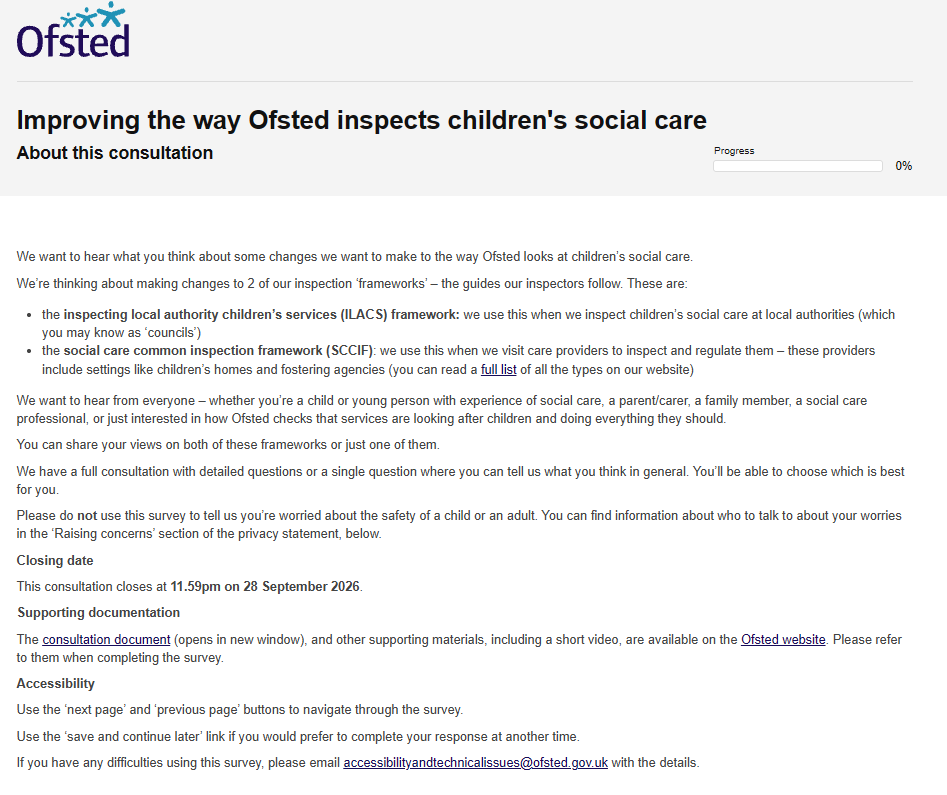
Ofsted’s consultation is open until 11:59pm on 28 September 2026. It includes a full consultation route and a shorter one-question option for children, young people, parents and carers.
Respond to the consultation here: https://www.smartsurvey.co.uk/s/ofstedsocialcare2026
The following model answers are intended to help people understand the issues and formulate their own response. They are not prescribed answers and should be adapted to reflect the respondent’s own views, experience and evidence.
You do not need to use every model answer or respond to every section. Use the points that are relevant to your own experience and views.
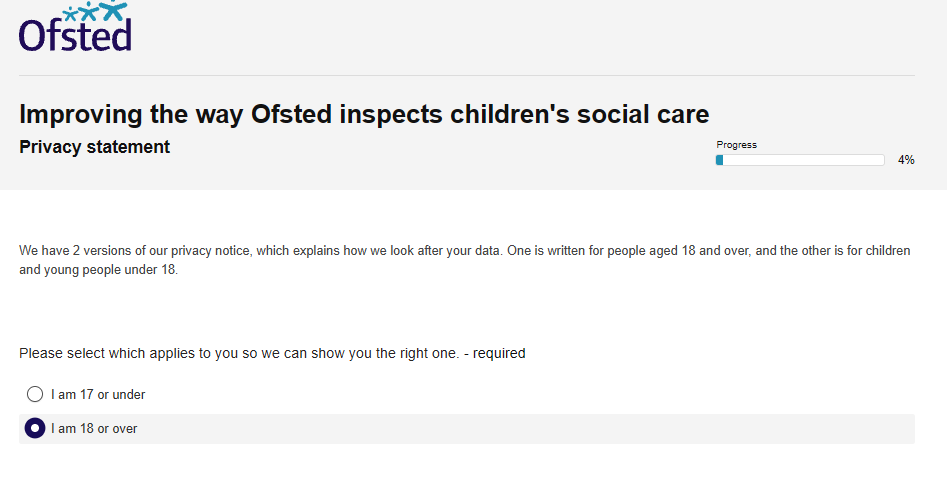
Next is their Privacy statement. Please read.

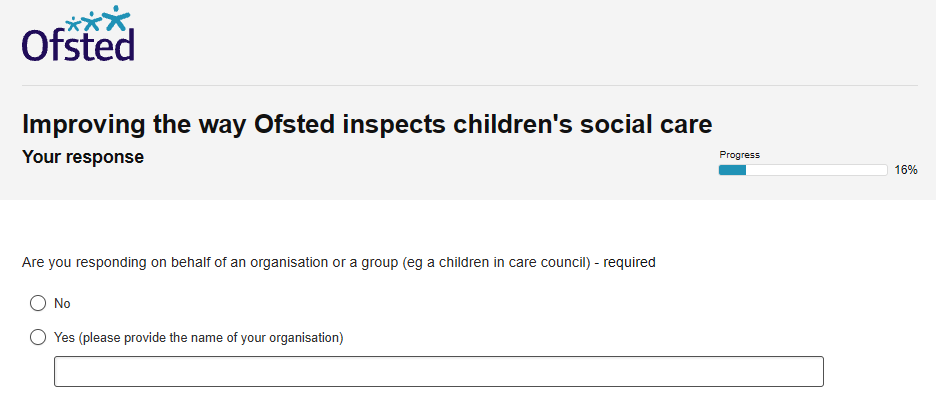
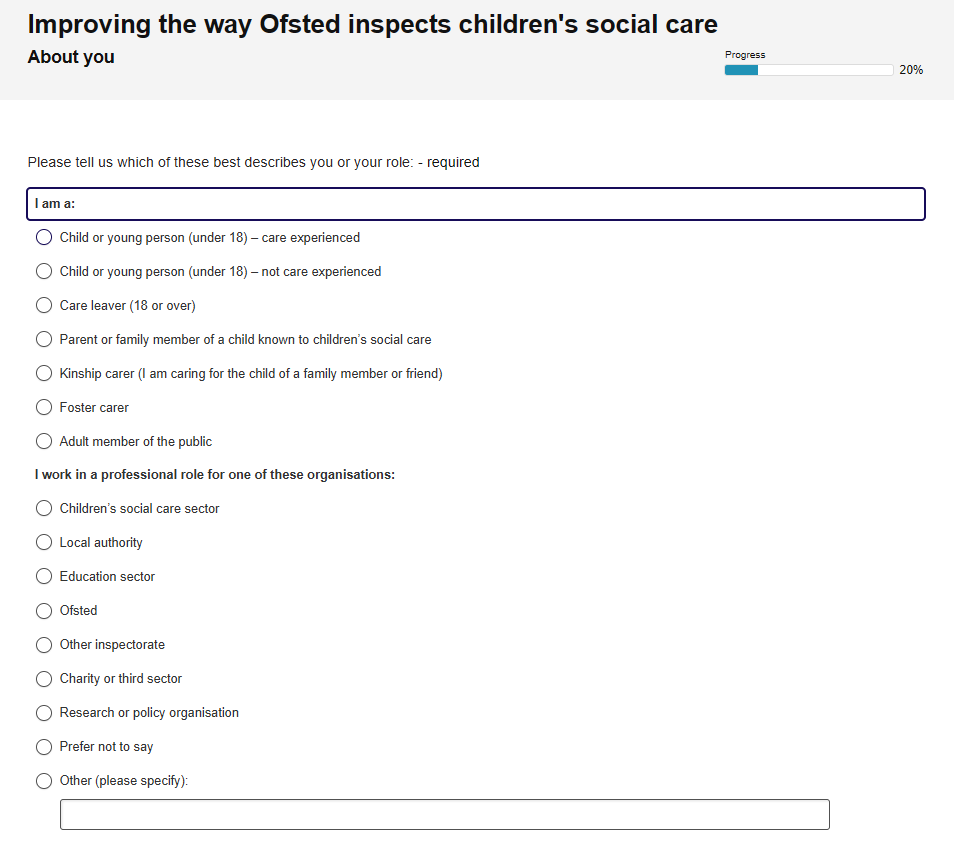
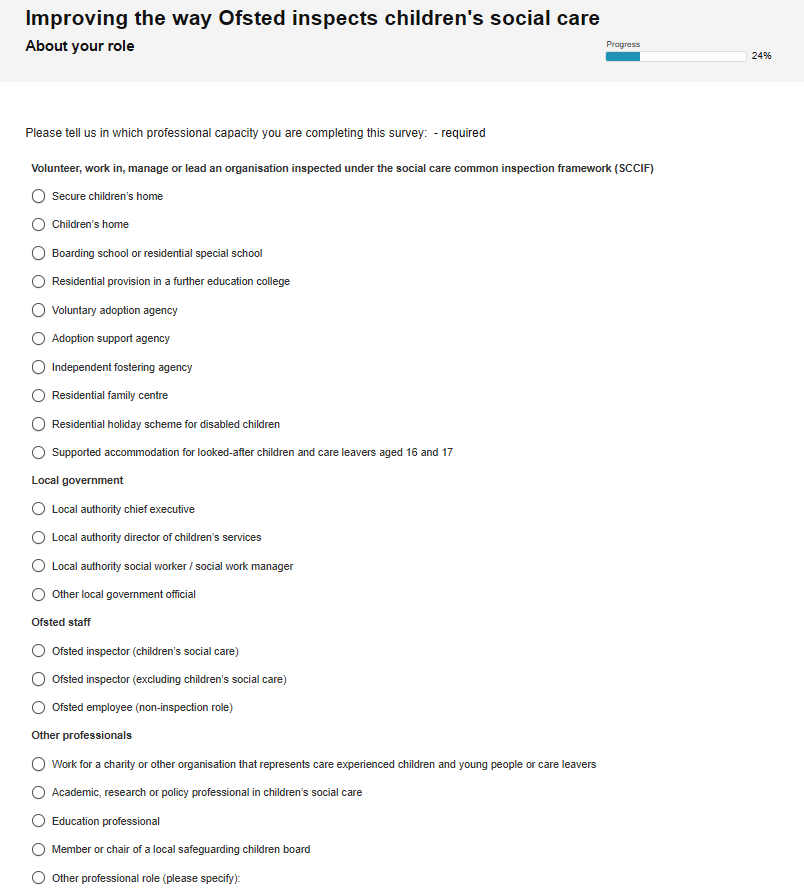
Choose if you want to reply in full, or just to specific questions:
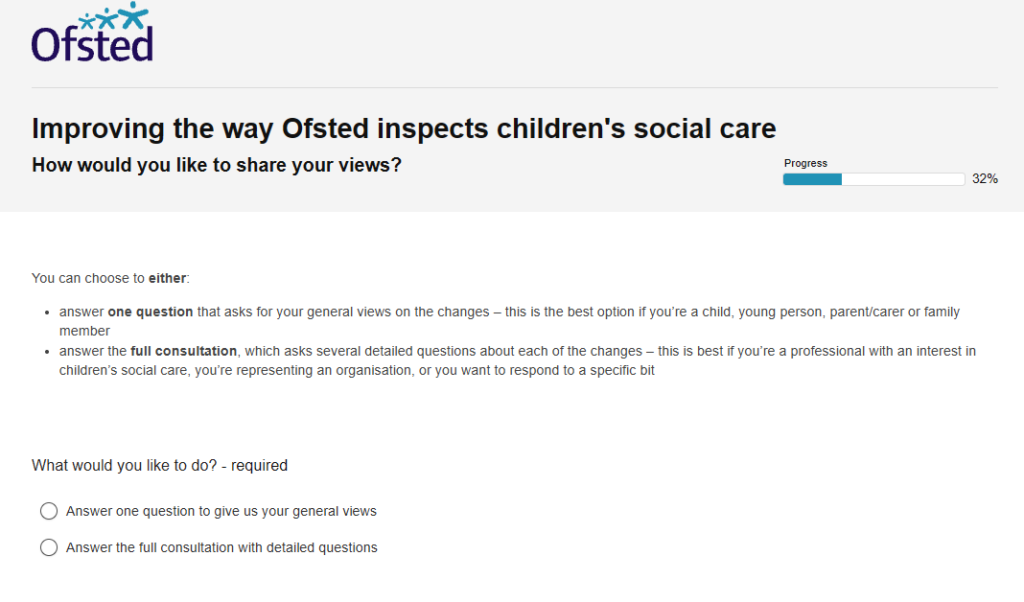
See below for the Consultation Questions and Our Model consultation answers
Proposal 1: The content of our inspection frameworks
We have set out our overall statement of ambition for ILACS and SCCIF in our consultation document. For more information, please refer to the consultation text about proposal 1.
Our ambition for ILACS inspections
What do you think about our proposed statement of ambition for children’s social care inspections in relation to ILACS?
Protect and Teach supports effective, proportionate and accountable independent inspection of children’s social care. We particularly welcome Ofsted’s emphasis on children’s safety. We would, however, encourage greater precision in the proposed statement of ambition. Phrases such as “a force for good”, “best outcomes” and “what matters most” express positive intentions but do not by themselves establish clear standards against which services, inspectors or Ofsted can be held accountable. We suggest a clearer formulation: “Our inspections promote safe, lawful, effective and high-quality children’s social care, with the protection of children from harm at their core.” Inspection should establish whether safeguarding duties are being fulfilled in practice, risks are identified and acted upon, children receive appropriate care and protection, and serious safeguarding weaknesses are recognised even where other aspects of a service perform well.
How can ILACS inspections support local authorities to meet the needs of children who have the most complex lives?
Protect and Teach supports greater inspection attention to children with multiple, additional or complex needs. However, Ofsted should clearly define how these concepts translate into consistent and assessable inspection criteria. Complexity should not automatically be attributed to the child. Circumstances may become more complex because suitable provision is unavailable, agencies fail to coordinate, communication needs are not understood, assessment or intervention is delayed, or placements repeatedly break down. Inspection should examine whether safeguarding risks and individual needs are identified promptly; whether disability, SEND, health, trauma and communication needs are recognised; whether reasonable adjustments are made; and whether relevant agencies share information and act effectively together. Repeated placement moves, disrupted education, unmet health or communication needs, distant placements or use of unsuitable provision should prompt examination of whether there is a wider problem in sufficiency, commissioning or multi-agency planning.
How can ILACS inspections encourage providers and local authorities to make sure that children are able to receive the right type of care and support in the right place?
ILACS should examine whether local authorities understand the current and anticipated needs of children in their area and whether commissioning and sufficiency planning translate that knowledge into appropriate provision. The focus should not simply be on whether a placement is available. Inspectors should consider whether it is safe, lawful and suitable for the individual child’s assessed needs, including disability, SEND, health, communication and safeguarding needs. Inspection should examine the consequences when appropriate provision is unavailable, including distant placements, repeated moves, placement breakdown, inappropriate restrictions or resort to provision that should be registered but is not. Where shortages exist, inspectors should distinguish between circumstances outside the immediate control of an individual local authority and weaknesses in planning or commissioning, while still examining what the authority has done to reduce risk to individual children. Placement decisions should also consider the safety and needs of children already living in a setting, not only the needs of the child requiring a placement.
What further changes can be made to ensure ILACS inspections focus on what matters for children?
ILACS should maintain a clear focus on whether children are protected from abuse, neglect, exploitation and other harm and whether intervention improves their actual experiences. Protect and Teach suggests that inspection consistently tests: Were children heard? Were concerns investigated? Were known vulnerabilities recognised? Were decisions evidence-based? Were reasons recorded? Was protective action taken? Was the child’s safety properly considered? Did anyone check whether the action worked? Inspectors should look beyond the existence of policies, procedures, training records and action plans to establish what happens in practice. Particular attention should be given to patterns across incidents, near misses, complaints, missing episodes, placement instability, whistleblowing and other safeguarding intelligence. An isolated error and a recurring systemic weakness should not be treated as equivalent. Policy tells an inspector what should happen. Practice shows what does happen. Outcomes help establish whether it works.
ILACS evaluation areas
What do you think about the proposed changes to ILACS evaluation areas?
Protect and Teach supports evaluation areas that allow inspectors to distinguish between different aspects of children’s services and identify where particular strengths or weaknesses lie. The revised areas should, however, retain a clear safeguarding thread across the framework. A serious weakness affecting children’s safety should remain visible even where performance in other areas is stronger. Evaluation criteria should also be sufficiently clear that local authorities, inspectors, children and families can understand what is being assessed and what evidence demonstrates the expected standard. We particularly support inspection examining the impact of leadership through what happens to children in practice, rather than relying primarily on the existence of strategies, policies or improvement plans. Greater nuance is useful only if it produces greater clarity rather than making serious safeguarding weaknesses harder to identify.
What do you think about our proposal that inspection activity on sufficiency and use of unregistered provision should sit within the ‘impact of leaders’ judgement in ILACS?
Protect and Teach considers it reasonable to examine sufficiency and the use of unregistered provision within the impact of leaders judgement because both are substantially affected by strategic planning, commissioning and leadership decisions. However, inspection should also examine their direct consequences for individual children. Sufficiency is not merely a strategic or commissioning issue when a shortage of suitable provision results in a child being placed somewhere unsafe, unsuitable, distant from important relationships or outside the intended regulatory framework. Inspectors should therefore connect leadership evidence with children’s actual experiences: what provision was required, what was available, what decisions were made when suitable provision was unavailable, what risks arose and how those risks were managed. Leadership plans should ultimately be tested against their practical effect on children.
What do you think about our proposal to make the use of unregistered provision a limiting criterion on ILACS inspections?
Protect and Teach supports giving the use of provision that should be registered but is not significant weight within inspection because of the safeguarding implications of children living outside the intended regulatory framework. The application of a limiting criterion should nevertheless take account of the circumstances and the actions of the local authority. Inspectors should examine why suitable registered provision was unavailable, how long the arrangement continued, what safeguarding checks and oversight were put in place, what efforts were made to secure lawful suitable provision and whether the use of such placements reflects a recurring failure of sufficiency or commissioning. National shortages of specialist provision provide important context and may constrain the options available to an individual authority. They do not remove the safeguarding risks for the child. The framework should therefore maintain a clear expectation that children receive safe, lawful and suitable care, while distinguishing appropriately between systemic national shortages and failures within the reasonable control of the authority.
What do you think about our proposal to change how inspectors look at sufficiency as part of an ILACS inspection?
Protect and Teach supports a more comprehensive assessment of sufficiency. Sufficiency should not be measured simply by the number of available placements. Inspection should examine whether there is a sufficient range of safe, lawful and suitable provision capable of meeting the needs of the children for whom the local authority is responsible. This should include whether appropriate provision exists for children with complex needs, disabilities and SEND; whether children can remain appropriately close to important relationships and services where this is in their interests; the frequency and causes of placement breakdown; use of distant placements; and reliance on provision that should be registered but is not. Inspectors should examine whether local authorities use information about current and anticipated need to plan provision and whether recurring placement difficulties lead to changes in commissioning and sufficiency strategies. The relevant question is not simply “Are there enough places?” but “Are there enough suitable places for the children who actually need them?”
ILACS proposals: How we grade
Proposal 2: How we grade
We propose to introduce a 5-point grade scale and move to a ‘secure fit’ approach to grading. For more information, please refer to the consultation text about proposal 2.
Secure fit: What do you think about our proposal to introduce the ‘secure fit’ grading methodology for ILACS inspections?
Protect and Teach understands the rationale for moving from a “best fit” to a “secure fit” methodology, particularly where this is intended to improve consistency and prevent stronger performance in some areas from compensating for failure to meet essential standards elsewhere. However, children’s social care cannot be assessed safely as a checklist exercise. Inspectors must retain sufficient professional judgement to distinguish between an isolated minor shortfall, recurring poor practice, a serious individual safeguarding failure and systemic failure. Equally, evidence that a local authority has policies, procedures, training or improvement plans in place should not establish that a criterion has been met unless inspectors can determine that the expected standard is being delivered in practice. We are also concerned that a rigid grading methodology could unintentionally discourage openness about weaknesses. A local authority that identifies a safeguarding problem itself, responds appropriately and evaluates whether its action has worked may demonstrate stronger safeguarding governance than one in which few problems are reported. Secure fit should therefore support consistency without replacing professional safeguarding judgement. The methodology should assess the significance and impact of the evidence, not simply whether individual criteria appear to have been satisfied.
5-point scale: What do you think about our proposal to introduce the 5-point grade scale for ILACS inspections?
Protect and Teach has reservations about the use of headline grades in children’s social-care inspection. Adding a fifth grade may provide greater differentiation than the current system, but it does not resolve the more fundamental limitations of reducing complex evidence about children’s services to a single category. A local authority may perform strongly in some areas while having significant weaknesses in others. Most importantly, a headline grade should never create false reassurance where inspectors have identified a serious safeguarding concern. We would therefore place greater value on clear reporting of what is working, what is not working, what risks have been identified, what requires improvement and how urgently action is required than on the headline grade itself. If Ofsted proceeds with the five-point scale, the grades should sit alongside sufficiently detailed and accessible findings so that children, families and the public can readily understand the evidence behind them. Serious safeguarding concerns should always be immediately visible and should not be obscured by stronger performance elsewhere. Ofsted should also evaluate whether the new grading system changes organisational behaviour in unintended ways, including whether services become focused on achieving or retaining a particular grade rather than identifying weaknesses openly and improving practice. Inspection should tell the public what Ofsted found, not merely what label Ofsted gave it.
For each of the following proposed ILACS grades, what do you think about the description we have proposed?
| Exceptional | The requirement for exceptional practice to be sustained and to make a significant and lasting positive difference provides an important safeguard against awarding the highest grade for isolated examples of excellent practice. However, Ofsted should explain clearly how judgements that practice is among the best nationally will be evidenced and quality-assured. The description should also ensure that exceptional performance cannot obscure a material safeguarding weakness elsewhere. The evidence behind the grade is more important than the label itself. |
|---|---|
| Strong standard | The distinction between meeting expected requirements and demonstrating consistently stronger practice is reasonable, provided it is based on demonstrable practice and outcomes rather than additional documentation. We particularly support examining whether evidence and learning actually change practice. A local authority should not demonstrate a strong standard merely by showing that reviews were completed, policies amended or training delivered. Inspectors should examine what changed and whether that change improved children’s experiences or safety. |
| Expected standard | The expected standard should provide a clear and objectively assessable baseline. Ofsted should distinguish clearly between legal duties, regulatory requirements, statutory guidance, professional expectations and non-statutory government guidance or policy. These do not all have the same status and should not become indistinguishable simply because they appear within an inspection framework. Meeting the expected standard should also require evidence that requirements are being fulfilled in practice. The existence of compliant policies and procedures is not, by itself, evidence that children are receiving safe and effective services. Compliance on paper should not substitute for evidence of practice. |
| Needs attention | Protect and Teach considers that the boundary between “needs attention” and “urgent improvement” requires particular clarity. A weakness does not necessarily have to be widespread to present a serious safeguarding risk. A significant failure affecting one child or a small number of children may require urgent action even where inspectors have not identified systemic failure across the authority. The framework should therefore distinguish between the prevalence of a weakness and its seriousness. Where an evaluation area is graded “needs attention”, any material safeguarding concern identified within it should nevertheless be clearly reported, together with the action required. The overall grade must not inadvertently minimise a serious individual concern. |
| Urgent improvement | Protect and Teach supports a description that recognises both serious and systemic failures as potentially requiring urgent action. It is important that the word “or” is preserved in the final criteria. A sufficiently serious safeguarding failure should not have to become widespread or systemic before urgent action can follow. The framework should consider the severity of the risk or failure, the number of children potentially affected, whether the problem is recurring or systemic, and the effectiveness and urgency of the local authority’s response. Where significant concerns about children’s safety or welfare are identified, these should be immediately apparent in the published inspection findings rather than requiring readers to infer their seriousness from the overall grade. |
ILACS proposals: How we report
Proposal 3: How we report
We propose to introduce online ‘report cards’ for ILACS. For more information, please refer to the consultation text about proposal 3.
Report cards: What do you think about our proposal to introduce report cards for ILACS inspections?
Protect and Teach has reservations about using report cards as the principal means of communicating the findings of children’s social-care inspections. We recognise the intention behind the proposal. Children’s social care is complex, and a single overall judgement can conceal substantial variation between different parts of a local authority’s services. Presenting findings across individual evaluation areas may therefore provide more information than a single headline grade. However, replacing one headline judgement with a collection of grades, indicators and summary information does not necessarily provide a more accurate picture of whether children are safe or whether services are effective. In children’s social care, the significance of evidence cannot always be understood by counting indicators or viewing categories independently. A serious safeguarding failure affecting a relatively small number of children may be more important than stronger performance across several other measures. Conversely, a local authority may identify significant problems itself and respond effectively; that should not automatically be interpreted as evidence of poor governance. We would therefore prefer inspection reporting to place greater emphasis on a clear narrative account of what inspectors found, what is working, what is not working, what safeguarding risks were identified, what action is required and how urgently it is required. If report cards are introduced, they should act as an accessible route into that evidence rather than becoming a substitute for it. Serious safeguarding concerns must be immediately visible and should never be obscured by stronger grades or positive indicators elsewhere. The purpose of inspection reporting should be to communicate the evidence clearly, not to compress complex safeguarding evidence into an attractive dashboard.
What are your views on including data and information in ILACS report cards?
Protect and Teach supports the use of relevant data and information as part of inspection, but data should inform professional judgement rather than become a proxy for it. Children’s social-care data requires careful interpretation. A low number of safeguarding referrals may indicate fewer concerns, but it could also indicate under-reporting. A low number of complaints may indicate good services, but could also reflect an inaccessible complaints process. Higher numbers of reported incidents may indicate deterioration, or they may demonstrate that staff are recognising and reporting concerns appropriately. For that reason, individual metrics should not be presented without sufficient context. Inspectors should examine trends over time, differences between groups of children and patterns across different sources of evidence. Data should also be triangulated with case evidence, children’s experiences, family evidence, complaints, whistleblowing, safeguarding incidents, professional evidence and inspection findings. Particular care should be taken with targets. A measure can produce an apparently positive result while encouraging behaviour that does not improve children’s safety or experiences. Report cards should therefore explain significant data rather than simply display it, including relevant limitations and the context necessary for readers to understand what it does; and does not, demonstrate. Data should generate questions, not substitute for inspection judgement.
Which data and information would be most meaningful to include on an ILACS report card?
Protect and Teach would prioritise information that helps children, families and the public understand children’s safety, stability, experiences and outcomes, together with information that can reveal emerging or systemic safeguarding risks. Relevant information may include: safeguarding concerns and referrals, including trends over time; serious incidents and relevant near misses; children missing from care and recurring missing episodes; placement stability, breakdown and repeated moves; use of out-of-area placements where this materially affects children’s care or safeguarding; use of provision that should be registered but is not; complaints and the themes emerging from them; whistleblowing and allegations concerning professionals or carers; relevant use of restraint or restrictive practices; workforce instability where this affects continuity, safety or quality of care; timeliness of assessments and safeguarding responses where delay can expose children to harm; information about whether children can access suitable provision capable of meeting assessed needs; and evidence of whether previously identified weaknesses have actually improved. Where materially relevant, data should be capable of being examined by characteristics such as sex and disability/SEND, so that significant differences in experiences or outcomes are not concealed within aggregate figures. However, the report card should not become an ever-expanding collection of indicators. Ofsted should include information because it helps explain children’s experiences or identify risk, not simply because the information can be counted. Near-miss information is particularly important but should not simply be presented as a number. Where incidents or near misses reveal recurring themes, inspectors should establish whether the local authority identified the pattern, what it learned, what changed in practice and whether the effectiveness of that change was subsequently evaluated. Wherever an indicator raises a concern, sufficient context should be provided to answer three further questions: What does this appear to show? What did inspectors find when they investigated it? What action, if any, is required?
ILACS proposals: Children, young people, parents, carers and family engagement
Proposal 4: Children, young people, parents, carers and family engagement during ILACS inspections
We propose to build a more consistent and inclusive approach to engaging with children, young people, parents, carers, and families during ILACS inspections. For more information, please refer to the consultation text about proposal 4.
How can we better engage with children and young people during ILACS inspections?
Protect and Teach supports a more consistent and inclusive approach to hearing directly from children and young people. However, engagement must be designed so that children who are hardest to hear are not consequently the easiest to miss. Inspectors should not rely predominantly on conventional interviews, questionnaires or children who are confident and readily able to communicate. Younger children, non-speaking children, disabled children, children with learning disabilities or SEND, children with communication or sensory needs, and children affected by trauma or fear may require different approaches. Ofsted should therefore use reasonable adjustments and, where appropriate, communication aids, interpreters, advocates, observation, familiar communication methods and additional time. The method should adapt to the child rather than requiring the child to adapt to the inspection. Ofsted should also guard against selection bias. Inspectors should not hear disproportionately from children who are easiest to engage or those selected by the service. Inspection should seek appropriate opportunities to hear from children who have experienced placement instability, raised complaints or safeguarding concerns, recently entered or left services, or may otherwise be less able to advocate for themselves. Children should, wherever practicable, have opportunities to communicate privately with inspectors and should understand how information they provide may be used, including the limits of confidentiality where safeguarding concerns are disclosed. Children’s accounts should be taken seriously but should not be considered in isolation. A child saying that they feel safe is important evidence, but does not by itself establish that safeguarding arrangements are effective. Their experiences should be triangulated with case records, observations, safeguarding information and other relevant evidence. Finally, engagement should be evaluated by what it contributes to inspection and safeguarding, not simply by the number of children consulted. Ofsted should be able to demonstrate how children’s experiences informed findings, identified concerns or contributed to changes in practice. Do not simply count how many children were heard. Ask whether the children who most needed to be heard could be.
How can we better engage with parents, carers and families during ILACS inspections?
Parents, carers and families can provide important safeguarding evidence about a child’s experiences which may not otherwise be visible to inspectors. They may identify changes in behaviour, distress, unmet health or communication needs, placement problems, unexplained injuries, concerns about care or information disclosed by the child. Engagement should therefore be accessible and meaningful. Parents and carers should have appropriate opportunities to raise concerns, provide relevant evidence, identify factual inaccuracies and understand how serious concerns can be escalated. Reasonable adjustments and accessible communication should be available where required. Inspectors should also examine complaints and concerns raised by families for recurring themes. A series of apparently separate complaints may reveal a wider safeguarding or systemic problem when considered alongside incidents, case records, children’s accounts or staff concerns. However, family engagement must strengthen safeguarding rather than constrain necessary protective action. There will be circumstances in which a parent, carer or family member may themselves be connected to the risk being assessed, information cannot safely or lawfully be shared, or accounts from different parties conflict. The welfare and protection of the child must remain central, with evidence considered from multiple sources. Ofsted should therefore not equate successful family engagement with parental satisfaction. Child-protection decisions may sometimes be difficult, contested or unwelcome. A more meaningful inspection test is: Were they heard? Were concerns investigated? Were decisions evidence-based? Were reasons recorded? Was the child’s safety properly considered? These questions allow inspectors to assess the quality and fairness of engagement without treating either professional opinion or family opinion as automatically determinative.
ILACS proposals: ILACS inspection scheduling
Proposal 5: ILACS inspection scheduling
We propose to inspect all local authorities using a standard inspection as the first inspection under the renewed ILACS framework, and to change our inspection cycle to take place over a 4-year period (plus or minus 6 months), while maintaining our focused visits and monitoring visits between inspections. We are also considering introducing assurance visits. For more information, please refer to the consultation text about proposal 5.
What do you think about our proposals for ILACS scheduling?
Protect and Teach has concerns about relying on a standard inspection cycle of approximately four years in children’s social care. Significant changes in leadership, workforce, demand, commissioning, placement availability and safeguarding practice can occur within that period. We recognise that focused visits and monitoring visits will continue between standard inspections. The effectiveness of a four-year cycle will therefore depend substantially upon the strength of the safeguarding intelligence and oversight operating between inspections, and Ofsted’s ability to respond promptly when evidence indicates deterioration or increased risk. We would favour proportionate continuing assurance between standard inspections rather than relying predominantly upon periodic full inspection. This need not mean repeatedly conducting a full inspection or creating substantial additional bureaucracy. Ofsted should be able to use relevant intelligence; including safeguarding incidents and near misses, complaints, whistleblowing, placement instability, missing episodes, workforce changes, use of unregistered provision and other emerging patterns; to determine whether earlier scrutiny is required. Consideration could also be given to proportionate interim assurance information from local authorities, focused on material changes and emerging safeguarding risks rather than extensive routine reporting. Importantly, inspection scheduling should not encourage a cycle in which services prepare intensively for inspection every four years. The objective should be continuous safeguarding assurance and continuous improvement. The effectiveness of a four-year inspection cycle depends partly upon the effectiveness of what happens between inspections. Services should not simply become “inspection ready”; they should maintain practice that is capable of scrutiny at any time.
What do you think about the idea to explore assurance visits, which would take place between standard inspections, and would review one evaluation area graded ‘needs attention’?
Protect and Teach supports exploring proportionate assurance visits between standard inspections. However, we would question limiting their purpose to reviewing an evaluation area previously graded “needs attention”. That approach would provide useful follow-up on a known weakness, but safeguarding oversight must also be capable of identifying new or emerging risks arising after the standard inspection. Assurance visits should therefore be capable of being triggered by significant safeguarding intelligence as well as a previous grade. This could include recurring incidents or near misses, serious complaints, whistleblowing, placement instability, increased use of unregistered provision, significant workforce or leadership changes, deterioration in relevant performance information, or other evidence suggesting that children may be at increased risk. Where a previous area was graded “needs attention”, an assurance visit should examine more than whether an action plan has been completed. Inspectors should establish what changed in practice and whether there is evidence that the change worked. Assurance visits should remain proportionate and risk-based so that they provide meaningful safeguarding oversight without effectively recreating a full inspection at frequent intervals. The purpose of assurance between inspections should not simply be to check whether a previous weakness has been addressed. It should also help identify whether a new weakness is developing.
ILACS proposals: Additional questions
We want to hear your views about the likely impact of our proposals.
What effect do you think the proposed ILACS changes will have on leaders’, practitioners’ and inspectors’ workload and wellbeing?
The proposed changes could reduce some unnecessary inspection pressure if they result in clearer expectations, proportionate evidence requirements and less periodic preparation for inspection. However, there is also a risk that additional evaluation areas, a secure-fit methodology, five grades, report cards and increased data requirements create new administrative burdens. Protect and Teach does not consider staff wellbeing and robust safeguarding oversight to be competing objectives. Unnecessary bureaucracy should be reduced where it does not contribute meaningfully to inspection, while evidence necessary to establish whether children are safe and receiving appropriate services must remain available. Ofsted should monitor whether the renewed framework causes local authorities to produce additional documentation primarily to demonstrate compliance. Inspectors should make appropriate use of evidence generated through ordinary safeguarding and social-care practice rather than encouraging parallel systems created for inspection. The framework should also avoid creating a culture in which practitioners or leaders are reluctant to identify weaknesses, report incidents or acknowledge uncertainty because of concern about the effect on inspection grades. Open identification of problems, followed by effective action and evaluation, can itself demonstrate good safeguarding governance. Reducing unnecessary inspection burden and maintaining rigorous safeguarding oversight should be treated as complementary objectives.
What steps could we take to reduce or manage any unintended consequences of our proposals?
Ofsted should actively monitor the renewed framework for unintended consequences rather than assuming that the intended effect of a measure will necessarily be its effect in practice. In particular, Ofsted should monitor for: increased production of documentation primarily for inspection purposes; excessive focus on achieving or retaining grades rather than identifying and improving weaknesses; perverse incentives to reduce reported complaints, safeguarding referrals, incidents or placement changes where lower numbers may appear favourable; serious safeguarding concerns becoming less visible within multiple grades, indicators or report-card information; organisations becoming focused on periodic inspection preparation rather than continuous safeguarding assurance; and emerging safeguarding risks developing between standard inspections without triggering timely scrutiny. Ofsted should use its proposed test-and-learn approach to examine these effects in practice and be prepared to amend the framework where unintended behaviours emerge. Evidence requirements should remain proportionate and should focus on what happens to children in practice. The existence of a policy, training record, review or action plan should not itself demonstrate effective safeguarding. Similarly, performance indicators should be interpreted in context. Low numbers of complaints or safeguarding reports are not necessarily evidence of strong performance. The key test should be: does the change make safeguarding failure easier to identify, or merely make compliance easier to demonstrate?
Please tell us how you think our proposed changes to ILACS may or may not impact Ofsted’s public sector equality duty.
Protect and Teach supports Ofsted considering protected characteristics consistently within ILACS. Equality analysis should strengthen safeguarding and help inspectors identify differential experiences, vulnerabilities and risks rather than operate as a separate compliance exercise. Children involved with social care may have multiple and overlapping vulnerabilities. Inspection should therefore consider whether protected characteristics, individually or alongside other circumstances, affect a child’s communication needs, access to services, placement suitability, health, privacy or exposure to particular risks of harm. This is particularly important for disabled children and children with SEND. Inspectors should examine whether reasonable adjustments are provided, whether communication needs are recognised and whether children have accessible means of raising concerns or disclosing harm. We also welcome the continued collection of sex data. Where sex is materially relevant to safeguarding, health, privacy, intimate care, accommodation or patterns of harm, inspectors should be able to examine accurate sex-disaggregated information. Ofsted’s Equality Impact Assessment confirms that inspection data currently includes sex, ethnicity, age and disability and is used to develop lines of enquiry about children’s experiences. At the same time, the existence of a protected characteristic should neither reduce safeguarding scrutiny nor itself be treated as evidence of risk. Inspectors should assess the individual child’s circumstances and evidence rather than rely upon assumptions associated with a particular characteristic. Equality analysis should help inspectors identify vulnerability and differential risk; it should not become a substitute for investigating the source of harm. The practical safeguarding question remains: What did professionals know about this child, what risks should reasonably have been recognised, what action was taken, and did that action protect the child?
Do you have any other comments about our proposed changes to ILACS?
Protect and Teach welcomes the opportunity to comment on the proposed renewal of ILACS. Our responses have been considered through a safeguarding lens: whether the revised framework will improve the ability of independent inspection to identify abuse, neglect, exploitation, poor practice and other risks of harm to children. We support clearer inspection expectations, meaningful engagement with children and families, stronger attention to sufficiency and unregistered provision, and effective use of safeguarding intelligence. However, we have reservations about relying heavily on grades, report cards and performance indicators to communicate the quality and safety of complex children’s services. The renewed framework should preserve professional safeguarding judgement and distinguish between minor shortfalls, recurring poor practice, serious individual safeguarding failures and systemic failure. The prevalence of a problem and its seriousness are not the same thing. Inspection should also test practice rather than paperwork. Following incidents, near misses, complaints, whistleblowing or previous inspection findings, inspectors should establish what was learned, what changed and whether there is evidence that the change worked. A four-year standard inspection cycle makes effective intelligence between inspections particularly important. Emerging safeguarding concerns should be capable of triggering proportionate scrutiny rather than waiting for the next scheduled inspection. Above all, the framework should remain capable of answering straightforward questions: Were children heard? Were concerns investigated? Were known vulnerabilities recognised? Were decisions evidence-based? Was protective action taken? Was the child’s safety properly considered? Did anyone check whether the action worked? The success of the renewed ILACS framework should ultimately be judged not by whether local authorities become better at demonstrating compliance, but by whether inspection becomes better at identifying risk, exposing poor practice and helping ensure that children are protected from harm.
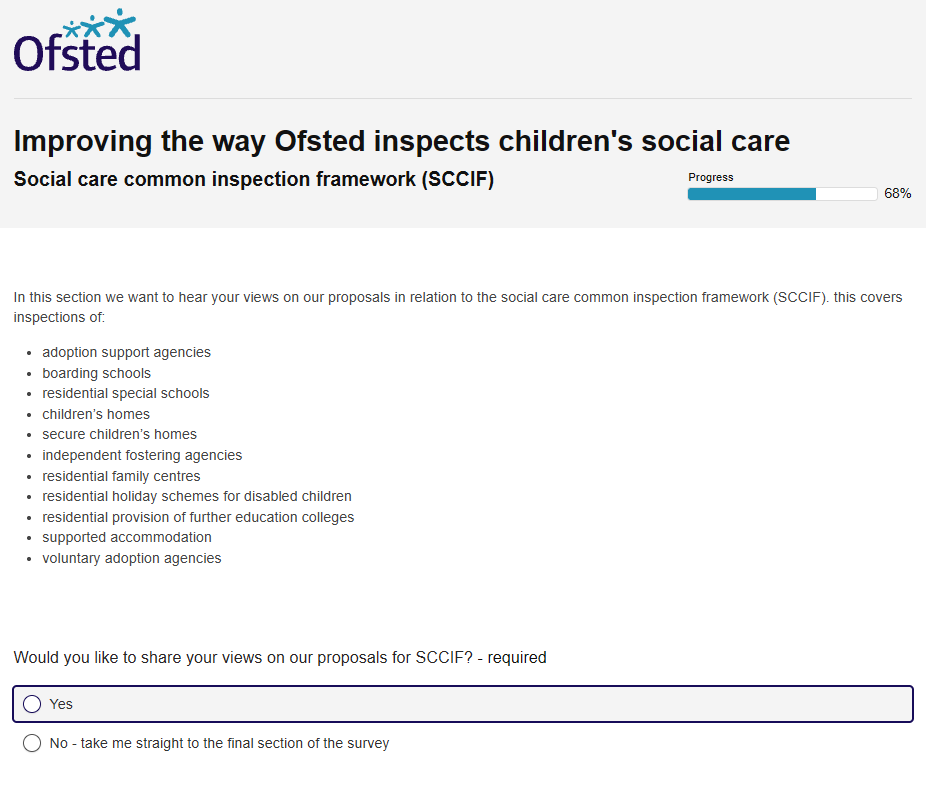
SCCIF proposals: The content of our inspection frameworks
Proposal 1: The content of our inspection frameworks
We have set out our overall statement of ambition for ILACS and SCCIF in our consultation document. For more information, please refer to the consultation text about proposal 1.
Our ambition for SCCIF inspections
What do you think about our proposed statement of ambition for children’s social care inspections in relation to SCCIF?
Protect and Teach supports effective, proportionate and accountable independent inspection of children’s social-care providers. We particularly welcome Ofsted’s statement that its most important role is to help make children safer. We would, however, encourage greater precision in the proposed statement of ambition. Phrases such as “a force for good”, “best outcomes”, “what matters most” and “full potential” express positive intentions but do not, by themselves, establish clear and objectively assessable standards. For SCCIF, the protection of children from abuse, neglect, exploitation and other harm should remain an explicit and identifiable priority. Inspection should establish whether providers comply with legal and regulatory requirements, identify and respond appropriately to safeguarding risks, provide safe and suitable care, and meet the individual assessed needs of the children they accept into their care. Wider considerations including stability, relationships, wellbeing and development are important, but should be translated into sufficiently clear inspection criteria grounded in legal requirements, statutory guidance, regulatory standards and reliable evidence. We suggest a clearer ambition: “Our inspections promote safe, lawful, effective and high-quality children’s social care, with the protection of children from harm at their core.” Positive aspiration is appropriate. Inspection standards, however, must be sufficiently clear that providers, inspectors, children and families can understand what is required and how it will be evidenced.
How can SCCIF inspections support providers to care for the children who have the most complex lives?
SCCIF should examine both whether a provider is capable of meeting a child’s individual needs and whether it actually does so in day-to-day practice. Complexity should not automatically be attributed to the child. A child’s circumstances may become more complex where communication needs are not understood, appropriate specialist support is unavailable, agencies fail to share information, risks are poorly assessed or a placement is unable to meet needs consistently. Inspection should therefore examine whether disability, SEND, health, trauma, communication and safeguarding needs are properly understood; whether reasonable adjustments are made; whether staff have the skills and support required; and whether relevant agencies share information and respond appropriately to changing risks. Ofsted should also examine providers’ decisions about accepting placements. A provider should be able to demonstrate that it has considered both the needs of the child requiring a placement and the safety and needs of children already living in the setting. Where placements repeatedly break down or children experience instability, inspection should examine the underlying causes rather than treating instability simply as a consequence of the child’s “complexity”. When a child’s life is described as complex, inspection should ask whether the service surrounding that child is reducing that complexity or adding to it.
How can SCCIF inspections encourage providers and local authorities to make sure that children are able to receive the right type of care and support in the right place?
SCCIF should examine whether providers accept children whose assessed needs they are genuinely capable of meeting, rather than allowing placement availability itself to determine suitability. The relevant question is not simply whether a place was available, but whether the provision was safe, lawful and suitable for the individual child’s assessed needs. Inspection should consider how providers work with placing local authorities before and during a placement; the quality of information available when decisions are made; whether disability, SEND, health, communication and safeguarding needs can be met; and whether the potential impact of a placement on children already living in the setting has been properly assessed. Providers should also be expected to identify promptly when a child’s needs have changed or can no longer safely be met and to work effectively with the placing authority and other agencies to address this. Ofsted should use evidence from SCCIF and ILACS together where appropriate to identify recurring mismatches between children’s assessed needs and available provision. Repeated placement breakdowns or inappropriate placements may reveal a problem extending beyond an individual provider. The objective should be the right provision for the individual child, not simply an available placement.
What further changes can be made to ensure SCCIF inspections focus on what matters for children?
SCCIF should retain an explicit focus on whether children are protected from abuse, neglect, exploitation and other harm and whether the care they receive is safe and appropriate to their individual needs. Inspection should look beyond policies, training records and other documentation to establish what children actually experience in the setting. Protect and Teach suggests that inspectors consistently ask: Were children heard? Were concerns investigated? Were known vulnerabilities recognised? Were decisions evidence-based? Were reasons recorded? Was protective action taken? Was the child’s safety properly considered? Did anyone check whether the action worked? Inspectors should also examine patterns across safeguarding incidents, near misses, complaints, allegations, missing episodes, restraint or restrictive practice where relevant, placement breakdowns, medication errors and whistleblowing. Individually minor events may reveal a significant problem when they recur. Particular attention should be paid to whether learning from incidents and near misses changes practice. The existence of an action plan or revised policy should not itself demonstrate improvement. Policy tells an inspector what should happen. Practice shows what does happen. Outcomes help establish whether it works.
SCCIF evaluation areas
What do you think of our proposal to add an evaluation area on enduring relationships into the SCCIF?
Protect and Teach recognises the importance of safe, stable and appropriate relationships in children’s lives. Maintaining significant relationships can contribute to continuity, identity, wellbeing and stability, particularly for children who have experienced disruption or repeated changes in care. However, an evaluation area on “enduring relationships” needs sufficiently clear criteria to distinguish the quality and appropriateness of relationships from their duration alone. An enduring relationship is not necessarily a beneficial or safe relationship. Inspection should therefore consider whether providers help children maintain safe and appropriate relationships that are important to them, while recognising circumstances in which contact may need to be restricted, supervised or reconsidered for safeguarding reasons. Inspectors should also consider the child’s wishes and individual circumstances rather than assuming that maintaining every existing relationship is necessarily in the child’s interests. If this becomes a separately graded evaluation area, Ofsted should define clearly what evidence demonstrates the expected standard and ensure that providers are not incentivised to preserve relationships where safeguarding evidence indicates that doing so would be inappropriate. The quality and safety of a relationship matter more than simply whether it endures.
What do you think about our proposal to add ‘the quality of foster carer recruitment, assessment and support’ as an additional evaluation area for independent fostering agencies?
Protect and Teach supports examining the quality of foster-carer recruitment, assessment and support, but believes the evaluation area should consider both safeguarding and proportionality. There is an important balance to achieve. Foster carers must be appropriately assessed, checked, prepared and supported because children placed with them may be particularly vulnerable. Essential safeguarding requirements should not be weakened simply to increase recruitment. At the same time, unnecessary duplication, disproportionate paperwork or administrative processes that do not materially improve safeguarding may discourage prospective carers or contribute to existing carers leaving. That matters in a system already experiencing significant pressure on placement sufficiency. Inspection should therefore examine not only whether agencies complete required processes, but whether those processes are necessary, proportionate and focused on information that genuinely informs suitability and safeguarding. Ofsted should distinguish between essential safeguarding assurance and administrative activity that adds little to the protection of children. Recruitment numbers alone should not determine success. Inspection should consider whether suitable applicants progress through assessment without avoidable delay; why prospective carers withdraw during the process; whether unnecessary duplication occurs; how existing carers experience administrative requirements; the quality of ongoing support and supervision; and why carers leave. This also has a wider safeguarding dimension. Insufficient suitable foster-care capacity can restrict placement choice and contribute to children being placed further from home or in provision less suited to their individual needs. The aim should therefore be to remove unnecessary barriers to fostering without lowering the safeguards necessary to determine whether a prospective carer is suitable. Good regulation should make it easier to become a suitable foster carer, not easier to become an unsuitable one.
SCCIF proposals: How we grade
Proposal 2: How we grade
We propose to remove the ‘overall experiences and progress’ judgement from SCCIF, introduce a 5-point grade scale, and move to a ‘secure fit’ approach to grading. For more information, please refer to the consultation text about proposal 2.
Removing the ‘overall experiences and progress’ judgement from SCCIF
What do you think about our proposal to remove the ‘overall experiences and progress’ judgement from SCCIF?
Protect and Teach understands the rationale for moving away from a single overall judgement, particularly where a headline judgement can oversimplify substantial differences within a service. However, we would be concerned if removing the “overall experiences and progress” judgement resulted in less prominence being given to what children actually experience. The purpose of inspection should remain centred on whether children are safe, appropriately cared for and receiving support that meets their individual needs. Ofsted should therefore ensure that children’s experiences remain clearly identifiable throughout the revised evaluation areas and reports, rather than becoming dispersed across multiple grades and indicators. This is particularly important where serious safeguarding concerns exist. Strong performance in several areas should not obscure evidence that children are unsafe or experiencing poor care. We therefore support moving away from reliance on a single overall judgement only if the replacement provides a clearer account of children’s actual experiences and safeguarding, rather than simply replacing one headline grade with several others. The framework should begin with what children actually experience, not with the grade ultimately attached to it.
Secure fit and 5-point scale
What do you think about our proposal to introduce the ‘secure fit’ grading methodology for SCCIF inspections?
Protect and Teach understands the rationale for a secure-fit approach where it is intended to improve consistency and prevent stronger performance in some areas from compensating for failure to meet essential standards elsewhere. However, social-care inspection cannot safely become a checklist exercise. Inspectors must retain sufficient professional judgement to distinguish between an isolated minor shortfall, recurring poor practice, a serious individual safeguarding failure and systemic failure. Evidence that policies, procedures, training or improvement plans exist should not establish that a criterion has been met unless inspectors can determine that the expected standard is being delivered in practice. The methodology should also avoid discouraging providers from identifying and reporting their own weaknesses. A provider that recognises a safeguarding problem, reports it appropriately, acts upon it and evaluates whether its response worked may demonstrate stronger safeguarding governance than one in which few problems are recorded. Secure fit should support consistency without replacing professional safeguarding judgement. The significance and impact of evidence matter as much as whether individual criteria appear to have been satisfied.
What do you think about our proposal to introduce the 5-point grade scale for SCCIF inspections?
Protect and Teach has reservations about the continued reliance on headline grades in children’s social-care inspection. Moving from four grades to five may provide greater differentiation, but it does not resolve the fundamental limitations of reducing complex evidence about children’s care and safeguarding to categorical labels. A provider may perform strongly in several areas while having a significant safeguarding weakness elsewhere. A headline grade should never create false reassurance where inspectors have identified a serious concern about children’s safety or welfare. We would place greater value on clear reporting of what inspectors found, what children experienced, what is working, what is not working, what risks were identified, what action is required and how urgently it is required. If Ofsted proceeds with the five-point scale, grades should always be accompanied by sufficiently clear evidence for children, families and the public to understand what inspectors actually found. Serious safeguarding concerns should be immediately visible. Ofsted should also monitor whether grading creates unintended incentives for providers to focus on retaining a grade rather than openly identifying weaknesses and learning from incidents. A grade should describe the evidence, not obscure it.
For each of the following proposed SCCIF grades, what do you think about the description we have proposed?
| Exceptional | The requirement for exceptional practice to be sustained and to make a significant and lasting positive difference is important. The highest grade should not be awarded on the basis of isolated examples of excellent practice. Ofsted should explain clearly how exceptional practice will be evidenced and quality-assured across very different types of SCCIF provision. Most importantly, exceptional performance in some aspects of provision should not obscure a material safeguarding weakness. The safety and actual experiences of children must remain central to the judgement. |
|---|---|
| Strong standard | The distinction between meeting expected requirements and demonstrating consistently stronger practice is reasonable, provided it is based on demonstrable practice and outcomes rather than additional documentation. Inspection should examine whether providers learn effectively from safeguarding incidents, near misses, complaints, allegations, placement breakdowns and other relevant evidence. A provider should not demonstrate a strong standard merely because reviews have been completed, policies amended or training delivered. Inspectors should establish what changed in practice and whether that change improved children’s care or safety. |
| Expected standard | The expected standard should provide a clear and objectively assessable baseline. Ofsted should distinguish clearly between legal and regulatory requirements, statutory guidance, professional expectations and wider government policy or non-statutory guidance. These do not all have the same status and should not become indistinguishable within inspection criteria. Meeting the expected standard should require evidence that requirements are being fulfilled in practice. Policies, procedures, training records and other documentation are important evidence, but do not by themselves establish that children are receiving safe and effective care. Compliance on paper should not substitute for evidence of practice. |
| Needs attention | Protect and Teach considers that the boundary between “needs attention” and “urgent improvement” requires particular clarity in children’s social-care settings. A safeguarding weakness does not have to be widespread to be serious. A significant failure affecting one child or a small number of children may require urgent action even where inspectors have not identified systemic failure across the provider. The framework should therefore distinguish between the prevalence of a weakness and its seriousness. Where a provider is graded “needs attention”, any material safeguarding concern should nevertheless be clearly identified, together with the action required. The overall grade must not inadvertently minimise a serious individual concern. How often something happens and how serious it is are different questions. |
| Urgent improvement | Protect and Teach supports a description that recognises both serious and systemic failures as potentially requiring urgent action. A sufficiently serious safeguarding failure should not have to become widespread or systemic before urgent action can follow. Inspectors should consider the severity of the risk or failure, the number and vulnerability of children potentially affected, whether the problem is recurring or systemic, and the effectiveness and urgency of the provider’s response. Where significant concerns about children’s safety or welfare are identified, these should be immediately apparent in the inspection findings rather than requiring children, families or the public to infer their seriousness from the overall grade. The framework should also recognise the difference between a provider that identifies and responds effectively to a serious incident and one in which similar concerns are ignored, concealed or repeatedly recur. The existence of an incident alone does not demonstrate the quality of safeguarding; the response to it is also critical evidence. |
SCCIF proposals: How we report
Proposal 3: How we report
We propose to introduce report cards for SCCIF inspections. For more information, please refer to the consultation text about proposal 3.
What do you think about our proposal to introduce report cards for SCCIF inspections?
Protect and Teach has reservations about using report cards as the principal means of communicating SCCIF inspection findings. We recognise the intention to provide a more detailed picture than a single overall judgement. However, replacing one headline judgement with several grades and indicators does not necessarily provide a clearer picture of what children actually experience or whether they are safe. This is particularly important in residential and other social-care settings. A serious safeguarding failure affecting one child may be more significant than strong performance across several other evaluation areas. Positive grades elsewhere should never make such a concern difficult for children, families or the public to identify. If report cards are introduced, they should provide an accessible route into the inspection evidence rather than become a substitute for it. They should clearly explain what inspectors found, what children experienced, what is working, what is not working, what safeguarding concerns were identified and what action is required. Ofsted should also test report cards with children, including disabled children and children with communication needs, as well as families and professionals, to establish whether they genuinely improve understanding. Inspection reporting should communicate the evidence clearly, not compress complex safeguarding evidence into a dashboard.
What are your views on including data and information in SCCIF report cards?
Protect and Teach supports including relevant data and information where it helps explain the context of a provider or identifies potential safeguarding concerns. However, data should inform inspection rather than become a proxy for professional judgement. Social-care data can be particularly easy to misinterpret. A low number of complaints, safeguarding concerns or reported incidents may indicate good care, but it could also indicate under-reporting. A higher number may reflect poorer practice, or a culture in which concerns are recognised, recorded and acted upon appropriately. Data should therefore be interpreted in context, examined for patterns over time and triangulated with inspection evidence, including children’s experiences, case records, complaints, safeguarding incidents, allegations, whistleblowing and staff and family evidence. Ofsted should also guard against creating perverse incentives. Providers should never have reason to believe that reporting fewer incidents, complaints or safeguarding concerns will make them appear safer. There is also a risk that report-card data becomes outdated. Where figures represent a snapshot at the time of inspection, this should be made immediately clear to readers and the relevant date should be prominent. Ofsted already uses this approach for its education report cards, where published figures remain a point-in-time snapshot rather than being subsequently updated. Data should generate questions for inspection, not provide the answers by itself.
Which data and information would be most meaningful to include on a SCCIF report card?
Protect and Teach would prioritise information that helps children, families and the public understand children’s safety, stability, experiences and the suitability of the care being provided. Depending on the type and size of provider, meaningful information could include: safeguarding concerns and significant incidents, considered in context and over time; relevant near misses and evidence of learning from them; allegations and complaints, including recurring themes; children missing from care and recurring missing episodes; placement stability, unplanned endings and repeated placement breakdown; restraint or restrictive practices where relevant; relevant medication errors or other recurring care concerns; workforce stability, vacancies and use of temporary staff where these affect continuity or safety; whistleblowing and significant staff concerns; the number and needs of children for whom the service is registered or intended to provide care, alongside actual occupancy; whether children’s disability, SEND, health and communication needs are being met; relevant information about foster-carer recruitment, assessment, retention and support for independent fostering agencies; and whether weaknesses identified at previous inspections have actually improved. Where materially relevant and statistically meaningful, information should be capable of being examined by characteristics including sex and disability/SEND, while protecting children’s confidentiality. Ofsted already collects inspection data including sex, ethnicity, age and disability to develop lines of enquiry about children’s experiences. Numbers should not be presented without explanation. For example, the number of restraints tells the reader relatively little without information about the circumstances, children involved, recurrence, proportionality and what the provider learned. Near-miss and incident information should similarly contribute to a learning cycle: What happened? → What was learned? → What changed? → Is the change happening in practice? → Has anyone checked whether it worked? Ofsted should resist turning the report card into an ever-expanding collection of indicators simply because information can be counted. Data should be included because it helps explain children’s experiences, identifies potential risk or provides meaningful context for inspection findings. The most useful information is not necessarily what is easiest to count, but what helps establish whether children are safe and receiving appropriate care.
SCCIF proposals: Children, young people, parents, carers and family engagement
Proposal 4: Children, young people, parents, carers and family engagement during SCCIF inspections
We propose to build a more consistent and inclusive approach to engaging with children, young people, parents, carers and families during SCCIF inspections. For more information, please refer to the consultation text about proposal 4.
How can we better engage with children and young people during SCCIF inspections?
Protect and Teach supports a more consistent and inclusive approach to hearing directly from children and young people. However, engagement must be designed so that children who are hardest to hear are not consequently the easiest to miss. Inspectors should not rely predominantly on interviews, questionnaires or children who are confident and readily able to communicate. Younger children, non-speaking children, disabled children, children with learning disabilities or SEND, children with communication or sensory needs, and children affected by trauma or fear may require different approaches. Ofsted should therefore use reasonable adjustments and, where appropriate, communication aids, interpreters, advocates, observation, familiar communication methods and additional time. The method should adapt to the child rather than requiring the child to adapt to the inspection. Children should, wherever practicable, have opportunities to communicate privately with inspectors and understand how information they provide may be used, including the limits of confidentiality where safeguarding concerns are disclosed. Inspectors should also guard against selection bias. Providers should not effectively determine which children inspectors hear from. Particular consideration should be given to children who have raised concerns or complaints, experienced placement instability, been involved in safeguarding incidents or may otherwise find it difficult to make their experiences known. A child saying that they feel safe is important evidence, but should not by itself establish that safeguarding arrangements are effective. Children’s accounts should be considered alongside observations, records, safeguarding information and other relevant evidence. Do not simply count how many children were heard. Ask whether the children who most needed to be heard could be.
How can we better engage with parents, carers and families during SCCIF inspections?
Parents, carers and families can provide important evidence about a child’s experiences that may not otherwise be visible during an inspection. They may identify changes in behaviour, distress, unmet health or communication needs, concerns about care, unexplained injuries or information disclosed by the child. Ofsted should provide accessible opportunities for parents, carers and families to contribute directly where appropriate, rather than relying solely on information mediated through the provider. Reasonable adjustments and accessible communication should be available where required. Inspectors should also consider whether complaints and concerns raised by families reveal recurring themes. A series of apparently separate concerns may indicate a wider safeguarding or quality problem when considered alongside incidents, records, children’s accounts or staff concerns. However, family engagement must strengthen safeguarding rather than constrain necessary protective action. There will be circumstances in which a parent, carer or family member may themselves be connected to the risk being assessed, information cannot safely or lawfully be shared, or accounts from different parties conflict. The welfare and protection of the child must remain central. Ofsted should therefore not equate successful family engagement with parental satisfaction. A more meaningful inspection test is: Were they heard? Were concerns investigated? Were decisions evidence-based? Were reasons recorded? Was the child’s safety properly considered? This allows inspectors to assess whether engagement is meaningful and fair without treating either professional or family opinion as automatically determinative.
SCCIF proposals: Additional questions
We want to hear your views about the likely impact of our proposals.
What effect do you think the proposed SCCIF changes will have on leaders’, practitioners’ and inspectors’ workload and wellbeing?
The proposed changes could improve inspection if they result in clearer expectations and a stronger focus on children’s actual experiences. However, additional evaluation areas, secure-fit grading, a five-point scale, report cards and associated information requirements could also increase workload if providers respond by producing additional documentation to demonstrate compliance. Protect and Teach considers it particularly important that Ofsted distinguishes between information genuinely necessary for safeguarding and quality assurance and paperwork produced primarily for inspection purposes. Inspectors should make appropriate use of records generated through the ordinary provision of safe care rather than encouraging parallel systems or additional evidence created simply to satisfy inspection criteria. This is also relevant to foster care: essential assessment and safeguarding requirements must remain robust, while unnecessary duplication or administrative burden that does not materially improve safeguarding should be identified and reduced. Ofsted should also consider inspectors’ workload. More evaluation areas and more granular grading require sufficient time to examine evidence properly, speak meaningfully with children and triangulate concerns. Greater detail should not inadvertently result in less time being available for professional safeguarding judgement. Reducing unnecessary bureaucracy and maintaining rigorous safeguarding oversight are not competing objectives. Keep what protects children; remove what merely produces paperwork.
What steps could we take to reduce or manage any unintended consequences of our proposals?
Ofsted should actively monitor the renewed SCCIF for unintended consequences and use its proposed test-and-learn approach to amend the framework where problems emerge. Particular attention should be given to: additional documentation being created primarily for inspection; providers focusing on achieving particular grades rather than identifying and improving weaknesses; incentives to under-report complaints, safeguarding concerns, incidents, restraint or other information because lower numbers appear favourable; serious safeguarding concerns becoming obscured within multiple grades and report-card indicators; providers becoming reluctant to accept children with complex needs because they fear poorer inspection outcomes; essential safeguarding processes becoming confused with unnecessary administrative burden; and inspection criteria unintentionally encouraging standardised practice where an individual child requires a different approach. Ofsted should specifically examine whether the revised framework affects provision for children with complex needs. Providers should not be penalised merely because they care for children whose circumstances involve greater levels of risk or complexity. Inspection should distinguish between the level of risk a provider manages and the quality with which it manages that risk. Data should also be interpreted carefully. Low numbers of incidents or complaints do not automatically demonstrate good practice, just as higher reporting does not automatically demonstrate poor practice. The test should remain whether the framework makes poor practice and safeguarding failure easier to identify, rather than merely making compliance easier to demonstrate.
Please tell us how you think our proposed changes to SCCIF may or may not impact Ofsted’s public sector equality duty.
Protect and Teach supports Ofsted’s intention to consider protected characteristics consistently across SCCIF inspections. Equality analysis should help inspectors identify differences in children’s experiences, barriers to appropriate care and circumstances that may increase vulnerability to harm. Particular attention should be given to disabled children and children with SEND, including whether communication needs are understood, reasonable adjustments are made, appropriate specialist support is available and children have accessible ways to communicate concerns or disclose harm. Inspection should also recognise that characteristics and vulnerabilities can interact. A child may simultaneously experience disability, communication difficulties, previous trauma, placement instability or other circumstances affecting both their needs and their ability to make concerns known. Accurate data remains important. Where sex is materially relevant to safeguarding, health, privacy, intimate care, accommodation, risk assessment or patterns of harm, inspectors should retain access to accurate sex-based information and be able to examine relevant differences in experiences and outcomes. At the same time, protected characteristics should not become proxies for individual risk. Inspectors should examine the circumstances and evidence relating to the individual child rather than assuming that a characteristic itself determines either vulnerability or need. Equality analysis should help inspectors identify vulnerability and differential risk; it should not become a substitute for investigating the source of harm. A useful safeguarding sequence is: Known vulnerability → identified risk → protective action → review of effectiveness.
Do you have any other comments about our proposed changes to SCCIF?
Protect and Teach welcomes the opportunity to comment on the proposed SCCIF reforms. Our responses have been considered principally through a safeguarding lens: whether the revised framework will improve Ofsted’s ability to identify abuse, neglect, exploitation, unsuitable care and other risks of harm to children. We support greater attention to children’s individual experiences, meaningful engagement with children and families, placement suitability, enduring safe relationships and the quality of foster-carer recruitment and support. However, these objectives should be translated into sufficiently clear and objectively assessable inspection criteria. Inspection should focus on practice rather than the production of evidence for inspection. Policies, training records and action plans have a legitimate role, but inspectors should establish what actually happens to children and whether action taken following concerns has worked. We also encourage Ofsted to consider safeguarding and proportionality together. Regulation should retain the checks and evidence necessary to protect children while identifying unnecessary duplication or bureaucracy that adds little to safeguarding. This is particularly relevant where the system needs more suitable foster carers and specialist provision for children with complex needs. Report cards, data and grades should support rather than replace professional judgement. A serious safeguarding failure affecting one child may require urgent action even where other aspects of a provider perform strongly. Finally, inspection should recognise the importance of an open safeguarding culture. A provider that identifies concerns, reports incidents, learns from near misses and changes practice should not automatically appear worse than one reporting very few problems. The central questions should remain straightforward: Are children safe? Are their individual needs understood? Are concerns heard and investigated? Are known vulnerabilities recognised? Is appropriate protective action taken? When something goes wrong, is it learned from, and does practice actually change? The success of the renewed SCCIF should ultimately be judged by whether it enables Ofsted to identify risk and poor practice reliably while supporting safe, suitable and proportionate care for children.
You’ve reached the end of the consultation
Once you have completed the final feedback questions, you have reached the end of the Ofsted consultation.
Before leaving the survey, submit your response. After submission, you will be given the option to download a copy of your responses for your own records.
Protect and Teach recommends saving this copy. It provides a record of exactly what you submitted and may be useful if you want to refer back to your response after the consultation has closed.
Remember: the consultation closes at 11:59pm on 28 September 2026.
References and further reading
The following official publications and sources informed Protect and Teach’s review of the proposed changes to children’s social-care inspection.
Ofsted, Improving the way Ofsted inspects children’s social care (2026) — consultation document and supporting materials setting out the proposed changes to ILACS and SCCIF.
Ofsted, Improving the way Ofsted inspects children’s social care: equality impact assessment (2026) — Ofsted’s assessment of the proposals against the Public Sector Equality Duty, including consideration of protected characteristics and children’s experiences within social care.
Department for Education, Working Together to Safeguard Children 2026 — statutory guidance on multi-agency working to help, support and protect children.
Department for Education, Working Together to Safeguard Children 2026: summary of changes — summary of the March 2026 revisions, including strengthened material concerning different forms of harm and looked-after children.
Home Office, Baroness Casey of Blackstock, National Audit on Group-based Child Sexual Exploitation and Abuse (2025) — independent audit examining group-based child sexual exploitation and abuse and the response of relevant agencies.
Ofsted, Regulatory activity in all types of children’s homes and supported accommodation providers between 1 April 2025 and 31 March 2026 — official regulatory data, including figures concerning potentially unregistered provision.
Ofsted, Children’s social care questionnaires 2025: what children and young people told Ofsted — evidence from children and young people about their experiences in social-care settings and the use of questionnaire evidence within Ofsted’s inspection intelligence.
Ofsted, Ofsted wins first successful prosecution of illegal children’s home provider (5 August 2026) — Ofsted’s first successful prosecution of an unregistered children’s-home provider, concerning three unregistered homes in Kent.
Ofsted, Ofsted outlines plans to tackle sharp growth in unregistered children’s homes (2026) — Ofsted’s account of the growth in unregistered provision, the pressures associated with placement sufficiency and its planned regulatory response.
Links were checked on 22 September 2026. External publications may subsequently be updated, moved or replaced by the publishing body.