
Protect & Teach · 27 September 2026
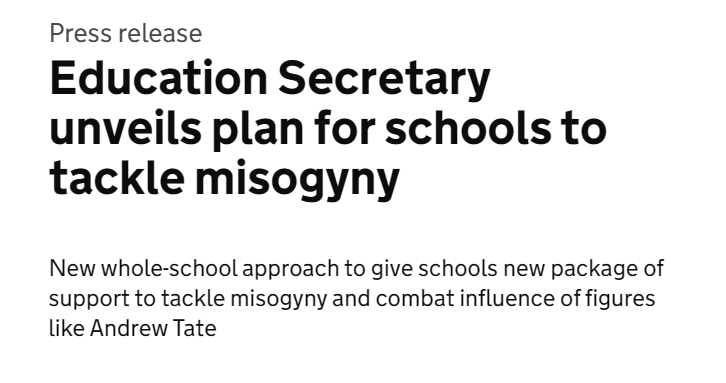
The Government has announced a new whole-school approach intended to help schools tackle misogyny, promote healthy relationships and respond to harmful online influences.
Protect & Teach supports effective, evidence-based action to protect girls from sexual harassment, abuse, coercion, image-based abuse and degrading behaviour. That is non-negotiable. Schools should be places in which girls and boys are safe, harmful conduct is challenged and children are taught how to recognise unhealthy relationships.
But safeguarding children does not remove the need for clarity, evidence, parental transparency or appropriate limits on what schools are being asked to do.
At present, several important questions remain unanswered.
What has the Government announced?
On 26 September 2026, the Department for Education said schools would be
“supported with a practical framework to tackle misogyny with resources including practical guides, teacher training and parent support”
The Department said the approach would
“help to create a culture of respect and belonging, and embed positive attitudes from classroom teaching and enrichment activities to pastoral support and interactions beyond the school gates”
The announcement also includes:
- a new £150,000 RSHE expert advisory group, to develop resources for teachers on “sensitive and complex topics”;
- two programmes under the £16 million Violence Against Women and Girls (VAWG) Prevention Programme, which began work this week: one with secondary pupils on attitudes to healthy relationships, the other with boys to challenge harmful attitudes and negative online influences;
- work with the Youth Endowment Fund involving children aged 12 to 16;
- and strengthened media-literacy teaching through future curriculum reforms, with no timetable given.
The two pilots will be tested “before being rolled out to further schools”.
The release also cites “new data”: 50% of girls reported hearing misogynistic comments from other pupils during a week at school in May, and 30% of Year 10 and 11 pupils had recently heard comments that made them worry about girls’ safety. It does not name the survey behind these figures. The source and methodology should be published.
“Required” or “supported”?
This is one of the most important distinctions in the announcement.
The Department for Education says schools will be “supported with a practical framework”.
However, in an interview published by the Guardian the same day, Education Secretary Lucy Powell was reported as saying that schools would be required to
“embed healthy relationships and belonging into every part of school life, not just RSHE [relationships, sex and health education] lessons”
The word “required” is the newspaper’s paraphrase; it sits outside the quotation marks.
Those are not the same thing.
The DfE press release does not identify new primary legislation, a new statutory instrument or a new public consultation establishing an additional legal duty on schools. Nor has the promised framework itself yet been published.
LabourList published a full text of Ms Powell’s conference speech on 27 September. That speech discusses education, belonging, school culture and wider curriculum reform, but does not mention misogyny, RSHE or any new requirement on schools. The specific schools announcement therefore rests on the DfE press release and the Guardian interview, rather than on the conference speech itself.
The schools detail rests on the DfE release and the Guardian interview.
So, at present, it remains unclear which elements will be compulsory, which will be guidance, and how any requirement would be enforced.
That distinction should be clarified before schools, parents or governors are expected to act on the announcement.
Much of the policy direction already existed
The idea of a whole-school approach is not new.
The Government’s December 2025 VAWG strategy already committed it to supporting schools to challenge misogyny and teach children about healthy relationships.
Its accompanying action plan states that
“by the end of this parliament in 2029, every state funded secondary school in England will have a credible offer for educating students about healthy and respectful relationships”.
Delivery models include the RSHE curriculum, in-house specialist training, “working with external providers to provide whole school sessions”, and mentoring, with £5 million “to pilot healthy relationships training delivered by external providers”.
The action plan also says the Government will “support schools to integrate learning about positive relationships and VAWG across every part of a child’s school life”, so that such learning “is not confined to RSHE” .
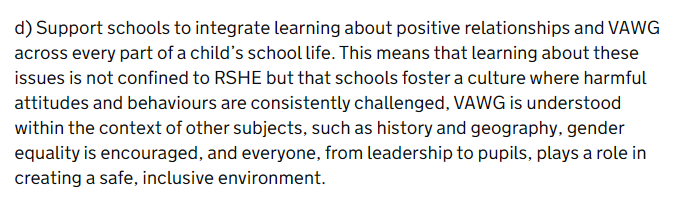
The revised RSHE statutory guidance, in force since 1 September 2026, likewise says the curriculum “is best delivered as part of a whole school approach to wellbeing and positive relationships, supported by other school policies, including behaviour and safeguarding policies”.
What is now becoming clearer is the extent to which this approach may move beyond the conventional RSHE classroom into wider school culture, behaviour, pastoral work and enrichment.
A whole-school approach creates an important boundary question
There is nothing inherently unusual about schools reinforcing safeguarding and respectful behaviour across the wider school environment. Keeping Children Safe in Education (KCSIE) 2026 already expects a zero-tolerance approach to sexual harassment, which “should never be passed off as ‘banter’ … or ‘boys being boys’”.
The difficulty arises when substantially similar material is delivered in several different settings but is subject to different rules.
A pupil might encounter healthy-relationships content through:
- a timetabled RSHE lesson;
- an assembly;
- a pastoral intervention;
- an external-provider workshop;
- a mentoring programme;
- enrichment activity;
- or behaviour-policy work.
That creates a practical question for parents:
Which rules apply where?
If content moves outside a clearly identified RSHE lesson, schools should still be able to explain what is being taught, who is delivering it, what safeguards apply and what parents are entitled to see.
What can parents see?
Parental transparency is central to confidence in RSHE, and parents should be treated as partners in their children’s education, not as obstacles to it.
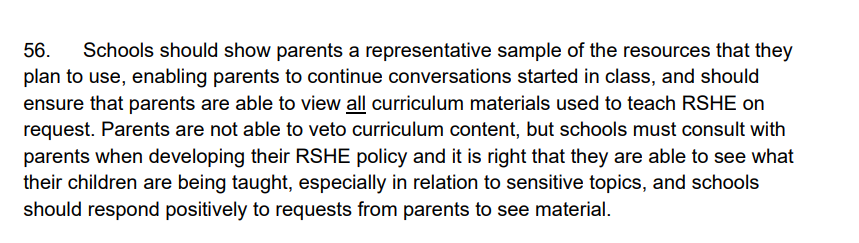
For RSHE itself, the 2026 guidance is clear. Schools should ensure parents “are able to view all curriculum materials used to teach RSHE on request”.
When contracting with external providers, schools
“should not agree to any contractual restrictions on showing parents any content”,
and copyright
“should never be used as a reason to refuse to share” materials.
External resources should be checked as “accurate, age and stage appropriate and unbiased”, with particular caution about organisations that “have a strong partisan view on a contested topic”.
These are important transparency protections within the RSHE framework. The unanswered question is how far equivalent transparency will apply when related material is delivered outside identifiable RSHE teaching?
Government should therefore explain whether parents will be able to see material used in:
- healthy-relationships assemblies;
- external workshops;
- mentoring programmes;
- pastoral interventions;
- pupil surveys;
- and behaviour-related activities.
Moving content around the school timetable should not make it harder for parents to know what their children are being taught.
The right to withdraw needs careful explanation
Parents should also be cautious about claims that this announcement has already removed or bypassed the right to request withdrawal from sex education.
Nothing in the DfE release changes it.
The key issue is more precise. Under the 2026 RSHE guidance:
- parents have the right to request that their child be withdrawn from some or all of sex education delivered as part of statutory RSE;
- in primary schools that teach sex education, head teachers must automatically grant a request, other than for content taught as part of the science curriculum;
- in secondary schools, head teachers can refuse a request in exceptional circumstances, for example because of safeguarding concerns or a pupil’s specific vulnerability;
- from three terms before a pupil turns 16, the pupil can choose to opt back into sex education even if a parent has requested withdrawal;
- there is no right to withdraw from relationships education, health education or science.
The right covers sex education only; it does not extend to safeguarding work or ordinary behaviour policies. Schools’ RSE policies should “differentiate between relationships and sex education”, so that parents have clear information.
The important question raised by the new whole-school model is therefore:
How will schools distinguish between sex education, relationships education, safeguarding, behaviour work, pastoral activity and enrichment where substantially overlapping material is delivered through several different routes?
Parents should be given a clear answer before new programmes are introduced.
Political impartiality still applies where content becomes political
Teaching children that sexual harassment, coercion and violence are wrong is not itself a partisan political proposition. DfE guidance lists “protection from violence and criminal activity” and “challenging discrimination and prejudice” among the shared principles that are not political issues in this context.
Schools do not have to manufacture a “balanced view” on whether violence against women and girls is acceptable.
However, whole-school programmes may move into areas where there are genuine political or ideological disagreements, including competing explanations of social problems, policy responses, contested theories about sex or gender, political campaigning, or wider claims about particular groups in society.
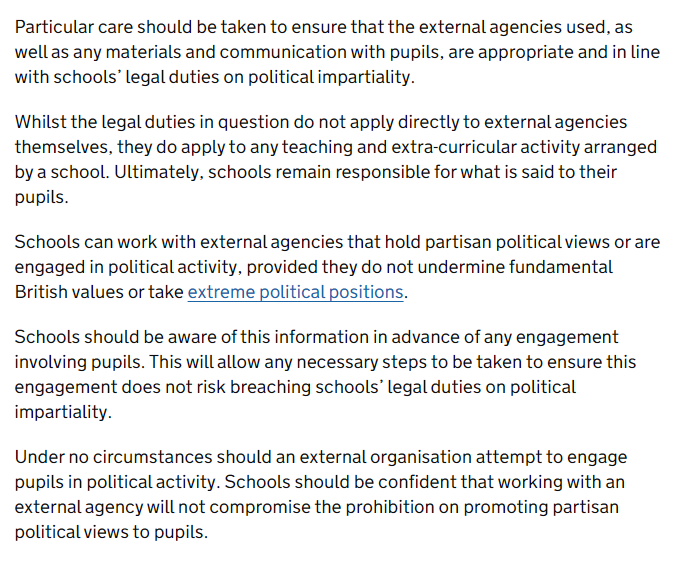
Where political issues are brought to pupils’ attention, schools remain subject to existing impartiality duties. DfE guidance states that schools “must prohibit the promotion of partisan political views” and “should take steps to ensure the balanced presentation of opposing views on political issues”. For maintained schools, those duties are set out in sections 406 and 407 of the Education Act 1996; most academies have an equivalent clause in their funding agreement, and the Independent School Standards also apply to academies.
The guidance notes that partisan political views may be held by “campaign groups, lobbyists and charitable organisations”, and that where external agencies are used, “schools remain responsible for what is said to their pupils”.
Content should be “reviewed and agreed in advance”, “age-appropriate” and “aligned to the developmental stage of pupils”.
That is especially relevant where charities, campaign organisations or external training providers are commissioned to deliver programmes to pupils. The announcement was trailed in an interview that also discussed Labour’s electoral strategy. That political context does not itself make the school programme partisan; however, once material reaches pupils, schools remain responsible for ensuring that genuinely political issues are handled in accordance with their impartiality duties.
Protecting girls must not mean treating boys as offenders-in-waiting
There is an obvious and legitimate reason to teach boys about consent, pornography, coercion, online influences and respectful relationships.
But interventions should treat children as individuals, and should distinguish between:
- perpetrators and non-perpetrators;
- harmful behaviour and unpopular opinions;
- safeguarding concerns and disciplinary issues;
- children who need support and children who pose a risk;
- and individual responsibility rather than collective guilt.
The Government’s own VAWG strategy says: “We will teach about ‘involuntary celibates’ (incels) and misogynistic influencers, without stigmatising boys”. The 2026 RSHE guidance asks schools to avoid “gendered language which might normalise male violence or stigmatise boys”.
That principle should be carried directly into the new programme, including the pilot aimed specifically at boys.
A programme intended to improve relationships should not begin by treating ordinary boys as a problem population.
What does the evidence show?
There is evidence that some relationship-violence prevention programmes can reduce harmful behaviour.
The Government’s VAWG strategy cites an international evidence review by the Youth Endowment Fund, which found that relationship-violence prevention lessons and activities “could reduce violence between young people in intimate relationships by 17% on average” .That evidence should be acknowledged.
The Youth Endowment Fund rates its confidence in the estimate as high, but notes “a lot of variation” between the 16 studies behind it, and that
“none of these studies were undertaken in England or Wales”.
But the evidence does not establish that every possible whole-school intervention works, nor does it prove that the particular programmes now being developed will achieve the same result in English schools.
The Government itself acknowledges evidence gaps, including on “what works to reduce … misogynistic and harmful content”, and “large gaps in long-term follow-up evidence and impact evidence”.
That is precisely why pilots matter, and why evidence should come before rollout.
Evaluation should examine actual outcomes, not simply whether pupils can repeat programme messages afterwards.
Protect & Teach would expect evaluation to consider:
- changes in harmful behaviour;
- sexual harassment and safeguarding incidents;
- unintended or adverse effects;
- whether boys and girls experience the intervention differently;
- age and developmental appropriateness;
- parental confidence;
- pupil freedom to ask questions and disagree;
- complaints or disciplinary consequences;
- and whether any improvement persists after the programme ends.
The evaluation criteria should be published before national expansion, not selected retrospectively.
“Misogyny” and “belonging” need operational definitions
Some conduct is straightforward. Threats, sexual harassment, degrading abuse or intimidation require an appropriate response regardless of terminology.
But schools also deal with immature language, arguments, political opinions, religious beliefs, jokes, disagreement and ordinary adolescent behaviour. Children develop at different rates, and a response that is proportionate for a 16-year-old may not be for an 11-year-old.
A behaviour framework needs to distinguish among them.
Government should therefore explain what schools will be expected to understand by “misogyny” for the purposes of this programme. “Belonging” is broader still.
It can describe a worthwhile aim: children should feel safe and included in their school.
It is also becoming a monitored policy objective. The Schools White Paper says that “by 2029, we expect every school to monitor pupils’ sense of belonging and engagement”.
It says a new Pupil Engagement Framework will be published “later this year” to support that expectation, including standard questions on belonging, safety, inclusion, relationships and motivation.
If belonging becomes an assessable policy objective, schools and parents need to know what it means in practice.
Does it concern:
- attendance;
- peer relationships;
- extracurricular participation;
- attitudes;
- speech;
- political beliefs;
- or adherence to particular values statements?
Schools cannot implement, and parents cannot scrutinise, a standard that has not been clearly defined.
What parents can do now ?
Parents do not need to wait for a national controversy before asking sensible questions.
They also do not need to assume that this announcement means their child’s school has already adopted a new programme. The framework itself has not yet been published.
The immediate step is simply to ask what, if anything, the school is currently using.
Parents can ask their child’s school:
- whether it currently uses external organisations for RSHE, healthy-relationships work or assemblies;
- what programme or materials are being used, and how parents can view them;
- whether any new programme arising from the Government announcement has been commissioned;
- how the school distinguishes RSHE from pastoral, safeguarding and behaviour interventions;
- whether pupils will complete surveys or questionnaires and what information will be collected;
- how parents will be informed before external providers work with pupils;
- what training staff receive;
- and how parents can raise concerns.
A polite request for information is entirely consistent with good parental engagement. The RSHE guidance itself says schools “should respond positively to requests from parents to see material”.
What Protect & Teach wants the Government to publish
Before wider rollout, Protect & Teach believes the Department for Education should publish:
- the complete practical framework;
- its statutory or non-statutory status;
- whether schools will be “required” to implement the approach, as the Guardian reported, and if so the legal or administrative basis for any such requirement;
- the names and interests of members of the new expert advisory group;
- the organisations commissioned to run the pilots;
- the evaluation methodology and outcome measures;
- the source and methodology of the survey data cited in the announcement;
- clear definitions of “misogyny”, “harmful attitudes” and “belonging”;
- guidance on parental transparency where material is delivered outside RSHE;
- guidance on the boundary between sex education, relationships education, safeguarding, behaviour and pastoral interventions;
- safeguards governing external organisations;
- and confirmation of how existing political-impartiality duties will be respected where programmes address genuinely political or contested issues.
Protecting girls from violence and abuse is important.
So is ensuring that programmes designed to protect children are transparent, evidence-based, developmentally appropriate and accountable.
Those objectives are not in conflict.
The Government has now announced an ambitious whole-school programme.
The next step should be to publish enough detail for parents, teachers and governors to understand exactly what it means.
Download our parent and governor guide
We have produced a practical guide to help parents, governors and school leaders ask clear questions about whole-school healthy relationships programmes, external providers, parental transparency, data collection, safeguarding and political impartiality.
Download: Whole-school healthy relationships programmes – questions parents and governors can ask or view online:
Follow the live tracker
We are maintaining a live tracker of the Government’s whole-school misogyny and healthy relationships plan, including what has been confirmed, what remains unanswered, and what Protect & Teach has formally asked the Department for Education.
Sources
- Department for Education and Rt Hon Lucy Powell MP, “Education Secretary unveils plan for schools to tackle misogyny”, press release, 26 September 2026. https://www.gov.uk/government/news/education-secretary-unveils-plan-for-schools-to-tackle-misogyny
- Jessica Elgot, “Labour must reunite progressive voters to win the next election, says Lucy Powell”, The Guardian, 26 September 2026. https://www.theguardian.com/politics/2026/sep/26/labour-must-reunite-progressive-voters-to-win-the-next-election-says-lucy-powell
- LabourList, “Deputy leader Lucy Powell addresses party conference – her speech in full”, 27 September 2026 (not an official Labour or DfE transcript). https://labourlist.org/2026/09/deputy-leader-lucy-powell-addresses-party-conference-her-speech-in-full/
- HM Government, “Freedom from violence and abuse: a cross-government strategy to build a safer society for women and girls”, Volume 1, 18 December 2025. https://www.gov.uk/government/publications/freedom-from-violence-and-abuse-a-cross-government-strategy/freedom-from-violence-and-abuse-a-cross-government-strategy-to-build-a-safer-society-for-women-and-girls-accessible
- HM Government, “Freedom from violence and abuse volume 2: action plan”, 18 December 2025 (actions 2(b)–2(d)). https://www.gov.uk/government/publications/freedom-from-violence-and-abuse-a-cross-government-strategy/freedom-from-violence-and-abuse-volume-2-action-plan-accessible
- Department for Education, “Relationships Education, Relationships and Sex Education (RSE) and Health Education”, statutory guidance in effect from 1 September 2026 (paras 14–21, 52, 56–60). https://www.gov.uk/government/publications/relationships-education-relationships-and-sex-education-rse-and-health-education
- Department for Education, “Keeping children safe in education 2026”, statutory guidance in force from 1 September 2026 (para 530). https://www.gov.uk/government/publications/keeping-children-safe-in-education–2
- Department for Education, “Political impartiality in schools”, guidance, updated 21 March 2025. https://www.gov.uk/government/publications/political-impartiality-in-schools/political-impartiality-in-schools
- Education Act 1996, section 406. https://www.legislation.gov.uk/ukpga/1996/56/section/406
- Education Act 1996, section 407. https://www.legislation.gov.uk/ukpga/1996/56/section/407
- Youth Endowment Fund, “Relationship violence prevention lessons and activities”, YEF Toolkit. https://youthendowmentfund.org.uk/toolkit/dating-and-relationship-violence-prevention/
- Department for Education, “Every child achieving and thriving” (Schools White Paper), 23 February 2026. https://www.gov.uk/government/publications/every-child-achieving-and-thriving