
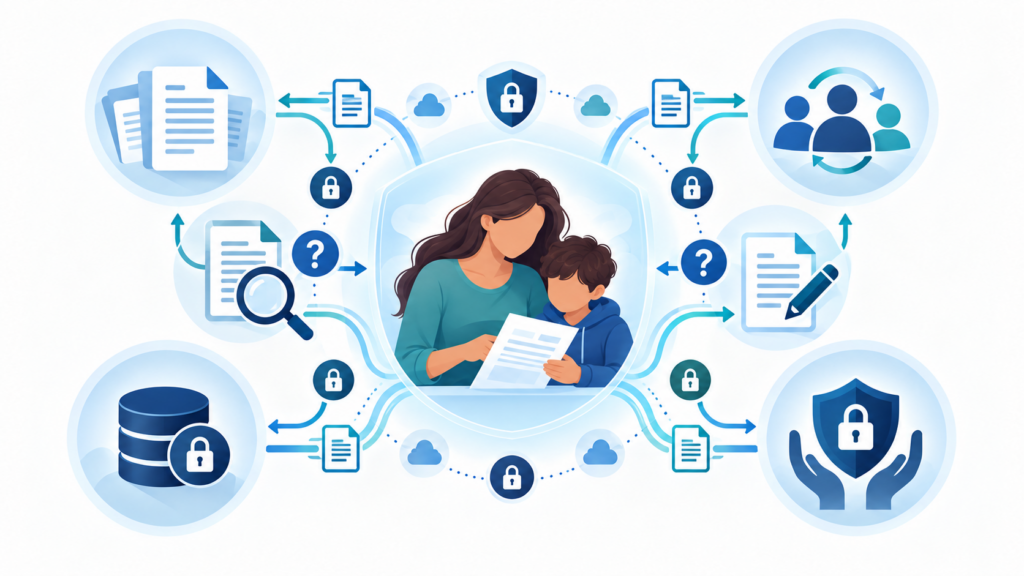
Live Tracker: Safeguarding Information-Sharing Duty
IN FORCE: Monitoring implementation of sections 16LA and 16LB Children Act 2004 from 30 September 2026
Since 30 September 2026, section 16LA of the Children Act 2004 has imposed a positive statutory duty to share relevant information in defined safeguarding and welfare circumstances.
The duty is intended to improve the sharing of information between organisations involved in safeguarding and promoting the welfare of children. It extends beyond cases in which significant harm has already been established and can operate in circumstances involving early help, prevention and emerging or unmet need.
Protect & Teach supports necessary information-sharing where it is genuinely required to safeguard children. This tracker will examine how the new duty operates in practice, including whether increased information-sharing is matched by strong safeguards around accuracy, proportionality, context, transparency, security and correction.
The new safeguarding information-sharing duty: understanding the new statutory duty, child protection and parental rights
The full Protect & Teach analysis examines the law, the Government’s rationale, parental rights, Family Help, disputed and malicious allegations, professional opinion, interoperability, rectification, privacy, retention and data security.
Status key
Current position
| Date | Status | Development | Why it matters |
|---|---|---|---|
| 10 Sept 2026 | GUIDANCE UPDATE | Department for Education updated Information sharing to safeguard children and young people as statutory guidance reflecting the new information-sharing duty. |
This is the principal operational guidance for practitioners and organisations implementing section 16LA.
View DfE guidance |
| 10 Sept 2026 | GUIDANCE UPDATE | Following consultation, DfE revised the final statutory guidance to strengthen or clarify provisions on consent, accuracy, transparency with children and families, relevance and proportionality, information about other individuals connected to a child, children with SEND, sharing across service boundaries within England and anti-discriminatory practice. |
Several of these changes address safeguards that Protect & Teach identified as important to implementation. The next question is whether they are applied consistently in frontline practice and local information-sharing arrangements.
View consultation outcome |
| 10 Sept 2026 | IMPLEMENTATION | DfE published strategic and operational template data-sharing agreements alongside the statutory guidance. | Local organisations can adapt these templates when establishing or reviewing multi-agency information-sharing arrangements. Protect & Teach will monitor how these agreements are used in practice. |
| 30 Sept 2026 | CONFIRMED | Sections 16LA and 16LB of the Children Act 2004 came into force in England. |
Section 16LA now creates an operative statutory duty, rather than merely a power to share information, where the statutory conditions are met. Section 16LB provides for information standards relating to the processing of safeguarding and welfare information.
View legislation |
| 30 Sept 2026 | P&T WATCHING | Implementation of the new duty begins across education, health, local authorities, police and other relevant safeguarding organisations. | The statutory wording relies heavily on professional judgment, including the concepts of “relevant”, “promoting welfare”, “may facilitate” and “more detrimental”. How those concepts are interpreted in practice will be important. |
| Current | GUIDANCE UPDATE | ICO safeguarding information-sharing guidance notes that some material is under review following the Data (Use and Access) Act. |
Changes could affect practical guidance on lawful sharing, security, data rights, retention or accountability.
View ICO guidance |
What changed in the final guidance?
Following consultation, the Department for Education made a number of changes to the final statutory guidance before the new duty came into force.
- Strengthened guidance on the accuracy of information.
- Strengthened expectations around transparency with children and families.
- Clarified the distinction between consent to information-sharing and consent to receive a service.
- Added further guidance on relevance and proportionality.
- Clarified sharing of information about parents and other individuals connected to a child, including links with adult social care.
- Added further welfare scenarios concerning children with SEND.
- Added specific guidance concerning information-sharing across service boundaries within England.
- Added material concerning anti-discriminatory practice.
These changes are significant because several relate directly to safeguards identified by Protect & Teach during our analysis of the new duty. Their inclusion in statutory guidance is important; this tracker will now examine how consistently those safeguards are implemented in practice.
What Protect & Teach is monitoring
1. Interpretation of “promoting welfare”
The new duty operates below the traditional significant-harm threshold. We will monitor how schools, local authorities, health services and other bodies distinguish genuinely relevant welfare information from information that is merely sensitive, interesting or potentially useful.
2. Voluntary Family Help
Family Help can remain voluntary even where information-sharing is lawful. The final DfE guidance expressly distinguishes consent to share information under data protection law from consent to receive a service. We will monitor whether that distinction is maintained in practice, whether declining voluntary support remains genuinely voluntary, and whether refusal is appropriately distinguished from safeguarding evidence.
3. Accuracy, allegations and professional opinion
We will look for evidence about how organisations distinguish observed fact, information reported by a child, third-party allegations, professional opinion and subsequent findings.
Particular attention will be paid to whether unverified information retains its source and status as it moves between organisations.
Following consultation, DfE strengthened the final guidance to include additional consideration of data accuracy. Protect & Teach will monitor whether this results in meaningful practice standards for recording source, context, evidential status and subsequent corrections or outcomes.
4. Rectification across multiple systems
Correcting inaccurate information in one organisation may not be sufficient if the original version has already been shared elsewhere. We will monitor how organisations notify recipients of corrections and whether amended information is reflected consistently across systems.
5. Information standards and interoperability
Section 16LB provides for information standards concerning safeguarding and welfare information. We will track new standards, technical specifications and implementation requirements as they are published.
Better connectivity can strengthen safeguarding, but it can also spread inaccurate or poorly contextualised information more efficiently if data-quality controls are weak.
6. Information about parents and other adults
Section 16LA can include information about another individual where that information relates to the child. Following consultation, DfE further clarified the final guidance on sharing information about other individuals connected to a child, including reference to adult social care. We will monitor how relevance, necessity, proportionality, accuracy and transparency are applied when sensitive information about parents, carers or other connected adults is shared.
7. Children with SEND
The final statutory guidance includes additional welfare scenarios concerning children with SEND. Protect & Teach will monitor whether information arising from disability, communication differences, behaviour, unmet educational need or requests for support is accurately contextualised when shared, and whether relevance, proportionality and transparency are maintained.
8. Data security and breaches
Increased lawful sharing means increased responsibility for secure transfer, access controls, audit trails and breach management. We will monitor relevant ICO guidance, enforcement and significant reported incidents involving safeguarding information.
9. Retention and historic information
We will monitor how long early-help and welfare information is retained and whether historic concerns remain accompanied by their context and eventual outcome.
10. Complaints, regulatory action and case law
Relevant ICO decisions, ombudsman findings, judicial review and other significant legal developments will be added where they clarify how the new duty should operate.
11. Evidence of benefits or unintended consequences
We will look for evidence that the duty is improving early identification of genuine safeguarding risks, as well as evidence of unintended effects such as inappropriate over-sharing, loss of context, reduced family trust or difficulty correcting inaccurate records.
Open questions
How broadly will “promoting welfare” be interpreted?
The statutory wording deliberately allows earlier intervention. The practical boundary between appropriate preventative sharing and unnecessary disclosure will depend substantially on professional judgment and organisational practice.
Will corrections reliably follow information between agencies?
Different organisations may use different recording systems and retention arrangements. We will monitor whether data-quality and rectification mechanisms keep pace with increased information-sharing.
Will voluntary support remain genuinely voluntary?
We will watch for evidence of whether declining Family Help or another voluntary service is recorded neutrally and in context, rather than automatically becoming evidence of non-engagement or safeguarding failure.
Will families remain willing to seek early help?
Earlier support depends partly on families being willing to disclose difficulties. We will monitor any emerging evidence about whether the new information-sharing environment strengthens or undermines that trust.
Protect & Teach will assess implementation against the same principle used in our policy analysis: good safeguarding is not maximum secrecy or maximum sharing. It is the right information, shared with the right person, for a clear safeguarding or welfare purpose, at the right time, with its source, context and evidential status preserved.
Official sources
Children’s Wellbeing and Schools Act 2026, section 4
Children’s Wellbeing and Schools Act 2026 (Commencement No. 2) (England) Regulations 2026
Department for Education: Information sharing to safeguard children and young people
Department for Education: Working together to safeguard children 2026
Information Commissioner’s Office: Sharing data to safeguard children FAQs
Last updated: 2 October 2026