
Media Coverage | 19 November 2026
Protect and Teach CIC has been named in an investigation published by [Un]Captured concerning the handling of a teacher’s gender transition at Alveston Church of England Primary School in Stratford-upon-Avon.
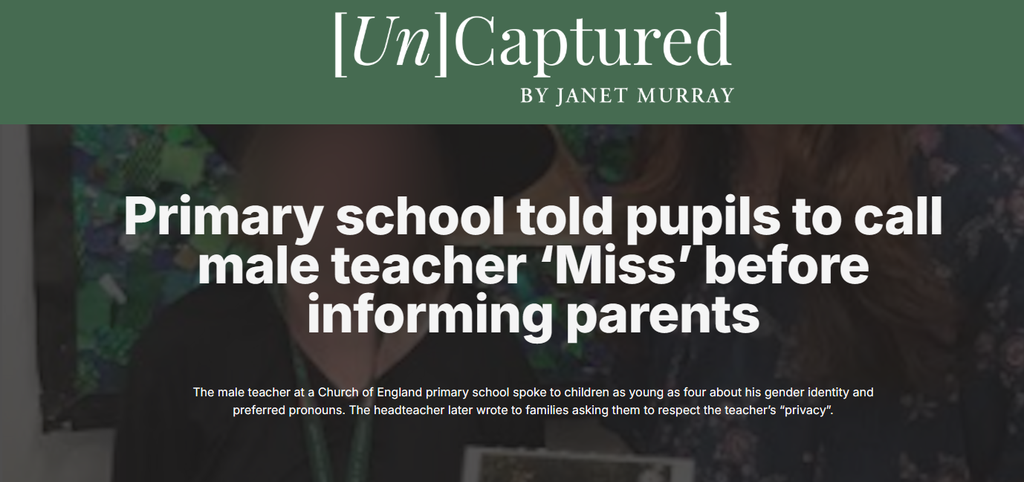
The article, written by Janet Murray and published on 18 November 2026, examines the school’s decision to inform pupils of a teacher’s change of title and pronouns before notifying parents.
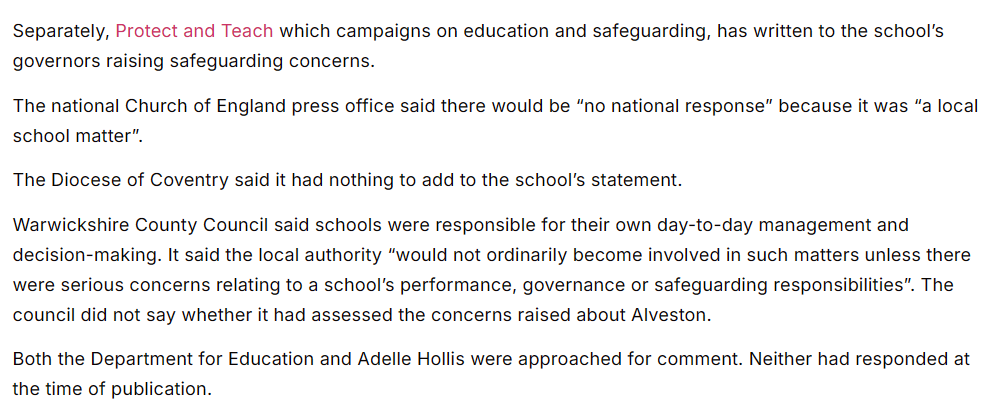
The report confirms that Protect and Teach has written to the school’s governing body raising concerns.
Read the full [Un]Captured investigation →
What has been reported?
According to the article, the headteacher wrote to parents on 3 June 2026 explaining that a teacher previously known as Mr Hollis would now be known as Miss Hollis.
The letter stated that the teacher had already shared a pronoun preference with pupils that day and invited questions.
A parent told [Un]Captured that the discussions took place separately with children from Reception through to Year 6, including children as young as four.
The parent questioned why families had not been informed beforehand and whether sufficient consideration had been given to children from families holding differing beliefs about sex and gender.
The school subsequently told [Un]Captured that its enquiry contained inaccurate and misleading information, although its published statement did not identify which details were disputed.
The school emphasised its safeguarding responsibilities, respect for the member of staff’s privacy and support for the teacher.
Protect and Teach’s concerns
Protect and Teach recognises that employees are entitled to dignity, privacy and protection from unlawful discrimination, including on grounds of gender reassignment.
Our concerns relate to the school’s reported approach to communicating the change to pupils, the involvement of parents and the professional judgement underpinning those decisions.
Schools have responsibilities towards pupils, parents and staff. These responsibilities must be considered together rather than treating the rights or interests of one group as automatically overriding those of another.
In particular, we believe the governing body should be able to explain:
- Age-appropriateness: What information was shared with pupils, and how was the discussion adapted for children at different developmental stages?
- Parental communication: Why were parents informed after pupils had reportedly been addressed, and what consideration was given to advance notification?
- Professional boundaries: Who authorised the discussions, and how were their purpose and content considered against the Teachers’ Standards?
- Freedom of belief: How would the school ensure that children and families with differing protected beliefs about sex and gender were treated fairly?
- Respectful disagreement: How would the school distinguish genuine bullying or harassment from appropriately expressed questions or disagreement?
These questions concern the school’s responsibilities and decision-making, not whether an individual teacher is entitled to respect or protection from discrimination.
What do the professional standards require?
Part Two of the Teachers’ Standards establishes expectations concerning professional conduct, including appropriate boundaries with pupils, regard for their wellbeing and respect for the rights of others.
The Equality Act 2010 also protects individuals against unlawful discrimination, including on the grounds of gender reassignment and religion or belief.
These protections require careful consideration of competing rights and circumstances. They do not mean that every disagreement is discrimination, nor do they remove the expectation that schools exercise professional judgement in their communications with children.
The reported discussions took place in June 2026, when Keeping Children Safe in Education 2025 was in force. The 2026 edition subsequently came into force on 1 September.
It is important not to confuse a question about school governance or professional judgement with an established safeguarding breach. The facts must be established before any such conclusion can be reached.
Transparency and parental confidence
A parent’s ability to raise legitimate concerns about a school’s decisions is an important part of accountability.
The [Un]Captured report describes a parent who felt unable to question the school’s approach openly because of concerns about possible repercussions.
That account has not been independently established, but it raises a question worth considering: do parents feel confident that they can respectfully challenge decisions affecting their children’s education without their concerns being dismissed or mischaracterised?
Schools should be able to promote kindness, courtesy and respect while also recognising that families may hold different protected philosophical or religious beliefs.
Respectful treatment should not require everyone to agree on every contested question.
Our position
Respect for a teacher’s rights and scrutiny of a school’s decisions are not mutually exclusive.
Protect and Teach believes that the central issues are age-appropriate communication, appropriate professional boundaries, parental transparency and fair treatment of differing beliefs.
We are not suggesting that a teacher’s gender transition, in itself, establishes a safeguarding concern or calls into question their fitness to teach.
Our concern is whether the school’s approach to communicating with pupils was appropriately considered, authorised and explained.
We hope the governors will provide a substantive response to the questions raised and clarify how the school’s decisions were reached.
Children, parents and staff all deserve clarity, fairness and professional accountability.
Read the original coverage
Janet Murray, [Un]Captured, 18 November 2026 Primary school told pupils to call male teacher ‘Miss’ before informing parents
Relevant guidance and legislation
- Department for Education — Teachers’ Standards
- Keeping Children Safe in Education 2025 — guidance applicable in June 2026
- Keeping Children Safe in Education 2026 — current guidance
- Equality Act 2010
Protect and Teach CIC will update this article if substantive further information or a response from the governing body becomes available.