
23 November 2026 | Protect and Teach CIC
Protect and Teach has written to the Department for Education requesting clarification of its published Equality Act advice for schools following the Supreme Court’s April 2025 judgment and the introduction of Keeping children safe in education 2026.
Why is Government advice from 2014 still being used in 2026?
More than eighteen months after the Supreme Court clarified the meaning of sex under the Equality Act 2010, the Department for Education (DfE) continues to publish advice for schools dating from May 2014.
The document remains available on GOV.UK, without a prominent notice on its publication page explaining how it should be interpreted following the Supreme Court’s judgment in For Women Scotland Ltd v The Scottish Ministers [2025] UKSC 16.
This matters because school leaders, governors, teachers and safeguarding professionals must apply the law as it stands today, not simply rely on guidance written before important judicial decisions and subsequent statutory guidance.
Protect and Teach is seeking answers about whether the Department has reviewed the document, whether particular passages require qualification and what schools should rely upon in the meantime.
The question is not whether the Supreme Court’s judgment applies. It does. The question is whether the Government has provided schools with sufficiently clear and up-to-date advice to apply it correctly.
The 2014 advice and its publication history
The DfE document, The Equality Act 2010 and schools: Departmental advice for school leaders, school staff, governing bodies and local authorities, was revised in May 2014.
It covers matters including discrimination, protected characteristics, single-sex education, disability and the public sector equality duty.
The document itself states that it was due to be reviewed before April 2016.
However, the GOV.UK publication history records its latest update as 28 June 2018, when a link was added to separate guidance on gender separation in mixed schools.
That webpage update did not constitute a substantive revision of the original advice.
An older document does not automatically become legally incorrect because of its age. Nevertheless, where subsequent case law clarifies the interpretation of legislation, schools need to know whether earlier official advice remains applicable without qualification.
What did the Supreme Court decide in April 2025?
On 16 April 2025, the Supreme Court delivered its unanimous judgment in For Women Scotland Ltd v The Scottish Ministers [2025] UKSC 16.
The Court held that the terms sex, woman and man in the Equality Act 2010 refer to biological sex.
Importantly, the judgment did not remove protections against discrimination because of gender reassignment. Both protected characteristics remain relevant to schools’ legal obligations.
The Court’s authoritative interpretation applies without Parliament needing to amend the Equality Act to restate it. Schools must therefore understand and apply the law as interpreted by the Supreme Court while respecting the continuing legal protections available to pupils.
A specific passage requiring clarification: paragraph 3.19
Protect and Teach has identified a particular passage in the May 2014 advice requiring clarification.
Paragraph 3.19, under the heading Single sex classes, concludes:
> Pupils undergoing gender reassignment should be allowed to attend the single sex class that accords with the gender role in which they identify.
The question is whether this statement remains accurate without qualification following the Supreme Court judgment.
There is also a need to distinguish ordinary classroom teaching from PE, sport, toilets, changing facilities and residential accommodation, which are subject to different statutory requirements.
We are not asserting that the rules applicable to these different settings are identical, or that paragraph 3.19 has necessarily been superseded in its entirety.
Rather, the Department should explain the current legal basis for the advice, identify any necessary qualifications and provide schools with clear direction.
What does KCSIE 2026 say?
Keeping children safe in education 2026 (KCSIE), statutory safeguarding guidance in force from 1 September 2026, contains provisions concerning children who are questioning their gender.
Paragraph 276 states that schools must not allow pupils into toilets, changing rooms, or boarding or residential accommodation designated for the opposite sex, with no exceptions.
Paragraph 278 states that supporting social transition will not include allowing children to join PE classes designated for the opposite sex where safety reasons justify single-sex PE.
These provisions are relevant when considering how schools should interpret earlier departmental advice. However, the legal requirements concerning single-sex classroom teaching, PE, sport and facilities should not be conflated.
The DfE’s 2014 document predates both the Supreme Court judgment and these provisions of KCSIE 2026.
Our concern is that it does not explain how paragraph 3.19 should now be read alongside them. That is precisely the clarification we are requesting.
These requirements did not begin with KCSIE 2026.
The School Premises (England) Regulations 2012 have long required schools to provide separate toilet facilities for boys and girls aged eight and over, subject to the exception for individual, internally lockable, single-user rooms. Equivalent requirements appear in the Education (Independent School Standards) Regulations 2014.
KCSIE 2026 reinforces these existing statutory obligations and provides explicit safeguarding guidance concerning access to facilities designated for the opposite biological sex.
The issue raised by Protect and Teach is therefore not whether schools were previously required to provide sex-separated toilets. They were. It is whether the DfE has adequately explained how its older Equality Act advice should be interpreted alongside existing premises legislation, the Supreme Court’s judgment and current safeguarding guidance.
Schools should not have to reconcile conflicting interpretations themselves
Schools already operate within a complex framework of statutory duties.
These include obligations relating to equality, safeguarding, reasonable adjustments, privacy, dignity, educational participation and access to appropriate facilities.
They must also apply current statutory safeguarding and Relationships, Sex and Health Education guidance.
The Equality and Human Rights Commission (EHRC) conducted a consultation in 2026 on technical guidance for schools, which closed on 30 September 2026.
Meanwhile, the EHRC’s 2026 Code of Practice for services, public functions and associations addresses a wider legal framework. The education-specific obligations applying to schools under Part 6 of the Equality Act must be distinguished from that broader framework.
This makes coordination between the Department and the EHRC particularly important.
A school should not be expected to determine, without clear official explanation, whether examples contained in older departmental advice remain appropriate following a binding Supreme Court judgment.
That does not mean every school referencing the May 2014 advice is acting unlawfully. Citing an older document is not, by itself, evidence of an Equality Act breach. The concern is whether schools are receiving clear, consistent and legally accurate guidance.
What Protect and Teach is asking the DfE
Our correspondence is addressed to Georgia Gould OBE MP, Minister of State for School Standards, copied to Bridget Phillipson MP, Minister for Women and Equalities.
We have raised eight substantive questions covering:
- Whether a formal legal or policy review of the May 2014 advice has taken place following the Supreme Court judgment.
- Whether the Department considers the advice accurate and suitable for use in its entirety.
- Why the GOV.UK publication page does not prominently acknowledge subsequent case law and guidance.
- Whether the Department intends to amend, withdraw, replace or annotate the document.
- What interim guidance schools have received concerning the Supreme Court judgment.
- How schools should reconcile the 2014 advice with KCSIE 2026, current RSHE guidance and applicable EHRC guidance.
- What steps are being taken to ensure schools distinguish biological sex, gender reassignment and concepts or policy positions that are not themselves protected characteristics.
- How the Department is coordinating with the EHRC to ensure consistency between different equality guidance documents and their respective legal scopes.
A separate Freedom of Information request
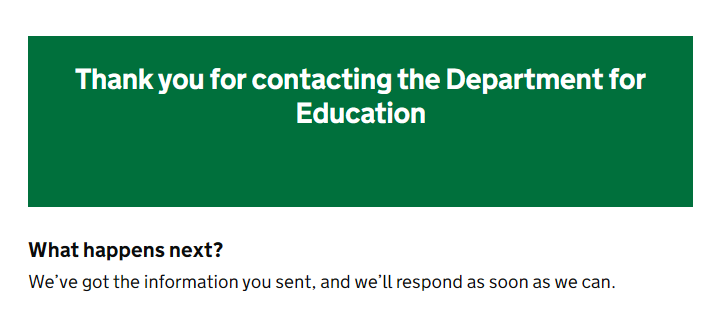
In addition to requesting a current policy explanation, our letter includes a formal request under the Freedom of Information Act 2000.
We are seeking copies of recorded reviews, legal or policy assessments, internal briefings, decision records and correspondence held by the Department concerning the accuracy or revision of the May 2014 advice following the Supreme Court judgment.
A request asking the Department to explain its current policy position is different from a Freedom of Information request seeking records that already exist.
The two processes serve different purposes, and we believe both are necessary to establish what consideration has been given to the continued publication of the 2014 document.
The Department may be entitled to withhold certain information under applicable FOI exemptions. We have asked it to identify any exemptions relied upon and disclose material that can lawfully be released.
What we want the Department to do
Protect and Teach has requested five practical actions:
- Confirm the status and accuracy of the May 2014 advice.
- Identify any passages requiring qualification following the Supreme Court judgment and KCSIE 2026.
- Publish a prominent interim clarification on GOV.UK where necessary.
- Provide a timetable for reviewing or replacing the document.
- Explain what schools should rely upon in the meantime.
These requests are intended to improve legal certainty and assist schools in meeting their responsibilities.
Why this matters for children, parents and professionals
The consequences of unclear guidance are not merely administrative. Schools make decisions affecting children’s privacy, dignity, educational participation, safeguarding and protection against discrimination.
Those decisions can also affect parental confidence, professional accountability and the consistency with which schools apply statutory duties. Protecting pupils from unlawful discrimination and ensuring their safety are not competing objectives. Schools must meet both. Schools must fulfil all applicable legal obligations, taking account of the different statutory rules governing different situations.
Clear, current and legally accurate guidance is therefore essential.
Our concern is not that every school has misunderstood the law. It is that the Government should not leave schools unnecessarily uncertain about how its own advice should be interpreted.
Read our correspondence to the Department for Education
[Letter sent to the DfE, dated 23 November 2026]
We are publishing the correspondence in the interests of transparency so that parents, governors, school leaders, safeguarding professionals and policymakers can see the specific questions raised.
We will report the Department’s response and distinguish confirmed explanations from any questions that remain unanswered.
Our position
The Equality Act must be applied as Parliament enacted it and as the courts have authoritatively interpreted it. Schools should not be expected to reconcile old departmental advice, subsequent judgments and newer statutory guidance without clear assistance from the Government responsible for issuing that advice.
This is about legal certainty, transparency and safeguarding, not making assumptions about the conduct of individual schools or the rights of particular pupils.
Schools deserve clear guidance. Children deserve lawful, consistent decisions. Parents deserve to know which standards are being applied.
Protect and Teach is asking the Department for Education to demonstrate that its published advice meets those requirements.
Sources and further reading
- DfE Equality Act 2010: advice for schools (May 2014)
- UK Supreme Court For Women Scotland Ltd v The Scottish Ministers [2025] UKSC 16
- DfE Keeping children safe in education 2026
- DfE Including guidance on children who are questioning their gender in KCSIE
- EHRC Technical guidance for schools consultation 2026
- EHRC Technical guidance for schools in England
- Government Equality Act 2010: Code of Practice for services, public functions and associations 2026
- DfE Relationships and sex education and health education guidance
Protect and Teach CIC | Evidence-informed analysis of education, safeguarding, equality and public policy.