
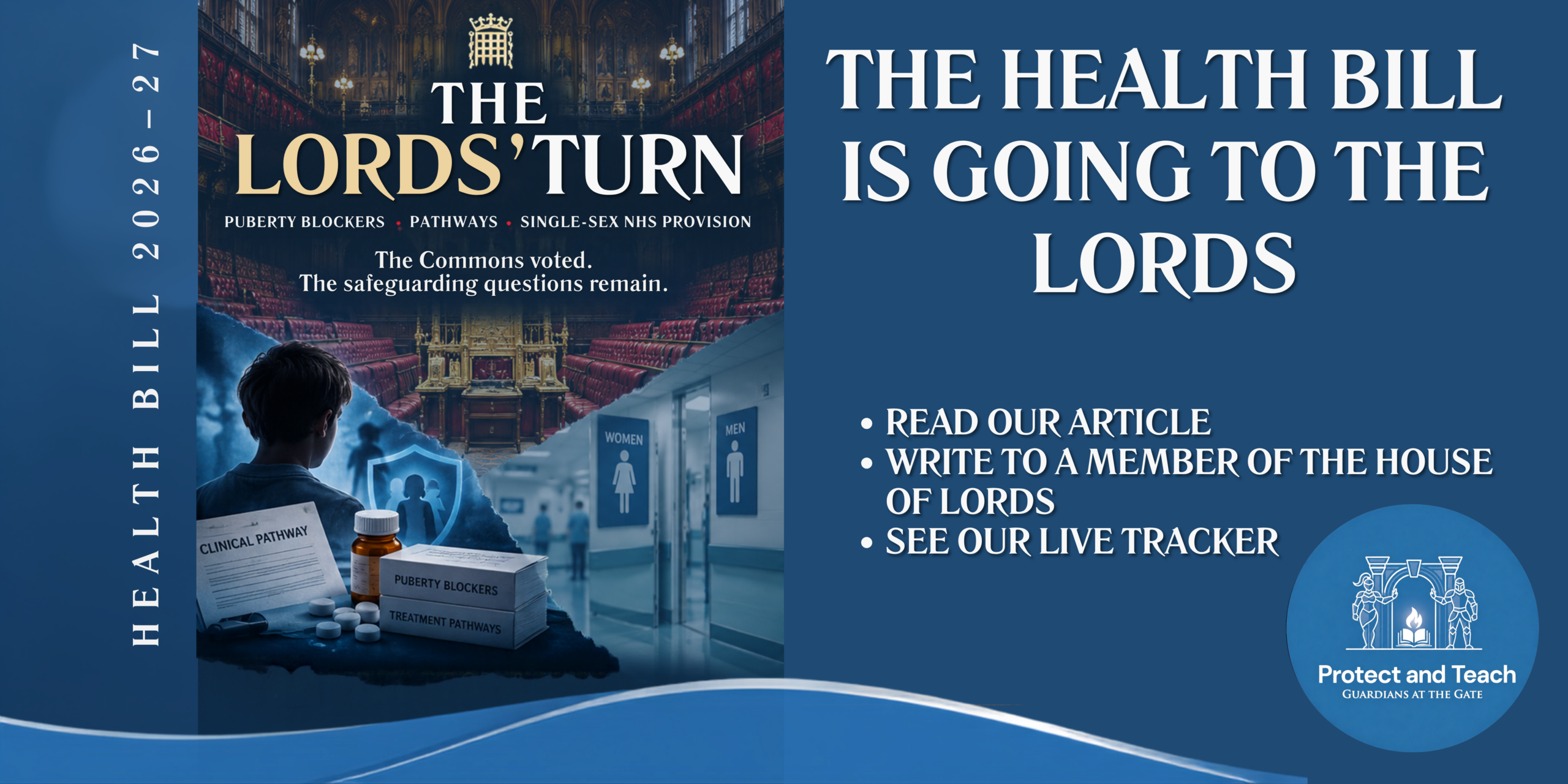
Two proposed safeguards were rejected as the Health Bill left the Commons. As the Bill reaches the House of Lords, Protect & Teach examines what MPs rejected, why we believe serious safeguarding questions remain, and what peers can still do.
Protect & Teach CIC | 6 October 2026
The Health Bill will receive its Second Reading in the House of Lords on Tuesday 13 October 2026.
It is a substantial Bill. Its principal purpose includes abolishing NHS England and transferring functions elsewhere within the health system, alongside wider reforms to NHS structures, patient safety, data and accountability. It completed its Commons stages on 8 September and was introduced into the Lords the following day as HL Bill 52. (See House of Commons Library)
But two questions which did not make it into the Bill deserve particular attention as it enters the Lords.
On 8 September MPs rejected two new clauses proposed by Conservative MP and paediatrician Dr Caroline Johnson.
New Clause 142 concerned puberty-suppressing drugs for children and young people experiencing gender dysphoria or gender incongruence.
New Clause 143 concerned single-sex NHS facilities for patients and staff.
Neither proposal became law. Neither appears in the Bill now before the Lords.
But that does not necessarily end Parliament’s consideration of the underlying issues.
Peers can scrutinise them at Second Reading and, subsequently, members of the House of Lords may table new amendments during the Bill’s later stages.
The question is therefore not whether the Lords can somehow resurrect Commons amendments numbered NC142 and NC143. Those amendments fell.
The question is whether peers should revisit the issues they raised.
For Protect & Teach, those issues concern fundamental principles: the protection of children from avoidable harm; the ethical limits of medical research involving children; informed consent; evidence-based practice; and the privacy, dignity and safety of NHS patients and staff.
Where is the Health Bill now?
The Bill was introduced in the Commons on 14 May 2026, received its Commons Second Reading on 1 June and completed Report Stage and Third Reading on 8 September. It received its formal First Reading in the House of Lords on 9 September.
Second Reading in the Lords is scheduled for 13 October. This is the stage at which peers debate the overall principles and major issues raised by a Bill.
If the Bill receives its Second Reading, Baroness Merron is proposing that it should then be considered by a Committee of the Whole House. That means the detailed Committee scrutiny would take place in the Lords chamber and all peers would be entitled to participate.
There is already a sign that the adequacy of the Bill’s Commons scrutiny may itself become an issue.
Lord Rooker has tabled an amendment to the proposed committal motion seeking a ministerial statement identifying clauses, schedules and amendments which the Commons did not have time to consider on the floor of the House before Committee stage begins in the Lords.
That matters because the Lords is not simply being asked to repeat the Commons debate. Its constitutional role includes detailed scrutiny and asking whether legislation leaving the elected House requires amendment.
1. Puberty blockers: what did MPs reject?
NC142 would have required the Secretary of State, within three months of Royal Assent, to make regulations preventing puberty blockers from being prescribed, dispensed or supplied to anyone under 18 for treatment related to gender dysphoria or gender incongruence anywhere in the United Kingdom.
But there was an important second element.
It would also have prevented those drugs being used in clinical trials for those purposes unless the particular trial had been specifically approved by resolutions of both Houses of Parliament.
That distinction matters.
The Commons was therefore not simply deciding whether routine prescribing should be prohibited. MPs were also being asked whether Parliament itself should have an additional role in authorising clinical trials involving puberty-suppressing medication for this group of children.
On 8 September the Commons rejected NC142: Ayes: 108 v Noes: 357
The proposal therefore fell by 249 votes. Votes in Parliament
There was, however, some cross-party support for it. Parliament’s amendment record lists sponsors from the Conservatives, Labour, Reform UK, the DUP and independent MPs.
This was not a vote on routine NHS prescribing as it existed before Cass
The context is important. Routine NHS prescribing of puberty blockers for children with gender dysphoria had already ended in March 2024.
The Government subsequently made restrictions on the sale and supply of puberty-suppressing hormones for gender dysphoria or gender incongruence to under-18s indefinite following advice from the Commission on Human Medicines. The restrictions are due for review in 2027. The unresolved issue is therefore substantially about research access and the evidential pathway from here.
That brings us to PATHWAYS.
2. The PATHWAYS trial
PATHWAYS is a UK-wide research programme investigating puberty-suppressing medication in children and young people experiencing so-called ‘gender incongruence’. The proposed trial is intended to recruit 226 children and young people under 15 years and 11 months and investigate outcomes including quality of life, mental health, gender-related outcomes, cognition and brain development, physical health and bone density.
King’s College London says there is currently insufficient information about the possible benefits and risks experienced by young people taking puberty-suppressing hormones and that PATHWAYS is intended to help address that gap.
Its history has already been complicated. The trial originally received regulatory and Research Ethics Committee approval in November 2025.
In February 2026, however, the Medicines and Healthcare products Regulatory Agency raised concerns and preliminary work was paused while those concerns were examined. Following discussions with the sponsor, King’s College London, the protocol was modified.
The MHRA describes the study as investigating effects on matters including:
- quality of life;
- mental health;
- physical development;
- cognitive function; and
- gender-related distress
The revised arrangements included additional safeguards concerning matters including minimum ages for entry, bone health, cognition, vaginal bleeding and information about fertility preservation. The modified protocol received the necessary regulatory and ethical approvals in June.
A legal challenge followed.
On 31 July 2026, the High Court refused applications seeking permission for judicial review and an order stopping the trial.
The Health Research Authority subsequently stated that PATHWAYS had the necessary approvals to begin recruitment in accordance with the approved protocol.
At the time of writing, however, King’s College London’s public PATHWAYS page describes the project’s status as “Starting”. We have therefore not assumed that recruitment has actually commenced. King’s College London
That distinction should be kept clear.
What was the argument in Parliament?
Dr Johnson argued that significant uncertainty remains about the long-term effects of puberty suppression and questioned whether the trial should proceed in its present form.
Opponents took a very different position.
Labour MP Kate Osborne argued that NC142 would harm access to healthcare and said that, if treatment is to depend upon further research, PATHWAYS should proceed without further delay. There is therefore a genuine policy disagreement here.
One side argues that the remaining uncertainty itself justifies greater restriction and parliamentary oversight. The other argues that uncertainty is precisely why controlled research is required. That is a more accurate description of the dispute than presenting it simply as being “for” or “against” puberty blockers.
Research is important. Evidence matters.
But safeguarding requires us to ask a prior question:
What risk is the individual child being asked to bear so that researchers can obtain that evidence?
And it gives the Lords several legitimate questions to examine.
Protect & Teach’s position: safeguarding children must come before the pursuit of further data
Protect & Teach opposes the PATHWAYS trial on ethical and safeguarding grounds.
Our concern is not simply that the evidence supporting puberty suppression for gender dysphoria is weak. Nor is our concern resolved by saying that further research is needed precisely because the evidence is weak.
Children are not simply a means by which gaps in an evidence base can be filled.
Puberty blockers deliberately suppress the normal hormonal processes of puberty. Government material underpinning the restrictions on their use records concerns about physical, psychosexual and cognitive development, bone health and fertility. It also records NICE’s finding that puberty blockers may reduce the expected increase in bone density during puberty, while evidence of benefit in areas including gender dysphoria, mental health, body image and psychosocial functioning was of low quality and did not demonstrate any statistically significant benefit, if any.
These concerns are not merely historical.
In February 2026, the MHRA raised new concerns specifically relating to the safety and wellbeing of children and young people who would participate in PATHWAYS, causing preparations for the trial to be paused.
The subsequently modified protocol introduced additional safeguards, including minimum ages for entry and clearer stopping criteria concerning bone health, cognition and vaginal bleeding, together with more detailed information about fertility preservation. Those safeguards may reduce particular risks.
They do not make those risks disappear.
For Protect & Teach, that distinction goes to the heart of the ethical problem.
There is an important difference between conducting research to observe children receiving an intervention that they would already receive as established treatment, and deliberately exposing children to a medical intervention within a trial in order to establish more reliable evidence about its effects, benefits and harms.
PATHWAYS exists precisely because important questions remain unanswered.
Protect & Teach does not accept that an inadequate evidence base justifies exposing another cohort of children to the intervention in order to improve that evidence base.
Safeguarding requires more than regulatory approval
Safeguarding is fundamentally concerned with protecting children from avoidable harm. That principle should not become weaker because an intervention occurs within a research protocol.
Children and young people recruited to PATHWAYS will be experiencing gender incongruence and may be experiencing significant distress. Their age and circumstances demand greater protection from risk, not a lower threshold because researchers need better evidence.
The ethical question is therefore not merely:
Can this trial be designed with sufficient monitoring and stopping rules to satisfy regulators?
It is:
Is it ethically acceptable to expose children to the known physiological consequences and identified potential harms of puberty suppression when the clinical benefits remain uncertain, for the purpose of obtaining better evidence?
Protect & Teach’s answer is no.
We recognise that the MHRA has accepted the modified protocol as meeting the applicable regulatory standards and that the Research Ethics Committee has approved it. Those are important facts and should not be obscured. But regulatory approval and ethical agreement within the clinical-trial system do not prevent Parliament, safeguarding organisations, parents or the wider public from questioning whether the trial should take place at all.
Indeed, the fact that the MHRA considered additional safeguards necessary around bone health, cognition and other outcomes illustrates why those questions deserve serious scrutiny.
The child must remain the primary consideration
Research can benefit future patients. But the interests of future patients cannot simply displace the interests of the child participating today.
For Protect & Teach, the safeguarding principle is straightforward:
The individual child must never become the means by which uncertainty about an intervention is resolved if participation exposes that child to harms or developmental interference that cannot be justified by a sufficiently established therapeutic benefit to that child.
That is why we believe the House of Lords should revisit the issue raised by NC142.
The question is bigger than whether PATHWAYS has passed the existing regulatory process.
It is whether using puberty-suppressing medication experimentally in children experiencing gender-related distress is compatible with the level of protection we ordinarily expect safeguarding systems to afford children.
3. If the evidence is uncertain, who carries the risk?
NC142 contained an unusual and significant proposition: that a clinical trial involving puberty suppression for gender dysphoria or incongruence could proceed only with the express approval of both Houses of Parliament.
That raises a question beyond this particular treatment.
Ordinarily, clinical trials are scrutinised through specialist regulatory, scientific and research-ethics processes. PATHWAYS has been considered by the MHRA and a Research Ethics Committee, and its revised protocol underwent further scrutiny following the concerns raised in February.
- Would requiring Parliament additionally to approve an individual clinical trial provide an extra democratic safeguard?
- Or would it substitute political decision-making for specialist regulatory and ethical scrutiny?
Those are legitimate arguments on both sides, and the Commons vote did not resolve the underlying ethical question.
But that procedural question does not answer the substantive safeguarding question.
Regulatory approval tells us that PATHWAYS has satisfied the applicable regulatory and research-ethics processes. It does not require Parliament or the public to conclude that exposing children to the intervention is ethically justified.
For Protect & Teach, the central question remains:
If significant uncertainty about an intervention is the reason further evidence is required, who carries the risk while that evidence is generated?
In PATHWAYS, it is the participating child.
That is why we believe peers should examine not merely whether PATHWAYS has been properly authorised, but whether the trial itself is compatible with safeguarding children from avoidable harm.
4. A second issue was also rejected: Single-sex NHS facilities
NC143 has sometimes been described simply as an amendment about “single-sex wards”. That understates it.
The actual proposed clause would have required the Secretary of State to ensure the availability of single-sex:
- changing rooms for NHS staff;
- toilets and washing facilities for NHS staff;
- wards for NHS patients; and
- toilets and washing facilities for NHS patients.
It also expressly allowed exemptions concerning patient wards and facilities where necessary for:
- children;
- intensive care;
- critical care; and
- specialist high-observation areas, including A&E resuscitation and initial theatre recovery.
On 8 September MPs rejected it: Ayes: 106 v Noes: 302. Votes in Parliament
Again, the underlying question has not disappeared merely because the amendment was defeated.
5. What does the NHS currently promise?
This is particularly important because the NHS’s own national guidance is presently unresolved.
Following the Supreme Court’s April 2025 judgment in For Women Scotland Ltd v The Scottish Ministers, NHS England announced that its 2019 Delivering same-sex accommodation guidance was being reviewed.
As of our check on 6 October 2026, NHS England’s own page still says that review is taking place.
In the meantime, providers of NHS-funded care are expected to meet patients’ clinical needs, safeguard them from harm and protect their privacy and dignity. Providers are also expected to continue recording breaches of the NHS Constitution pledge on same-sex accommodation.
NHS England says revised guidance will be published “as soon as possible”. NHS England
That means Parliament is considering substantial legislation concerning the NHS while national guidance governing an issue directly affecting privacy, dignity and safeguarding remains under revision following a Supreme Court judgment delivered approximately eighteen months ago.
Protect & Teach believes that deserves scrutiny, and creates an obvious question for the Lords:
If Parliament is being asked to legislate extensively about the future structure and governance of the NHS while national same-sex accommodation guidance remains under review, should Parliament leave this matter entirely to policy and guidance?
Or should some requirements appear expressly in legislation?
That was essentially the question NC143 attempted to answer.
The issue concerns NHS staff too
NC143 was not confined to patient accommodation. It also covered single-sex changing rooms, toilets and washing facilities for NHS staff.
The practical significance of this issue can be seen in Hutchinson and others v County Durham and Darlington NHS Foundation Trust, concerning NHS staff changing-room arrangements. The Employment Tribunal upheld a number of the nurses’ complaints, including claims concerning harassment and indirect sex discrimination.
The judgment does not establish that every NHS facility must operate precisely as NC143 proposed. But it demonstrates that questions surrounding staff changing facilities engage real issues of privacy, dignity and employment law, rather than being merely hypothetical.
6. Permission is not the same as a guarantee
There is an important distinction at the heart of the debate.
Existing equality law can permit separate- and single-sex services where the statutory requirements are satisfied.
NC143 sought something different.
It attempted to create an express statutory requirement that specified NHS facilities be single-sex, subject to defined exceptions.
The questions for Parliament are therefore not simply:
Can an NHS provider lawfully provide a single-sex facility?
but:
Should patients and staff be entitled to expect specified single-sex provision without having to depend upon variable local interpretation, policy or implementation?
And:
Should something as fundamental as bodily privacy in toilets, washing, changing and hospital accommodation rest principally upon guidance, or should Parliament establish a statutory minimum?
Protect & Teach’s position is that clear single-sex provision is an important safeguard for privacy, dignity and safety, while appropriate additional arrangements can and should be made for individuals requiring them.
That is why we believe the substance of NC143 also deserves further consideration in the Lords.
7. What has this got to do with schools?
At first sight, puberty-blocker trials and NHS accommodation might appear remote from Protect & Teach’s work with education and safeguarding.
They are not.
Children do not live in institutional silos.
A child supported by a teacher or designated safeguarding lead may simultaneously be receiving support from health services, children’s social care or other agencies.
- Schools do not prescribe medication.
- Teachers should not attempt to make clinical decisions.
- But schools are part of the safeguarding system surrounding the same children affected by these policies.
Since 1 September 2026, Keeping Children Safe in Education 2026 has been the statutory safeguarding guidance in force for schools and colleges in England.
KCSIE expressly says:
“Safeguarding is everyone’s responsibility.”
It requires a child-centred approach and says schools and colleges form part of a wider safeguarding system alongside children’s social care, police and health services.
The Government also deliberately brought guidance concerning children questioning their gender within KCSIE so that their wellbeing and safeguarding could be considered within the established statutory safeguarding framework.
That is directly relevant.
8. KCSIE now requires a safeguarding approach
The Government’s approach to children questioning their gender emphasises consideration of the individual child’s best interests, parental involvement, clinical input where available, wider vulnerabilities and the effect of decisions upon other children.
The same framework also deals expressly with single-sex facilities.
The Government says schools must not permit children aged eight and over to use toilets designated for the opposite biological sex, or children aged eleven and over to use changing rooms designated for the opposite biological sex, and should provide suitable alternatives where necessary without compromising single-sex provision.
That creates an important point of principle.
In education, the Government has explicitly placed questions concerning gender-questioning children and single-sex facilities within a safeguarding framework.
Protect & Teach believes comparable clarity about safeguarding, bodily privacy and the protection of children should inform decisions made elsewhere too.
That does not mean applying school rules to hospitals.
It means applying the same fundamental principle: start with the welfare of the individual child.
9. What can the House of Lords actually do?
The Lords cannot simply vote again on Commons “NC142” and “NC143”.
Those amendments fell.
If peers wish to revisit either issue, a member of the House of Lords would need to table a new Lords amendment. It could reproduce aspects of the Commons proposal, modify them substantially or adopt a different approach.
Second Reading on 13 October provides peers with an opportunity to raise the principles involved.
If the Bill receives its Second Reading, Baroness Merron has proposed that it proceed to a Committee of the Whole House, meaning detailed scrutiny would take place on the floor of the Lords rather than in a smaller Grand Committee.
There is already a wider scrutiny issue on the Order Paper.
Lord Rooker has tabled an amendment seeking a ministerial statement identifying provisions and amendments which the Commons did not have time to consider on the floor of the House before Lords Committee stage begins.
The Lords therefore has an opportunity not merely to repeat the Commons debate, but to examine issues that peers consider insufficiently resolved.
10. Questions now facing the Lords
The Lords stages provide an opportunity for closer scrutiny of both issues.
For PATHWAYS, the central question for Protect & Teach is whether exposing children to the known physiological effects, identified safety concerns and unresolved uncertainties of puberty suppression for the purpose of obtaining further evidence is compatible with safeguarding them from avoidable harm.
Protect & Teach’s position is that it is not.
On single-sex NHS provision, Parliament must consider whether privacy, dignity and safety are adequately protected through existing law, NHS guidance and local policy, or whether clearer statutory provision is required.
Protect & Teach will provide peers with a separate briefing setting out the detailed questions we believe require examination during the Bill’s Lords stages.
11. The Commons voted. The safeguarding questions remain.
It is important to describe what happened on 8 September accurately.
- The House of Commons rejected two particular proposed new clauses.
- It did not establish that puberty suppression is harmless.
- It did not resolve the ethical objections to PATHWAYS.
- It did not complete the evidence base concerning puberty blockers.
- And it did not make the questions of privacy, dignity and single-sex NHS provision disappear.
- The Health Bill has now moved to another House of Parliament.
- That gives peers an opportunity to look again.
For Protect & Teach, the starting point should be straightforward:
Safeguarding is not an obstacle to research.
Safeguarding determines the limits within which research involving children should be permitted.
And where children are being asked to bear the consequences of an intervention precisely because significant uncertainty remains about that intervention, the burden of justification must be exceptionally high.
Likewise, privacy and dignity should not become abstract concepts when a patient enters hospital or an NHS employee enters a changing room.
These are practical safeguards affecting real people.
The Commons has had its say on NC142 and NC143.
On 13 October, scrutiny passes to the House of Lords.
Protect & Teach will be watching what happens next.
Protect & Teach will track the Health Bill
We will shortly launch a Health Bill Live Tracker, following:
Lords Second Reading – 13 October 2026 • any Lords amendments concerning puberty blockers or PATHWAYS • any amendments concerning single-sex NHS provision • PATHWAYS developments • revised NHS England same-sex accommodation guidance • Committee • Report • Third Reading • consideration of Lords amendments by the Commons • Royal Assent.
Follow the Health Bill on the official UK Parliament website
Follow this issue
This Bill is continuing through Parliament. Protect & Teach will be following developments as it progresses through the House of Lords.
🔎 Follow our Health Bill 2026–27 Live Tracker
Track parliamentary stages, Lords amendments and developments concerning PATHWAYS, puberty blockers and single-sex NHS provision.
[VIEW THE LIVE TRACKER]
✉️ Write to a member of the House of Lords
We have prepared a template letter for readers who wish to ask a Peer to scrutinise these issues during the Bill’s Lords stages.
[VIEW / DOWNLOAD THE TEMPLATE LETTER]
About this analysis
Protect & Teach distinguishes throughout this article between established facts and regulatory decisions, areas of evidential uncertainty, and our own safeguarding and policy conclusions.
The fact that we disagree with a regulatory or policy decision does not alter what that decision was. Equally, the existence of regulatory approval does not prevent scrutiny of its ethical or safeguarding implications.
This article was last checked on 6 October 2026. Parliamentary proceedings, clinical-trial information and NHS guidance may change. Substantive developments will be recorded in our Health Bill Live Tracker.
References and primary sources
Department for Education. Including guidance on children who are questioning their gender in Keeping Children Safe in Education (KCSIE). Government explanation of the approach incorporated into statutory safeguarding guidance, including children’s best interests, parental involvement, clinical advice, vulnerabilities, social transition and legal requirements concerning single-sex facilities. Available online at: https://www.gov.uk/government/publications/including-guidance-on-children-who-are-questioning-their-gender-in-kcsie
Department for Education. Keeping Children Safe in Education 2026. Statutory safeguarding guidance applying to schools and colleges in England from 1 September 2026. Available online at: https://www.gov.uk/government/publications/keeping-children-safe-in-education–2
Department for Education. Keeping Children Safe in Education 2026, Part One. Includes the position of schools and colleges within the wider safeguarding system alongside children’s social care, police and health services. Available online at: https://assets.publishing.service.gov.uk/media/6a9088e19a177a1decf97b01/Keeping_children_safe_in_education_2026_Part_one.pdf
Department of Health and Social Care. Ban on puberty blockers to be made indefinite on experts’ advice. Government announcement following advice from the Commission on Human Medicines concerning restrictions on puberty blockers for under-18s experiencing gender dysphoria or gender incongruence. Available online at: https://www.gov.uk/government/news/ban-on-puberty-blockers-to-be-made-indefinite-on-experts-advice
Department of Health and Social Care. The Handbook to the NHS Constitution for England. Includes current expectations concerning sleeping accommodation, bathroom and toilet provision and women-only day spaces within mental-health settings. Available online at: https://www.gov.uk/government/publications/supplements-to-the-nhs-constitution-for-england/the-handbook-to-the-nhs-constitution-for-england
Employment Tribunal. Ms B Hutchinson and others v County Durham and Darlington NHS Foundation Trust (2501192/2024 and others). Employment Tribunal decision concerning complaints arising from NHS staff changing-room arrangements. Available online at: https://www.gov.uk/employment-tribunal-decisions/ms-b-hutchinson-and-others-v-county-durham-and-darlington-nhs-foundation-trust-2501192-slash-2024-and-others
Health Research Authority. An update on the PATHWAYS Trial. HRA information concerning regulatory and ethical consideration of the PATHWAYS protocol. Available online at: https://www.hra.nhs.uk/about-us/news-updates/an-update-on-the-pathways-trial/
Health Research Authority. Our response to the outcome of a legal challenge of the PATHWAYS Trial. HRA response following the July 2026 High Court proceedings, including the position concerning approvals and recruitment. Available online at: https://www.hra.nhs.uk/about-us/news-updates/our-response-to-the-judicial-review-decision-on-pathways-trial/
House of Commons. Health Bill, Report stage debate, 8 September 2026. Parliamentary debate surrounding the Bill and proposed new clauses, including competing arguments concerning puberty blockers, PATHWAYS and single-sex NHS provision. Available online at: https://hansard.parliament.uk/Commons/2026-09-08/debates/75FDFFB2-DB84-43F7-BA06-DC35923F9851/HealthBill
House of Lords. Business for 13 October 2026: Health Bill, Second Reading and instruction. Second Reading of the Health Bill and proposed committal to a Committee of the Whole House. Available online at: https://lordsbusiness.parliament.uk/ItemOfBusiness?itemOfBusinessId=176887§ionId=38&businessPaperDate=2026-10-13
King’s College London. PATHWAYS Trial. Official research project page. At the time of Protect & Teach’s check on 6 October 2026, the project was publicly described as “Starting”. Available online at: https://www.kcl.ac.uk/research/pathways-trial
Medicines and Healthcare products Regulatory Agency. MHRA statement on the PATHWAYS puberty blocker trial. Government/MHRA account of regulatory consideration of the PATHWAYS trial. Available online at: https://www.gov.uk/government/news/mhra-statement-on-the-pathways-puberty-blocker-trial
NHS England. Delivering same-sex accommodation. NHS England guidance concerning same-sex accommodation. The page currently records that the guidance is being reviewed following the Supreme Court judgment in For Women Scotland. Available online at: https://www.england.nhs.uk/publication/delivering-same-sex-accommodation/
UK Parliament. Commons Division on New Clause 142, 8 September 2026 (Division 2421 / Division 69). Result: Ayes 108; Noes 357. Available online at: https://votes.parliament.uk/Votes/Commons/Division/2421
UK Parliament. Commons Division on New Clause 143, 8 September 2026 (Division 2422 / Division 70). Result: Ayes 106; Noes 302. Available online at: https://votes.parliament.uk/Votes/Commons/Division/2422
UK Parliament. Health Bill 2026–27. Official Bill page, including the current text, parliamentary stages, amendments and publications. Available online at: https://bills.parliament.uk/bills/4124
UK Parliament. Health Bill: parliamentary stages. Official chronology of the Bill through the House of Commons and House of Lords. Available online at: https://bills.parliament.uk/bills/4124/stages
UK Parliament. Health Bill publications and written evidence. Official collection of Bill documents and written evidence submitted during parliamentary scrutiny. Available online at: https://bills.parliament.uk/bills/4124/publications
UK Parliament. New Clause 142: Puberty blockers. Amendment tabled by Dr Caroline Johnson MP concerning the prescription, dispensing and supply of puberty blockers to under-18s for gender dysphoria or gender incongruence, including proposed parliamentary approval for clinical trials. Available online at: https://bills.parliament.uk/bills/4124/stages/21130/amendments/10038149
UK Parliament. New Clause 143: Single-sex NHS facilities. Proposed requirements concerning single-sex changing rooms, toilets and washing facilities for NHS staff, and wards, toilets and washing facilities for NHS patients, subject to specified exemptions. Available online at: https://bills.parliament.uk/bills/4124/stages/21130/amendments/10038150
UK Parliament. Written answer: Hospital Wards: Sex (HL7234). Government response concerning revision of NHS England guidance following the Supreme Court judgment and alignment with the EHRC’s statutory guidance. Available online at: https://questions-statements.parliament.uk/written-questions/detail/2025-05-07/HL7234/
UK Supreme Court. For Women Scotland Ltd v The Scottish Ministers [2025] UKSC 16. Supreme Court judgment concerning the meaning of “sex”, “woman” and “man” within the Equality Act 2010 and the continuing protection afforded by the protected characteristic of gender reassignment. Available online at: https://caselaw.nationalarchives.gov.uk/uksc/2025/16